IoT Fundamentals · Study deck
Path Loss and Link Budgets
Picture a loading-bay sensor that works with the door open but loses reports when a truck parks nearby.
Physics Phoebe is your guide for this deck.

After studying this chapter
Learning objectives
You will be able to:
- Explain: Common Pitfalls Multiplying FSPL by the path-loss exponent: Use the log-distance model from a reference point; multiplying the whole FSPL result by n / 2 greatly overstates loss and hides the assumption.
- Explain: If the application is critical or the site is variable, a thin remaining margin should trigger better placement, antenna work, a gateway move, a lower data rate, or a different link choice.
- Explain: Path loss is the baseline cost of distance, frequency, and environment; free-space loss is the clean-air reference and doubling distance or frequency each adds about 6 dB.
Major section
In 60 Seconds
A range claim alone cannot tell the operator whether the installed path is safe to use.
- A gateway means the boundary system that joins local devices to another network or service.
- Received signal strength means the radio power that arrives at a receiver.
- RSSI means received signal strength indicator, the radio's reported estimate of that power.
Major section
Start With the Story
You will estimate received power and margin, then compare the calculation with delivery evidence from the site.
- Distance and concrete consume margin that the bench result could not expose, producing retries before the budget is complete.
- Measured delivery at the real location tests both the prediction and that reserve, making the budget an auditable promise.
Major section
What a Link Budget Promises
Path loss is the signal a radio link spends while crossing distance, frequency, walls, clutter, and motion.
- If you only need the intuition, this layer is enough: a link budget is a bank account in decibels.
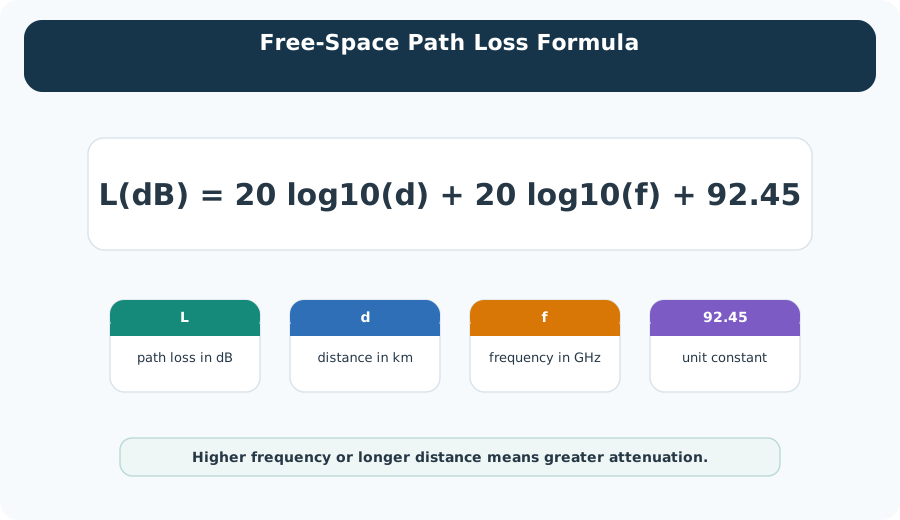
- Its distance term uses kilometers, and its frequency term uses gigahertz; the constant belongs to those units.
Major section
What a Link Budget Promises (continued)
The section's doubling rule gives about 6 dB more loss for either distance or frequency.
- Double the distance and your voice is noticeably harder to hear; add a wall, a crowd, or wind and it gets worse fast.
- Radio behaves the same way, except we can put numbers on each effect in decibels and add them up before anyone installs hardware.
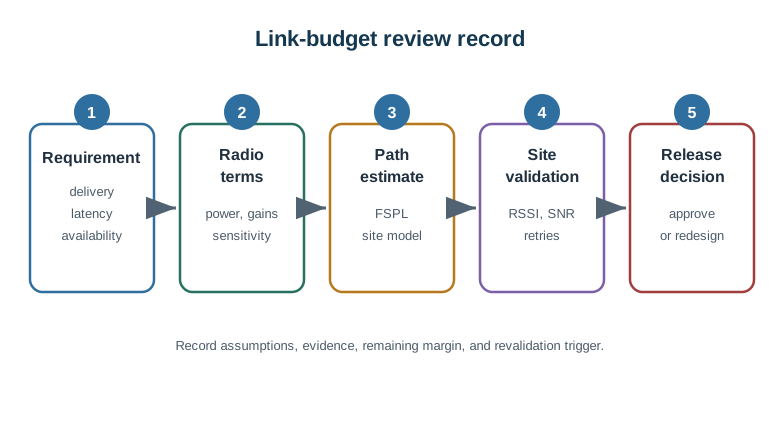
- Delivery at the installed site must still test that estimate.
Major section
What a Link Budget Promises (continued)
A higher transmit power does not fix a link that fails on receiver sensitivity, antenna placement, or interference.
- Increasing either term raises loss in decibels, so a farther gateway or a higher band spends more of the link budget before walls and installation effects are counted.
- Both distance and frequency contribute logarithmic loss, so increasing either increases attenuation.
- If this gives you enough to reason about why a link reaches or fails, you can stop here.
Major section
Apply It: Build the Link-Budget Ledger
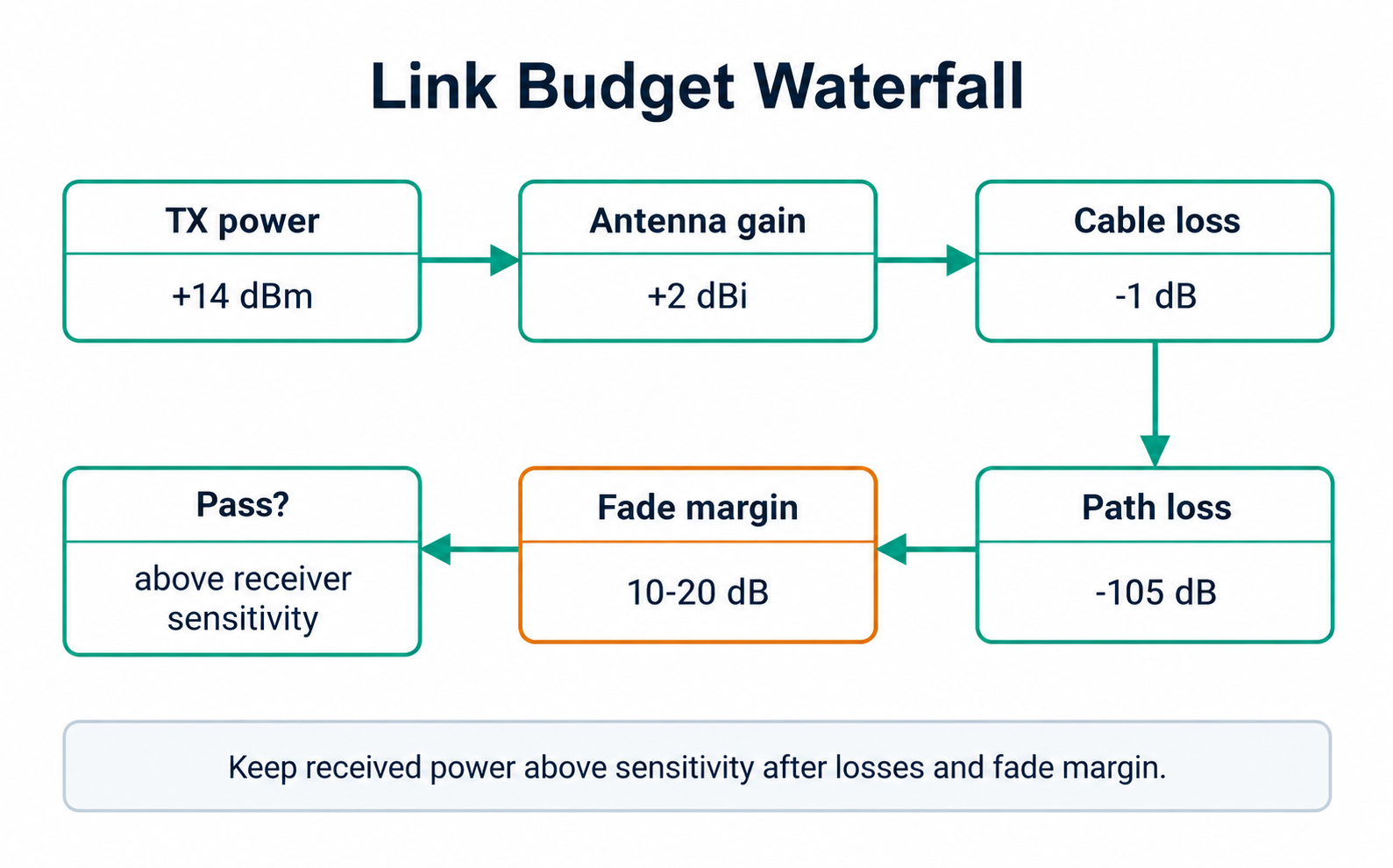
A link budget is an accounting ledger.
- Gains are positive, losses are negative, and the result is compared with receiver sensitivity and a reserved margin.
- The workflow below produces a number you can defend in review.
- Include both ends when external antennas, pigtails, or adapters are used.
- Raw link margin is -105 - (-126) = 21 dB.
Major section
Apply It: Build the Link-Budget Ledger (continued)
Walkthrough: From Radio Terms to a Release NumberState the requirement: Name the packet delivery, latency, and availability target the link must meet.
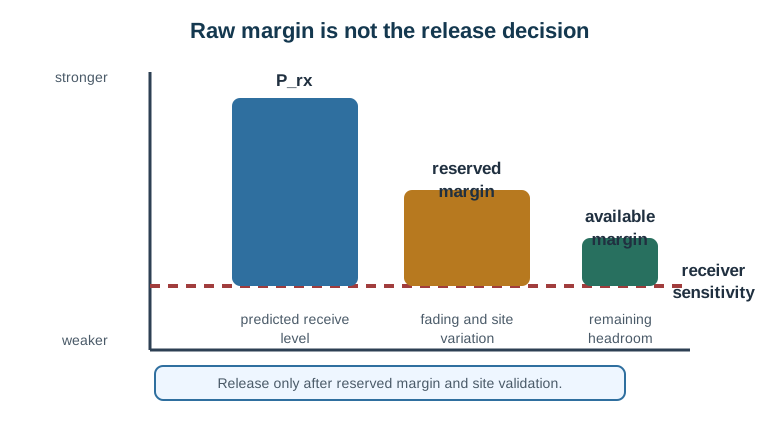
- After reserving 12 dB for fading and shadowing, 21: 12 = 9 dB remains.
- This model closes, but it is not a release by itself.
- The team should validate the route under expected mounting, traffic, weather, occupancy, and interference.
Major section
Apply It: Build the Link-Budget Ledger (continued)
If the application is critical or the site is variable, a thin remaining margin should trigger better placement, antenna work, a gateway move, a lower data rate, or a different link choice.
- If a field measurement fails, the team can see which assumption to retest instead of hiding losses inside one optimistic number.
- A ledger that collapses everything into a single "path loss" figure cannot be debugged later.
- If your job is to produce a defensible budget and a release number, you can stop here.
Major section
Under the Hood: Path-Loss Math and Failure Modes
The deeper layer explains where the ledger numbers come from and how each one fails.
- Path loss is the row most often estimated wrongly, so it gets the most attention here.
- The formulas are useful only when the assumptions are visible.
- If distance is in meters, convert first ( 30 m = 0.03 km ).
Major section
Under the Hood: Path-Loss Math and Failure Modes (continued)
Free-Space Path LossFree-space path loss (FSPL) is the clean-air baseline: a clear line of sight, no walls, no reflectors, no people, and no detuning.
- The 20 log10 terms are exactly why doubling either distance or frequency adds about 6 dB.
- The Log-Distance Model (and the n/2 Trap)Real environments grow loss faster than free space.
- n is the environment's path-loss exponent.
Major section
Under the Hood: Path-Loss Math and Failure Modes (continued)
The environment changes the distance-growth term.
- The path-loss exponent n describes how quickly loss grows after a reference point.
- X_sigma is shadowing variation from walls, people, vehicles, shelves, terrain, and layout changes.
- Their gap, Prx−Psensitivity, is raw margin in decibels.
Major section
Under the Hood: Path-Loss Math and Failure Modes (continued)
A positive release margin is still just a model result.
- Clear or Outdoor LOSUse n near 2 only with a credible line-of-sight path and a mostly clear Fresnel region.
- Office or Light IndoorUse a larger exponent when furniture, partitions, people, and reflections make the path worse than clean air.
- The last stage must test hard places and real work states.
Major section
Under the Hood: Path-Loss Math and Failure Modes (continued)
Obstructed or IndustrialMetal, dense walls, equipment, vehicles, and non-line-of-sight routes consume margin quickly and must be measured.
- A vendor range claim or one good RSSI value cannot replace any of those steps.
- RSSI Is Not a Universal Grade dBm is an absolute power unit.
- Example: -85 dBm means very different things at sensitivity -92 dBm (raw margin 7 dB) versus -120 dBm (raw margin 35 dB).
Major section
Under the Hood: Path-Loss Math and Failure Modes (continued)
Forgetting receiver mode: Sensitivity changes with data rate, bandwidth, coding, and error target.
- RSSI is a receiver-reported strength indicator that may be calibrated differently across chipsets and radio families, so the same RSSI can be healthy for one link and unusable for another.
- This gives: RSSI Is Not a Universal Grade evidence to revisit.
- A trustworthy decision records each limit instead of trusting one optimistic range number.
Major section
Under the Hood: Path-Loss Math and Failure Modes (continued)
Copying RSSI thresholds across radios: A value that is weak for one link can be healthy for another with different sensitivity, bandwidth, modulation, and SNR.
- The final branch accepts or redesigns the link using measured conditions; the calculation alone does not approve deployment.
- Common PitfallsMultiplying FSPL by the path-loss exponent: Use the log-distance model from a reference point; multiplying the whole FSPL result by n / 2 greatly overstates loss and hides the assumption.
- At this depth, a link is a chain of limits: transmit power, antenna gain, path loss, environment, receiver sensitivity, reserved margin, and measured evidence.
Major section
Checkpoint: Summary
Path loss is the baseline cost of distance, frequency, and environment; free-space loss is the clean-air reference and doubling distance or frequency each adds about 6 dB.
- The log-distance model describes how loss grows from a reference distance in a real site; the exponent belongs in the distance term, never as an n / 2 multiplier on total FSPL.
- A link budget adds gains, subtracts path and installation losses, compares the result with receiver sensitivity, and reserves margin for variation.
- RSSI is meaningful only against the specific receiver's sensitivity, SNR, and delivery, not as a universal grade.
Deck summary
Key takeaways
A range claim alone cannot tell the operator whether the installed path is safe to use.
- You will estimate received power and margin, then compare the calculation with delivery evidence from the site.
- Path loss is the signal a radio link spends while crossing distance, frequency, walls, clutter, and motion.
- The section's doubling rule gives about 6 dB more loss for either distance or frequency.
- A higher transmit power does not fix a link that fails on receiver sensitivity, antenna placement, or interference.
Retrieval practice
Recall check 1 of 3

Physics Phoebe says: answer from memory, then check your reasoning.
Q1What does a link budget help estimate before deployment?
Show answer
Answer: A A link budget checks if expected gains and losses leave enough signal margin above receiver sensitivity.
Retrieval practice
Recall check 2 of 3
Physics Phoebe says: answer from memory, then check your reasoning.
Q2A reviewed link predicts P_rx = -104 dBm. The selected receiver mode has sensitivity -116 dBm, and the team reserved 10 dB for fading and site variation. What is the available margin?
Show answer
Answer: C Available margin = P_rx - P_sensitivity - M_reserved = -104 - (-116) - 10 = 2 dB.
Q3What transmit power, antenna, cable-loss and receiver-sensitivity inputs feed a link budget?
Show answer
Answer: B Transmit power, antenna gains, cable loss, and receiver sensitivity are budget inputs.
Retrieval practice
Recall check 3 of 3
Physics Phoebe says: answer from memory, then check your reasoning.
Q4At 2.4 GHz, the path loss at a 1 m reference distance is about 40 dB. For an indoor path with path-loss exponent n = 3.0, what is the estimated path loss at 10 m using the log-distance model?
Show answer
Answer: D Use PL(d) = PL(d0) + 10n log10(d/d0).
Print reference
Answers
Answer key.
- A · A link budget checks if expected gains and losses leave enough signal margin above receiver sensitivity.
- C · Available margin = P_rx - P_sensitivity - M_reserved = -104 - (-116) - 10 = 2 dB.
- B · Transmit power, antenna gains, cable loss, and receiver sensitivity are budget inputs.
- D · Use PL(d) = PL(d0) + 10n log10(d/d0).