IoT Fundamentals · Study deck

Fading and RF Interference

Packet loss means that some sent units never reach the other end.

Physics Phoebe is your guide for this deck.

wirelesspropfading
Physics Phoebe, the module guide, in a scene from this chapter.
iotclass.org

After studying this chapter

Learning objectives

You will be able to:

  • Explain: If you only need the intuition, this layer is enough: wireless links vary over time and space, so an acceptable average can still hide deep fades and busy-hour interference.
  • Explain: Interference is a loud crowd drowning them out even when they are standing right next to you; the wanted voice is there, but the noise wins.
  • Explain: RSSI says how much signal the receiver sees; SNR says how much cleaner the wanted signal is than the background and interfering energy.
  • Explain: A gateway is a device or service that joins a local network to another system.
iotclass.org

Major section

In 60 Seconds

A gateway is a device or service that joins a local network to another system.

  • A protocol is a set of rules for exchanging data.
  • Received signal strength is a radio's estimate of received power.
  • The full label is Received Signal Strength Indicator, often shortened to RSSI.
  • The fixes are different.

Key terms

Packet loss
Packet loss means that some sent units never reach the other end.
iotclass.org

Major section

In 60 Seconds (continued)

A low power reading may point to distance, walls, or antenna position.

  • A strong reading with poor delivery may point to other radio use.
  • More transmit power can waste energy or make a nearby sender harder to hear.
  • One average reading can also hide short deep fades.
iotclass.org

Major section

Fading and Interference Are Not the Same Failure
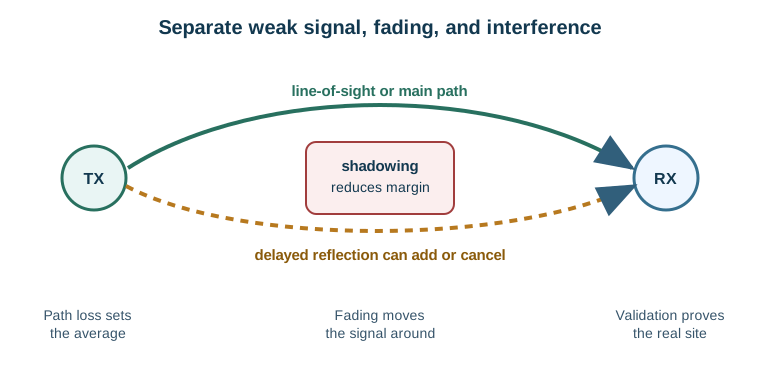
Fading and interference can both cause packet loss, but they are different problems.

  • Fading is variation in the wanted signal caused by distance, shadowing, motion, and reflected copies of the same transmission.
  • Interference is unwanted energy from other transmitters or noise sources that reduces usable signal-to-noise ratio.

Why it matters

The One-Minute View Path loss The average signal is too low because the link is too long, blocked, poorly oriented, or outside the antenna pattern.

The reliability map: separate baseline path loss, multipath fading, and interference before choosing a fix.
iotclass.org

Major section

Fading and Interference Are Not the Same Failure (continued)
Fading is the other person's voice getting quieter as they move behind furniture; the signal you want changes.

  • The important idea is to keep the two diagnoses separate.
  • In an IoT deployment, make that distinction with evidence instead of guesswork.
  • Shadowing reduces margin, while delayed reflections can reinforce or cancel the signal.
iotclass.org

Major section

Fading and Interference Are Not the Same Failure (continued)
Fading The average may look fine, but motion, reflections, and objects create local dips below the required margin.

  • If you only need the intuition, this layer is enough: wireless links vary over time and space, so an acceptable average can still hide deep fades and busy-hour interference.
  • Interference is a loud crowd drowning them out even when they are standing right next to you; the wanted voice is there, but the noise wins.
  • Interference The wanted signal may still be strong, but competing energy raises the noise floor or occupies the same channel.
iotclass.org

Major section

Apply It: Diagnose a Wireless Reliability Failure
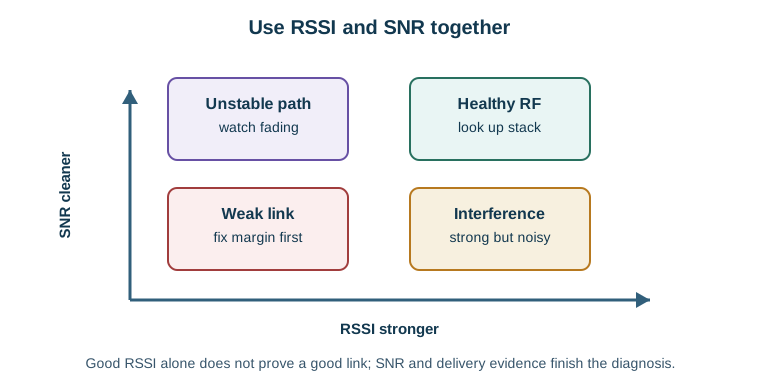
RSSI says how much signal the receiver sees; SNR says how much cleaner the wanted signal is than the background and interfering energy.

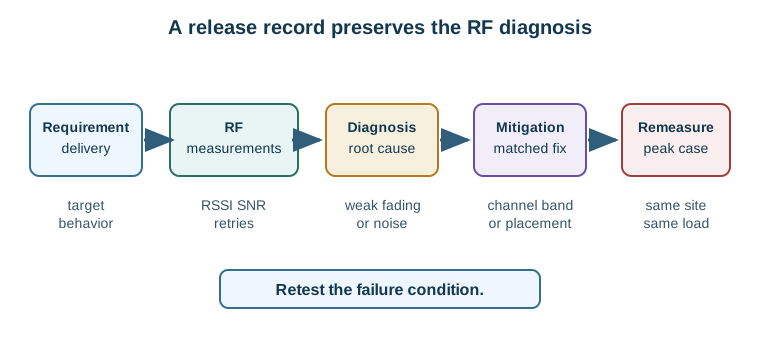
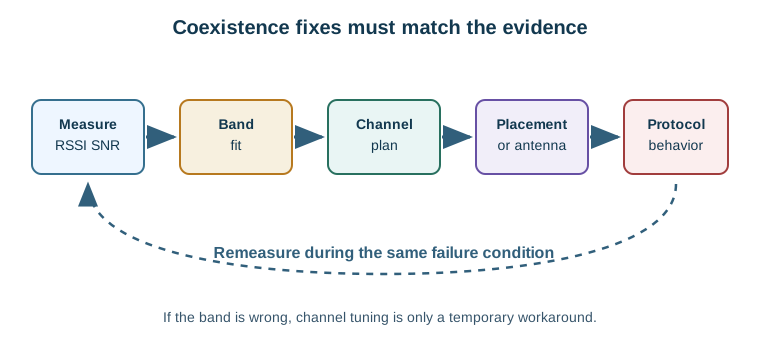
  • Retest after mitigation.: Any placement, antenna, channel, or band change needs a fresh measurement under the failing condition.
  • The wanted signal is weak or the link budget is short.
The diagnosis matrix: RSSI and SNR together separate weak signal, fading, and interference.
iotclass.org

Major section

Apply It: Diagnose a Wireless Reliability Failure (continued)

The wanted signal is present, but the channel is noisy or occupied.

  • The link is sensitive to fading, motion, orientation, or shadowing.
  • The RF layer is probably not the main cause.
  • Intermediate For a mobile asset that fails at certain positions, explain why fade margin and placement come before a channel change.
iotclass.org

Deck summary

Key takeaways

A gateway is a device or service that joins a local network to another system.

  • A low power reading may point to distance, walls, or antenna position.
  • Fading and interference can both cause packet loss, but they are different problems.
  • Fading is the other person's voice getting quieter as they move behind furniture; the signal you want changes.
  • Fading The average may look fine, but motion, reflections, and objects create local dips below the required margin.
iotclass.org

Retrieval practice

Recall check 1 of 3

Physics Phoebe says: answer from memory, then check your reasoning.

Q1A node has good average signal strength but intermittent packet loss. What should the learner consider?

ACheck fading and interference, not only average RSSI
BAverage RSSI proves every packet will succeed
CThe problem must be text encoding because the packets are wireless
DMore dashboard refreshes will remove multipath
Show answer

Answer: A Wireless links vary over time and space, so an average can hide deep fades and busy-hour interference.

iotclass.org

Retrieval practice

Recall check 2 of 3

Physics Phoebe says: answer from memory, then check your reasoning.

Q2A sensor reports strong RSSI, but packet retries increase whenever nearby equipment is active. What should you review first?

ASNR, channel occupancy, and time-correlated interference evidence
BPath-loss margin and antenna distance from the gateway
CIncrease transmit power before measuring anything else
DIgnore SNR because RSSI is already strong
Show answer

Answer: A Strong RSSI means the wanted signal arrives; poor delivery during equipment activity points to interference or noise that reduces SNR.

iotclass.org

Retrieval practice

Recall check 3 of 3

Physics Phoebe says: answer from memory, then check your reasoning.

Q3A link passes the link-budget spreadsheet with almost no spare margin and works in an empty warehouse. Why is that not enough release evidence?

AFading and interference vary with motion, occupancy, and time.
BA spreadsheet pass guarantees field performance, so no further testing is needed
CEmpty-warehouse results are always worse than occupied results
DMargin only matters for wired links
Show answer

Answer: A One quiet, empty-site pass does not prove the link survives people, inventory, vehicles, and busy-hour interference; reserve margin and remeasure under load.

iotclass.org

Print reference

Answers

Answer key.

  1. A · Wireless links vary over time and space, so an average can hide deep fades and busy-hour interference.
  2. A · Strong RSSI means the wanted signal arrives; poor delivery during equipment activity points to interference or noise that reduces SNR.
  3. A · One quiet, empty-site pass does not prove the link survives people, inventory, vehicles, and busy-hour interference; reserve margin and remeasure under load.
iotclass.org