Core Networking · Study deck

UART and RS-232 Protocols

A sensor console prints nonsense when connected to a legacy instrument.

Packet Pete is your guide for this deck.

wiredcommuart
iotclass.org

After studying this chapter

Learning objectives

You will be able to:

  • Explain: The scale on the left of Figure: RS-232 uses inverted high-voltage signaling runs from plus fifteen volts to minus fifteen, and the two logic bands sit at its extremes.
  • Explain: A serial record should preserve connector gender, viewpoint, pin numbers, signal direction, and cable type, because a continuity test can pass while a mirrored interpretation still swaps TX and RX.
  • Explain: The serial-link record below must name each endpoint, the viewed side of the pinout, voltage standard, and any flow-control wires, then verify them on the actual link.
RS-232 uses inverted high-voltage signaling; it must be translated before it reaches normal 3.3 V or 5 V microcontroller UART pins.
iotclass.org

Major section

Start With Two Devices Sending Bytes

A microcontroller means a small computer on one chip that reads inputs and controls a device.

  • UART is the simplest useful story for many devices: one side sends timed bits, the other samples them, and both must agree on framing and speed.
  • That simplicity is why UART is common for consoles, sensors, modules, and debugging.
  • It also means the evidence must be practical: voltage level, ground reference, baud rate, framing, and what each received byte is supposed to mean.
Connector diagrams must state the viewing side. Mirrored DB9 views are a common source of swapped TX/RX pins.
iotclass.org

Major section

Overview: UART Sends Bytes Without A Clock Wire

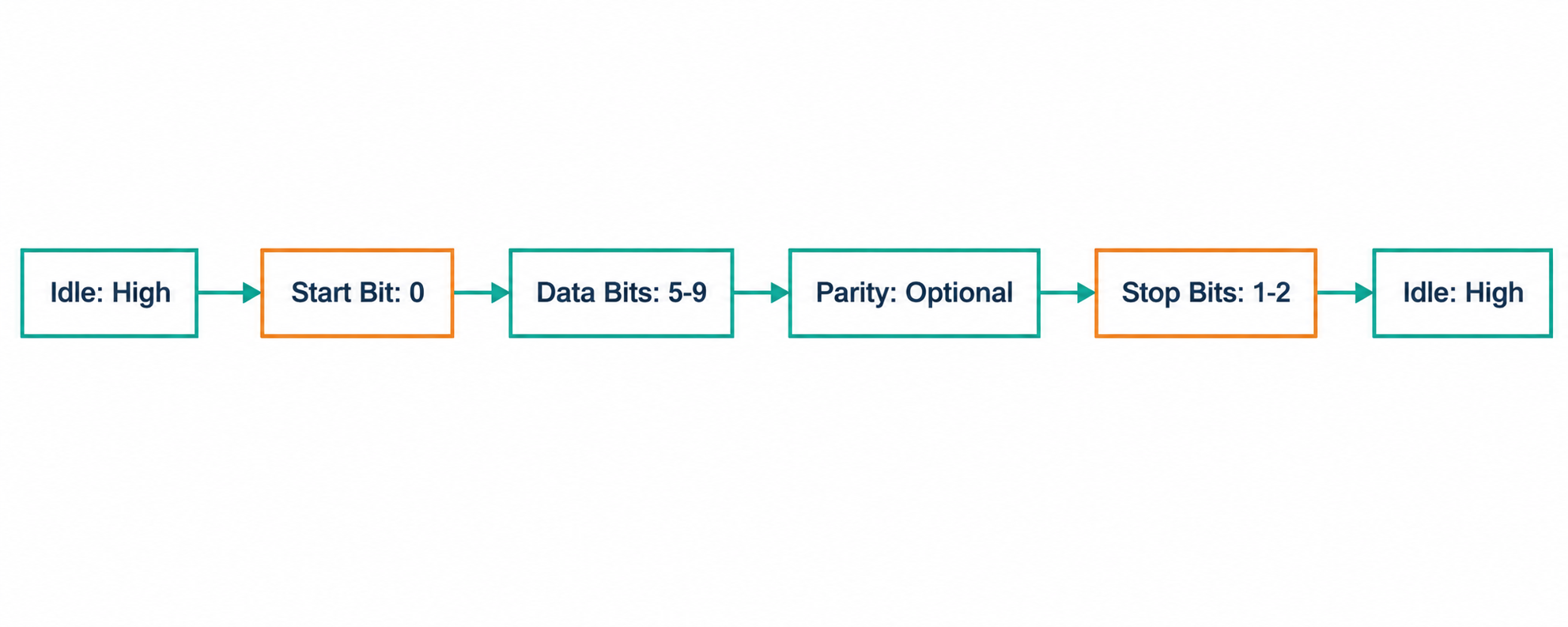
The line rests high while nothing is being sent.

  • The start bit is a single low, and it exists only to mark the moment the receiver should begin counting.
  • An optional parity bit sits after them, then one or two stop bits return the line to its idle level, ready for the next byte.
  • The whole of Figure: UART frame diagram moves from idle-high line to is therefore an agreement made in advance.
UART frame diagram moves from idle-high line to a low start bit, five to nine data bits, optional parity and one or two stop bits.
iotclass.org

Major section

Overview: UART Sends Bytes Without A Clock Wire (continued)

Both ends must already share the bit rate and the frame shape, or the bits are counted in the wrong places.

  • The line begins idle, then the falling start bit gives the receiver a timing reference.
  • It samples the data bits near their centres using its own baud-rate clock, optionally checks parity, and expects a stop bit at the idle level.
  • For an 8-N-1 frame, eight data bits plus start and stop make 10 bits; at 9600 bit/s, one frame takes 10 / 9600 s = 1.04 ms.
UART trades addressing and shared-clock features for a simple point-to-point byte stream.
iotclass.org

Major section

Practitioner: Keep A Serial Link Record

Positive means zero here and negative means one, the reverse of the convention a microcontroller pin uses.

  • The photo shows several DB9/RJ45 adapter pieces beside a handwritten pinout note.
  • A connector shape and a handwritten note do not prove which pins the installed peer uses.
  • Two results follow, and both belong in the link record.

Why it matters

A serial record should preserve connector gender, viewpoint, pin numbers, signal direction, and cable type, because a continuity test can pass while a mirrored interpretation still swaps TX and RX.

Real photograph of db9 rs-232 connector/cable
iotclass.org

Major section

Practitioner: Keep A Serial Link Record (continued)

The serial-link record below must name each endpoint, the viewed side of the pinout, voltage standard, and any flow-control wires, then verify them on the actual link.

  • That single fact settles what each end can mate with, and it is not visible in any wiring diagram.
  • Contact gender, retention and installed length are three entries the link record needs, and the name RS-232 supplies none of them.
  • The scale on the left of Figure: RS-232 uses inverted high-voltage signaling runs from plus fifteen volts to minus fifteen, and the two logic bands sit at its extremes.
A coiled DB9 serial cable shows two female nine-contact connectors, metal shells, thumbscrews and molded strain relief. Record installed length and pinout before swapping TX and RX. Photo: David Marsh, CC BY 2.0
iotclass.org

Major section

Practitioner: Keep A Serial Link Record (continued)

Between them lies a band around zero that decodes to nothing at all, so noise landing there is simply undefined.

  • A level shifter is needed before any 3.3 or 5 volt pin, and the wide swing is what buys this link its noise tolerance over roughly fifteen metres.
  • Handshake lines must be crossed or intentionally omitted according to the configured flow control.
  • A serial record should preserve connector gender, viewpoint, pin numbers, signal direction, and cable type, because a continuity test can pass while a mirrored interpretation still swaps TX and RX.
iotclass.org

Major section

Under The Hood: Timing Error Accumulates Across The Frame

A start bit tells the receiver when to sample the data bits, and stop bits check the end of the frame.

  • USB adds a host, device setup, named end points, framed moves, and error checks.
  • An adapter links the two systems, but it does not make their voltage, pins, flow control, or UART settings the same.
  • No protocol is named and no property is scored.
Asynchronous serial links depend on both endpoints keeping close enough timing until the stop bit is sampled.
iotclass.org

Major section

Separate a Framing Error from a Voltage Mismatch

At 19,200 bits per second, one bit lasts about 52.08 microseconds and a full frame takes about 520.8 microseconds.

  • A 64-byte record takes about 33.33 ms without gaps.
  • Its nominal bit period is about 104.17 microseconds, twice the transmitter's.
  • Timing and wiring are separate checks.

Key terms

Adding a shared clock
Adding a shared clock is not the remedy; servicing the buffer or controlling the source rate addresses the observed failure.
A receiver synchronizes on the start bit, samples the data bits by timing, optionally checks parity, then waits for the stop bit.
iotclass.org

Major section

Separate a Framing Error from a Voltage Mismatch (continued)
The next byte needs space or an explicit overflow policy.

  • It samples the incoming signal on the wrong time scale, so clean voltage transitions cannot produce the intended byte stream.
  • The receiver uses that transition to establish timing for one frame.
  • This module makes serial troubleshooting a sequence of measurable boundaries.
iotclass.org

Major section

Separate a Framing Error from a Voltage Mismatch (continued)

The wiring figure at Figure: UART frame diagram moves from idle-high line to then connects transmit to receive with the required reference.

  • RS-232 signalling needs the appropriate electrical interface; direct connection to a low-voltage UART pin can be unsafe for the component.
  • For example, an incoming 64-byte burst fills a 64-byte receive buffer completely if nothing is removed during that interval.
  • Adding a shared clock is not the remedy; servicing the buffer or controlling the source rate addresses the observed failure.
UART frame diagram moves from idle-high line to a low start bit, five to nine data bits, optional parity and one or two stop bits.
iotclass.org

Deck summary

Key takeaways

A microcontroller means a small computer on one chip that reads inputs and controls a device.

  • The line rests high while nothing is being sent.
  • Both ends must already share the bit rate and the frame shape, or the bits are counted in the wrong places.
  • Positive means zero here and negative means one, the reverse of the convention a microcontroller pin uses.
  • The serial-link record below must name each endpoint, the viewed side of the pinout, voltage standard, and any flow-control wires, then verify them on the actual link.
iotclass.org

Retrieval practice

Recall check 1 of 3

Packet Pete says: answer from memory, then check your reasoning.

Q1A 3.3 V irrigation controller must read a water-meter module whose data sheet says 9600 baud, 8N1, TTL UART over a short harness. What must the release record prove before the field board is approved?

ARecord bench baud alone and let the controller infer voltage and wiring at startup.
BCheck a device address, as though UART provides I2C-style bus addressing.
CProve matching baud, 8N1, voltage, crossed TX/RX, and shared ground on the field harness.
DCheck a clock wire, as though UART uses a shared synchronous clock.
Show answer

Answer: C A working UART link requires matching timing, framing, electrical compatibility, physical wiring, and the actual installed harness.

iotclass.org

Retrieval practice

Recall check 2 of 3

Packet Pete says: answer from memory, then check your reasoning.

Q2A 3.3 V microcontroller must read a legacy device with a DB9 connector labeled RS-232. What is the safest next step?

AConnect DB9 TX directly to the 3.3 V pin because both links are serial.
BRaise baud rate to reduce exposure to the legacy signal voltage.
COmit ground because RS-232 uses positive and negative signaling.
DConfirm pinout and add an RS-232-to-TTL voltage-level shifter.
Show answer

Answer: D RS-232 and TTL UART can carry similar serial data, but they need a translator because their electrical levels differ.

iotclass.org

Retrieval practice

Recall check 3 of 3

Packet Pete says: answer from memory, then check your reasoning.

Q3A pump-house UART debug link works at 9600 baud but drops bytes intermittently at 115200 baud on the production cable. Which review question is most useful?

ACheck whether the receiver learned a new address at higher baud.
BAdd parity and assume it corrects timing and cable-induced byte loss.
CJoin TX and RX on one pin to create a shared data conductor.
DCheck clock error, thresholds, cable, ground, and signal edges.
Show answer

Answer: D UART failures at higher baud rates often expose timing, voltage, cable, edge-rate, or oscillator margin problems that were hidden at slower rates.

iotclass.org

Print reference

Answers

Answer key.

  1. C · A working UART link requires matching timing, framing, electrical compatibility, physical wiring, and the actual installed harness.
  2. D · RS-232 and TTL UART can carry similar serial data, but they need a translator because their electrical levels differ.
  3. D · UART failures at higher baud rates often expose timing, voltage, cable, edge-rate, or oscillator margin problems that were hidden at slower rates.
iotclass.org