Core Networking · Study deck

Wired Communication Fundamentals

A controller reads a slow temperature probe while refreshing a display and printing debug records.

Packet Pete is your guide for this deck.

wiredcomm
Packet Pete, the module guide, in a scene from this chapter.
iotclass.org

After studying this chapter

Learning objectives

You will be able to:

  • Explain: This reading constrains more wires can buy throughput or simpler timing, but the extra pins and routing still need to be justified and supplies the visual evidence for overview: wired links are local design contracts.
  • Explain: Its diagram makes Synchronous vs Asynchronous and: Shared Clock vs Start/Stop Bits explicit within synchronous buses move data against an explicit clock; asynchronous links recover timing from the frame.
  • Explain: For an illustrative asynchronous debug connection at 9,600 bits per second, use one start bit, eight data bits and one stop bit per byte.
iotclass.org

Major section

Start With Why a Wire Is Still Useful

A microcontroller is a small computer that reads devices and controls local work.

  • A protocol is an agreed set of exchange rules.
  • Universal asynchronous receiver-transmitter (UART), inter-integrated circuit (I2C), and serial peripheral interface (SPI) are three common ways to connect nearby parts.
  • The debug link needs simple point-to-point access.

Key terms

Wireless links
Wireless links are convenient, but wires still solve hard IoT problems: predictable timing, power delivery, noise control, security boundaries, and simple commissioning.
iotclass.org

Major section

Start With Why a Wire Is Still Useful (continued)
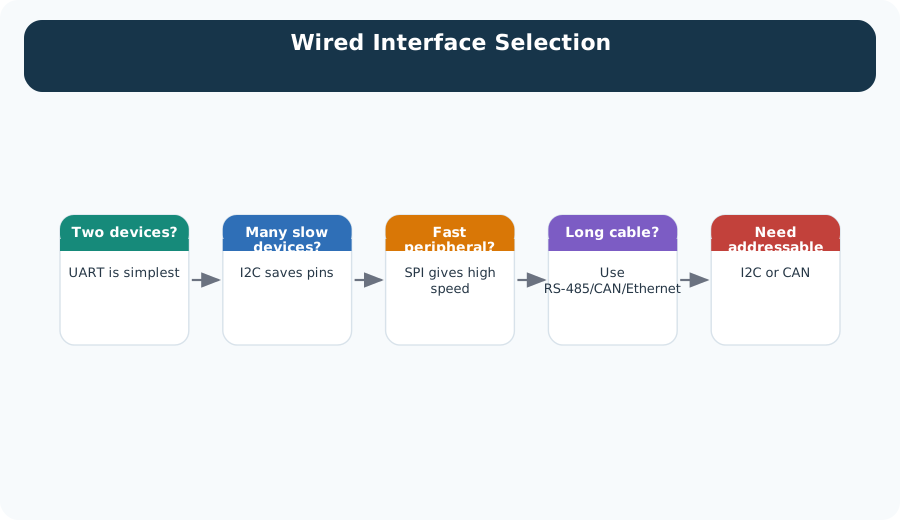
The deeper sections explain framing, addressing, pull-ups, timing, discovery, and stronger links for long or noisy cable runs.

  • The sensors can share a short addressed bus.
  • The display needs fast transfers and a separate select line.
  • One wire choice does not fit all three jobs.
iotclass.org

Major section

Start With Why a Wire Is Still Useful (continued)

These checks do not prove that data is true after it leaves the board.

  • Wireless links are convenient, but wires still solve hard IoT problems: predictable timing, power delivery, noise control, security boundaries, and simple commissioning.
  • The choice is not old versus new; it is which physical path gives the system enough trust.
  • UART, I2C, SPI, Ethernet, and industrial wiring each make different promises about distance, speed, topology, timing, and evidence.
iotclass.org

Major section

Overview: Wired Links Are Local Design Contracts
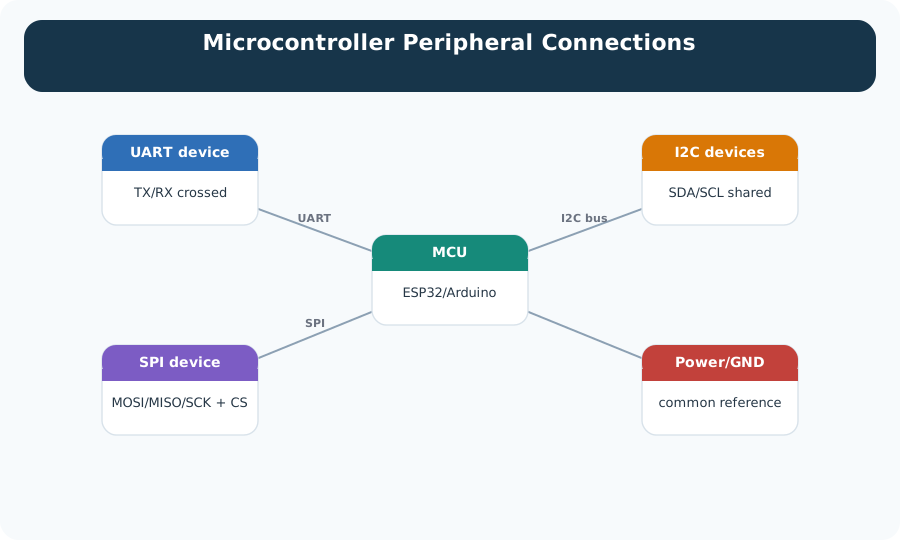
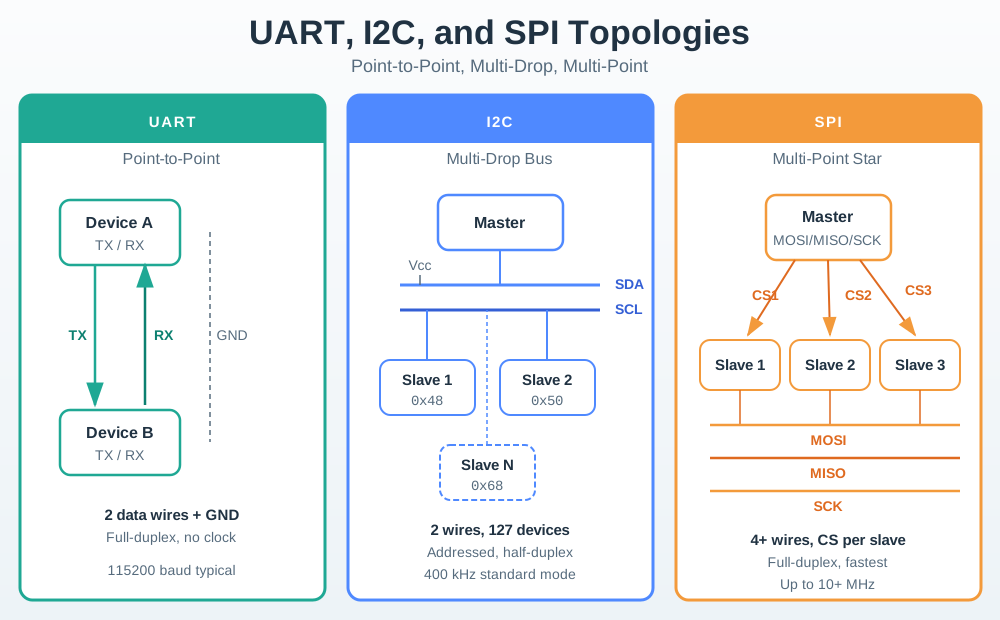
That visual pairing grounds local wired protocols connect board-level peripherals before traffic ever reaches an ip network in named evidence.

  • That sequence keeps overview: wired links are local design contracts tied to what is visibly labelled.
  • That labelled check bounds topology drives both wiring effort and fault behavior.
Local wired protocols connect board-level peripherals before traffic ever reaches an IP network.
iotclass.org

Major section

Overview: Wired Links Are Local Design Contracts (continued)
The visual evidence for overview: wired links are local design contracts sits in Figure: More wires can buy throughput or simpler timing.

  • This reading constrains more wires can buy throughput or simpler timing, but the extra pins and routing still need to be justified and supplies the visual evidence for overview: wired links are local design contracts.
  • Together those labels make the selection route should reject buses that do not meet physical or traffic constraints testable.
  • The next claim about under the hood: timing, edges, and electrical limits decide reliability depends on Figure: Synchronous buses move data against an explicit clock.
iotclass.org

Major section

Overview: Wired Links Are Local Design Contracts (continued)

Its diagram makes Synchronous vs Asynchronous and: Shared Clock vs Start/Stop Bits explicit within synchronous buses move data against an explicit clock; asynchronous links recover timing from the frame.

  • That labelled check bounds synchronous buses move data against an explicit clock; asynchronous links recover timing from the frame.
  • For under the hood: timing, edges, and electrical limits decide reliability, retain: SYNCHRONOUS as evidence for the resulting choice.
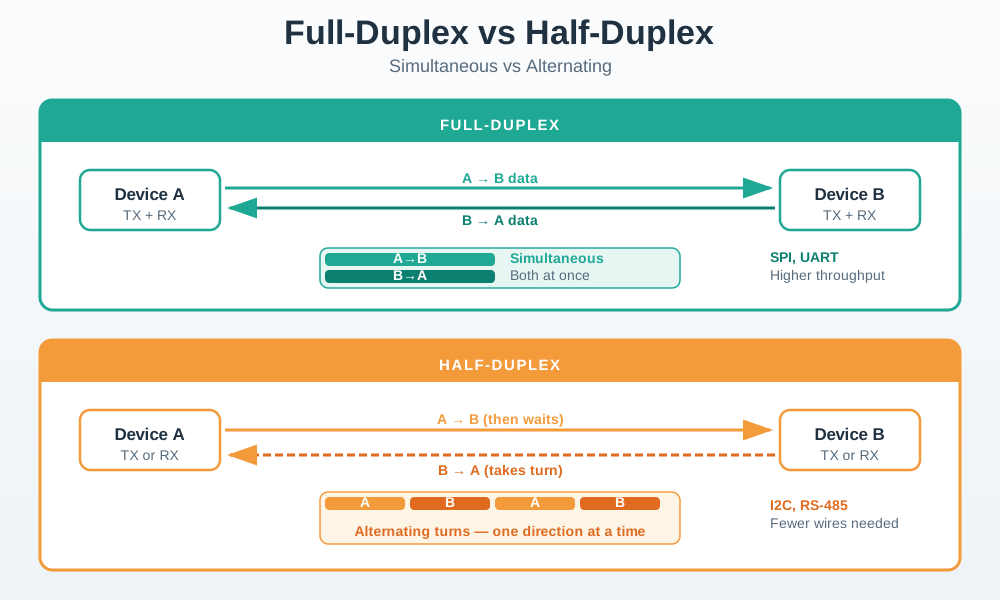
  • That visual pairing grounds duplex mode determines whether both sides can talk at once or must take turns in named evidence.
iotclass.org

Major section

Phoebe's Field Notes: Why the I2C Pull-Up Value Is a Narrow Window

The mathematical gist.: I2C pull-ups sit between two limits.

  • With 3.3 V, a 0.4 V low level, and 3 mA sink current, the resistor must be at least 967 Ω.
iotclass.org

Major section

Budget the Debug Port and the Display Separately
For an illustrative asynchronous debug connection at 9,600 bits per second, use one start bit, eight data bits and one stop bit per byte.

  • Each useful byte therefore needs ten wire bits.
  • A 40-byte line takes 400 divided by 9,600 = about 0.0417 s, or 41.7 ms, before gaps.
Topology drives both wiring effort and fault behavior.
iotclass.org

Major section

Budget the Debug Port and the Display Separately (continued)

Printing many such lines can block a simple program even though the sensor itself is slow.

  • The raw shift time is 8,192 divided by 1,000,000 = 0.008192 s, or 8.192 ms.
  • The comparison explains why a clocked peripheral link can suit the display while the debug port remains simple and separate.
  • A shared sensor bus saves pins but gives a stuck device a way to affect neighbours.
iotclass.org

Major section

Budget the Debug Port and the Display Separately (continued)

The synchronous-versus-asynchronous figure then explains which timing comes from a shared clock and which comes from framing.

  • Extra capacitance, noise and ground differences can violate the interface's electrical limits even when the bit-rate calculation still fits.
  • The calculations are useful upper-level budgets; a logic trace and the component timing requirements establish what the connected hardware actually tolerates.
  • Choosing separate interfaces can make both debugging and failure containment easier without forcing every peripheral onto the fastest available option.
iotclass.org

Deck summary

Key takeaways

A microcontroller is a small computer that reads devices and controls local work.

  • The deeper sections explain framing, addressing, pull-ups, timing, discovery, and stronger links for long or noisy cable runs.
  • These checks do not prove that data is true after it leaves the board.
  • That visual pairing grounds local wired protocols connect board-level peripherals before traffic ever reaches an ip network in named evidence.
  • The visual evidence for overview: wired links are local design contracts sits in Figure: More wires can buy throughput or simpler timing.
iotclass.org

Retrieval practice

Recall check 1 of 3

Packet Pete says: answer from memory, then check your reasoning.

Q1A wearable board has three low-rate sensors on the same PCB and very few spare microcontroller pins. Which wired bus is the best first candidate?

AI2C, because multiple addressed sensors can share the same data and clock wires.
BSPI, because short transactions leave the processor more time to sleep between sensor reads.
CUART on a shared data line, because it avoids needing a separate clock signal.
DRS-485, because differential signaling improves noise rejection when several devices share a link.
Show answer

Answer: A A same-board, low-rate, pin-limited sensor group is the classic reason to start with I2C.

iotclass.org

Retrieval practice

Recall check 2 of 3

Packet Pete says: answer from memory, then check your reasoning.

Q2A board has three low-rate I2C-capable sensors, a TFT display that needs frequent screen updates, and a microSD card. Which selection record is strongest?

APut all devices on I2C, then lower the display refresh rate until the bus seems stable.
BUse I2C for the sensors, SPI for the display and microSD, then check pins and bus loading.
CPut all devices on SPI, then add chip-select lines even for sensors that only expose I2C.
DUse UART for the whole board, then serialize each peripheral through the same debug link.
Show answer

Answer: B A defensible wired selection can mix buses when different peripherals have different traffic, pin, and electrical needs.

iotclass.org

Retrieval practice

Recall check 3 of 3

Packet Pete says: answer from memory, then check your reasoning.

Q3A prototype works on short jumper wires, but the installed device sometimes corrupts I2C sensor readings when a nearby SPI display refreshes. What evidence should the team collect first?

AAdd a cloud dashboard first, because corrupted readings can be repaired after upload.
BSeparate display and sensor controllers, then compare whether the read errors disappear.
CScope I2C routing, pull-ups, capacitance, ground reference, and nearby SPI edges.
DMeasure errors after raising the I2C clock to shorten exposure to display activity.
Show answer

Answer: C Wired-bus failures often require electrical evidence: routing, pull-ups, capacitance, grounding, clock edges, and real installation conditions.

iotclass.org

Print reference

Answers

Answer key.

  1. A · A same-board, low-rate, pin-limited sensor group is the classic reason to start with I2C.
  2. B · A defensible wired selection can mix buses when different peripherals have different traffic, pin, and electrical needs.
  3. C · Wired-bus failures often require electrical evidence: routing, pull-ups, capacitance, grounding, clock edges, and real installation conditions.
iotclass.org