Wi-Fi & 802.11 · Study deck

Wi-Fi Security: Provisioning and Recovery Evidence

A device that cannot rotate a key will fail its next security review.

Radio Remi is your guide for this deck.

wifi-securityprovisioning-reviewcredential-management
Radio Remi, the module guide, in a scene from this chapter.
iotclass.org

After studying this chapter

Learning objectives

You will be able to:

  • Explain: The repair is a state-machine invariant: after a key is installed, a retransmitted message may be acknowledged but must not reinstall that key or reset its nonce/replay counters.
  • Explain: The failure appears when a client treats a valid retransmission as a command to install the same pairwise key again and resets state that must never move backwards.
  • Explain: Legacy Wi-Fi security is easiest to reject when its failure mechanisms are traced through the packet-protection sequence rather than reduced to an age label.
  • Explain: The four-way handshake must tolerate a lost final acknowledgement.
iotclass.org

Major section

Authenticate, Then Derive Keys

For home and IoT networks the dominant schemes are WPA2-Personal and its successor WPA3-Personal.

  • Both start from a shared password, but they turn it into keys very differently — and that difference decides how resistant the network is to attack.
  • Typing a passphrase into a sensor with no keyboard is impossible, so the industry built dedicated onboarding methods.
  • The review should keep those jobs separate.
iotclass.org

Major section

The WPA2 Four-Way Handshake and Its Weakness
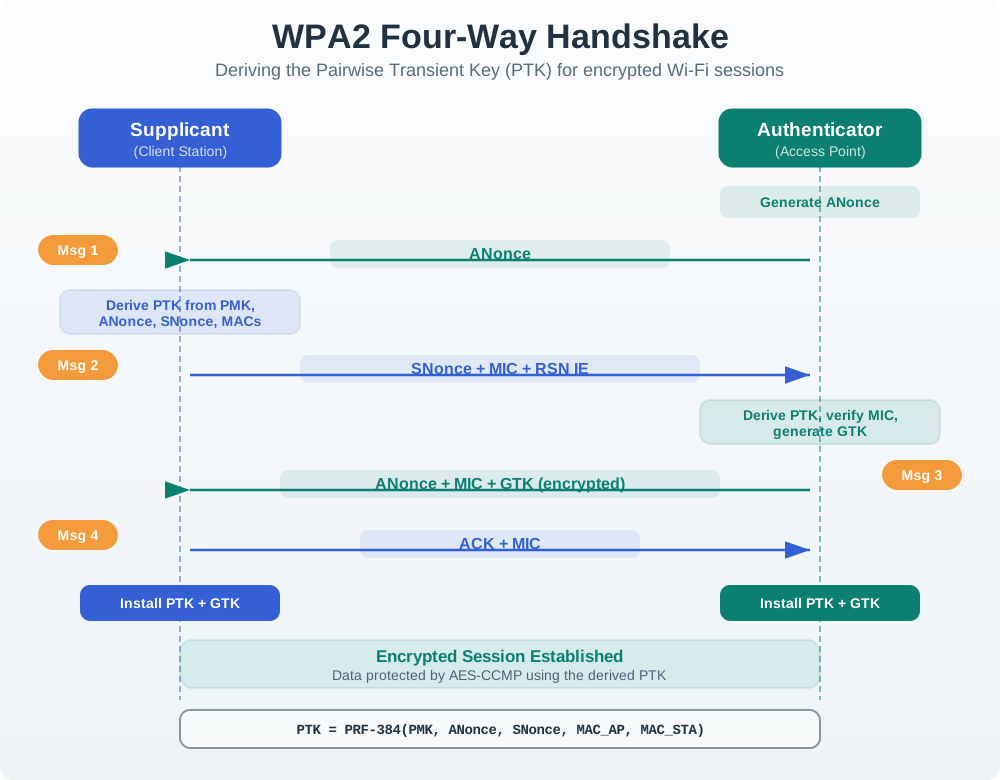
That distinction is necessary before judging what a captured handshake reveals and why passphrase quality still matters.

  • The passphrase itself is not transmitted; both peers derive the PTK from the PMK, nonces, and addresses, while MICs prove possession.
  • This offline-guessing exposure is exactly what WPA3 was designed to close.
  • Retransmission itself is correct.
Use the handshake diagram to separate proof of session-key establishment from the broader fleet questions: password strength, shared-secret exposure, rotation, segmentation, and device removal.
iotclass.org

Major section

The WPA2 Four-Way Handshake and Its Weakness (continued)

A capture therefore supplies material for offline guesses: an attacker can derive candidate keys and test the MIC without contacting the AP.

  • This connects session establishment to the chapter's fleet controls for passphrase entropy, rotation, segmentation, and device removal.
  • In a defensive review, the point is not to reproduce an attack.
  • The four-way handshake must tolerate a lost final acknowledgement.
iotclass.org

Major section

The WPA2 Four-Way Handshake and Its Weakness (continued)

If message 4 does not reach the AP, the AP retransmits message 3.

  • The failure appears when a client treats a valid retransmission as a command to install the same pairwise key again and resets state that must never move backwards.
  • The repair is a state-machine invariant: after a key is installed, a retransmitted message may be acknowledged but must not reinstall that key or reset its nonce/replay counters.
  • WPA2 devices with patched supplicants can be safe from this flaw; migrating protocol labels without updating vulnerable implementations is not a fix.
iotclass.org

Major section

Figure Review: Migration and Handshake State

Legacy Wi-Fi security is easiest to reject when its failure mechanisms are traced through the packet-protection sequence rather than reduced to an age label.

  • Modern protocol review must also distinguish a sound key exchange from an unsafe implementation state transition.
WEP failure and TKIP migration sequence.
iotclass.org

Deck summary

Key takeaways

For home and IoT networks the dominant schemes are WPA2-Personal and its successor WPA3-Personal.

  • That distinction is necessary before judging what a captured handshake reveals and why passphrase quality still matters.
  • A capture therefore supplies material for offline guesses: an attacker can derive candidate keys and test the MIC without contacting the AP.
  • If message 4 does not reach the AP, the AP retransmits message 3.
  • Legacy Wi-Fi security is easiest to reject when its failure mechanisms are traced through the packet-protection sequence rather than reduced to an age label.
iotclass.org

Retrieval practice

Recall check 1 of 5

Radio Remi says: answer from memory, then check your reasoning.

Q1A team wants every deployed sensor to use the same Wi-Fi password because it is easy to install. What is the strongest review response?

AApprove it because one password is easiest for support.
BReject all Wi-Fi devices because shared passwords are the only possible Wi-Fi authentication model.
CAccept it if the password is written only in the installer guide.
DRequire a decision record covering device risk, credential owner, rotation, lost-device response, segment limits.
Show answer

Answer: D The review must connect credential choice to ownership, recovery, network limits, and lifecycle operations.

iotclass.org

Retrieval practice

Recall check 2 of 5

Radio Remi says: answer from memory, then check your reasoning.

Q2A headless device opens a temporary setup path for Wi-Fi onboarding. What evidence should the reviewer request before accepting it?

AA happy-path setup screenshot plus the installer app name, device model, and no failure evidence.
BA support note saying setup mode is temporary and usually closes after install.
CEntry/exit rules, possession proof, credential handling, timeout, failures, reset, support, and retest triggers.
DThe SSID, phone OS version, and QR-code label photo used during one successful setup.
Show answer

Answer: C Provisioning is part of the security boundary and must be reviewed as a lifecycle workflow.

iotclass.org

Retrieval practice

Recall check 3 of 5

Radio Remi says: answer from memory, then check your reasoning.

Q3What two distinct problems does Wi-Fi security-and-provisioning address for an IoT device?

ASecuring the link via key agreement (WPA2/WPA3).
BChoosing a channel and setting transmit power.
CAssigning IP addresses and DNS.
DSelecting between 2.4 and 5 GHz.
Show answer

Answer: A Key agreement protects traffic; provisioning is the separate challenge of onboarding a device with no keyboard.

iotclass.org

Retrieval practice

Recall check 4 of 5

Radio Remi says: answer from memory, then check your reasoning.

Q4Why is a captured WPA2-Personal four-way handshake a security risk?

AIt exposes the plaintext Wi-Fi passphrase directly inside the captured frames.
BIt gives an attacker offline material for passphrase guesses by deriving keys and checking the MIC.
CIt lets the attacker change the AP channel and force clients onto weaker RF settings.
DIt matters only for open networks, because password-protected WPA2 has no handshake.
Show answer

Answer: B WPA2's handshake is vulnerable to offline dictionary attack once captured, which is why passphrase strength matters.

iotclass.org

Retrieval practice

Recall check 5 of 5

Radio Remi says: answer from memory, then check your reasoning.

Q5How does WPA3's SAE handshake defeat the offline dictionary attack that threatens WPA2?

ASAE automatically lengthens weak passphrases before the AP accepts a client.
BSAE sends the password encrypted, so the passphrase can be reused safely.
CSAE removes the four-way handshake and uses only protected management frames.
DSAE makes each password guess require a fresh online exchange and adds forward secrecy.
Show answer

Answer: D SAE (Dragonfly) removes any offline-verifiable value, throttling guesses to online attempts and protecting past sessions.

iotclass.org

Print reference

Answers 1 of 2

Answer key.

  1. D · The review must connect credential choice to ownership, recovery, network limits, and lifecycle operations.
  2. C · Provisioning is part of the security boundary and must be reviewed as a lifecycle workflow.
  3. A · Key agreement protects traffic; provisioning is the separate challenge of onboarding a device with no keyboard.
  4. B · WPA2's handshake is vulnerable to offline dictionary attack once captured, which is why passphrase strength matters.
iotclass.org

Print reference

Answers 2 of 2

Answer key.

  1. D · SAE (Dragonfly) removes any offline-verifiable value, throttling guesses to online attempts and protecting past sessions.
iotclass.org