Wi-Fi & 802.11 · Study deck

Wi-Fi Power Consumption

An access point is the network unit that a Wi-Fi device joins.

Radio Remi is your guide for this deck.

wifi-powerpower-budgetsleep-wake
Radio Remi, the module guide, in a scene from this chapter.
iotclass.org

After studying this chapter

Learning objectives

You will be able to:

  • describe the Wi-Fi power states that matter in IoT reviews
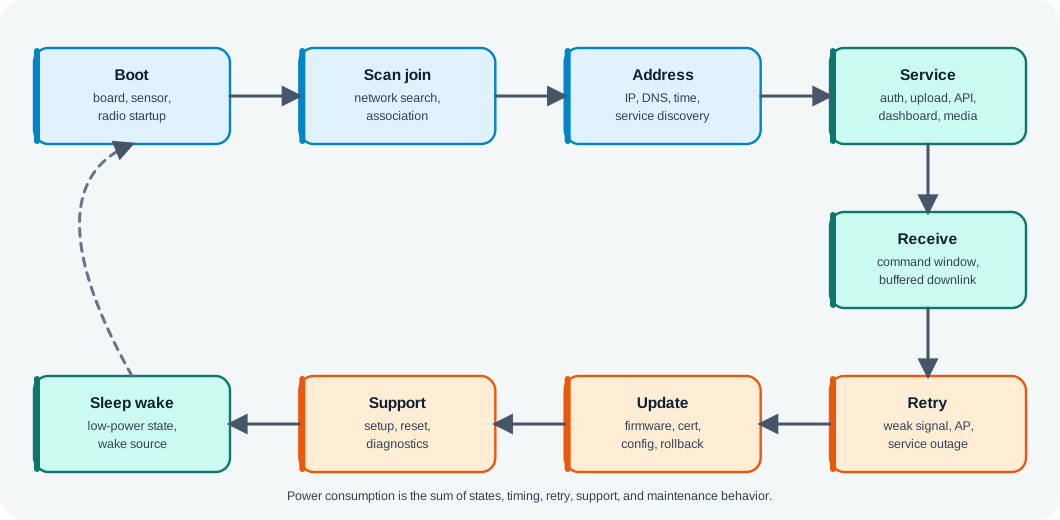
  • explain why connection, service, retry, and maintenance work can dominate a power budget
  • separate data-sheet current values from measured device evidence
  • review sleep, wake, downlink, and AP-coordination behavior without universal battery-life claims
iotclass.org

Major section

Start With the Wireless Story

An access point is the network unit that a Wi-Fi device joins.

  • Its timing and traffic can change how long the device must stay awake.
  • Most of its energy may still be spent finding the network, joining it, waiting for a reply, or staying awake for downlink traffic.
  • Longer sleep can delay commands.

Key terms

access point
access point is the network unit that a Wi-Fi device joins.
Wi-Fi battery life
Wi-Fi battery life is a sequence of states, not a single current number.
iotclass.org

Major section

Start With the Wireless Story (continued)
A tiny sleep-current value does not prove long battery life.

  • More retries can improve delivery while using more energy.
  • The access point's wake schedule can change both results.
  • The Practitioner section explains beacon timing and practical power settings.
  • Under the Hood shows how newer wake schedules change the old beacon rhythm.
iotclass.org

Major section

Start With the Wireless Story (continued)

A daily budget needs both send and receive work.

  • A short high peak can reset the board.
  • A long low wait can use more energy than the brief send.
  • A sleeping device cannot hear all the time.
  • It may wake for a network notice or at a set time.
iotclass.org

Major section

Start With the Wireless Story (continued)

Longer sleep can save energy but delay a command.

  • Many devices may wake after a power cut or at the same clock time.
  • That burst can cause waits and retries.
  • Fix the model when the two do not agree.
  • Recheck after any of them changes.
iotclass.org

Major section

Comparing Wi-Fi With Other Networks

A technology comparison is useful only when it starts from the requirement.

  • Wi-Fi may be a strong fit for powered, IP-heavy, local-dashboard, media, gateway, update, or diagnostic workflows.
  • A lower-power technology may be a better fit for tiny, infrequent, long-life battery telemetry.
  • A gateway-assisted design may be better when Wi-Fi is useful for the gateway but not for each leaf device.
iotclass.org

Major section

Wi-Fi Sleeps Between Beacons

A Wi-Fi radio left fully on is a battery killer, so 802.11 lets a station sleep and wake only when needed.

  • For an IoT review, the question is not whether power save exists.
  • A missing AP, buffered command, credential change, or update prompt can keep the radio awake far longer than the nominal telemetry path.

Why it matters

The route prevents a low average-current number from hiding an unacceptable command delay or a long failure wake.

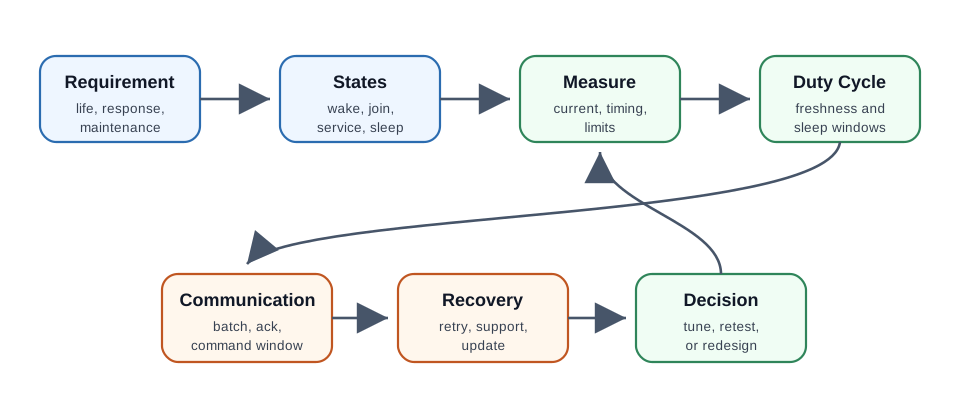
Use the route to keep power-save claims tied to evidence: the review starts with the requirement, then checks states, measurement, communication timing, recovery, and the final tune-or-redesign decision.
iotclass.org

Major section

DTIM, PS-Poll, and U-APSD

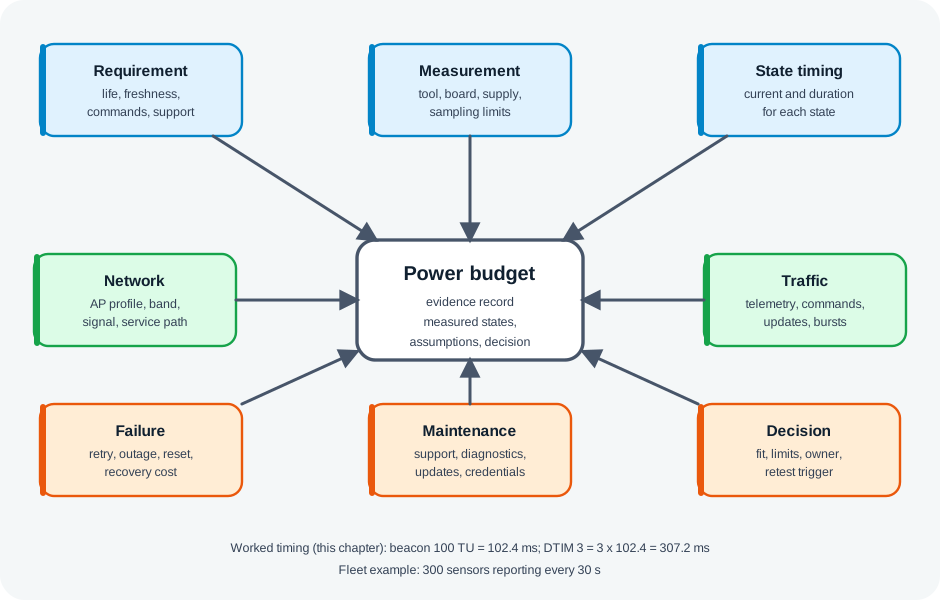
The DTIM period is a key knob: a station may sleep through ordinary beacons and only must wake at the DTIM beacon.

  • Worked example.: A battery sensor rarely receives commands.
  • A voice handset would keep DTIM = 1 for responsiveness.
  • The knob is set per use case.
  • Practitioner evidence should separate the knob from the outcome.
iotclass.org

Major section

Target Wake Time Breaks the Beacon Cadence

Worked example.: A building has 300 Wi-Fi sensors reporting every 30 seconds.

  • Legacy power save still ties a station to the AP's beacon rhythm and makes it contend with everyone when it wakes.
  • Target Wake Time (TWT), introduced in 802.11ax (Wi-Fi 6), removes both limits.
  • The under-the-hood evidence is the negotiated schedule, not the marketing label.

Why it matters

TWT does double duty: it saves power (far longer, predictable sleeps than DTIM allows) and reduces contention, because the AP staggers different stations' wake times so they do not all pile onto the channel at once.

iotclass.org

Major section

Target Wake Time Breaks the Beacon Cadence (continued)

TWT can improve a fleet only when the station, AP, firmware, and application timing all honor the same contract.

  • The station and AP negotiate a schedule — a wake time and a service-period duration — so the station can sleep for seconds or minutes and wake only at its agreed slot, independent of the beacon interval.
  • For a large fleet of Wi-Fi sensors, TWT is the difference between hundreds of radios waking together in a thundering herd and each waking politely in its own window.
  • Without those retest triggers, a good lab TWT result becomes a fragile deployment assumption.
iotclass.org

Deck summary

Key takeaways

An access point is the network unit that a Wi-Fi device joins.

  • A tiny sleep-current value does not prove long battery life.
  • A daily budget needs both send and receive work.
  • Longer sleep can save energy but delay a command.
  • A technology comparison is useful only when it starts from the requirement.
iotclass.org

Retrieval practice

Recall check 1 of 5

Radio Remi says: answer from memory, then check your reasoning.

Q1A team estimates Wi-Fi battery life using only active transmit current and payload size. What is the strongest review response?

ARequire a state-based power model covering connect, service, retry.
BAccept it because transmitting draws the highest instantaneous current.
CAccept it, since payload size sets the total battery life
DSwitch to BLE based on its lower quoted radio current.
Show answer

Answer: A Wi-Fi battery life needs a state-based model covering connect, service, retry, sleep, and maintenance, not just transmit current.

iotclass.org

Retrieval practice

Recall check 2 of 5

Radio Remi says: answer from memory, then check your reasoning.

Q2A device can save energy by sleeping longer, but it also needs occasional downlink commands. What should the reviewer require?

AAlways choose the longest sleep interval because energy is the only goal.
BDisable commands so the power budget looks better.
CA record showing wake schedule, command latency, AP buffering or scheduling behavior.
DAssume the access point will buffer commands correctly without testing.
Show answer

Answer: C Sleep and wake behavior must be reviewed against freshness, command, AP, retry, and support requirements.

iotclass.org

Retrieval practice

Recall check 3 of 5

Radio Remi says: answer from memory, then check your reasoning.

Q3In Wi-Fi power-save mode, how does a sleeping station learn it has downlink traffic waiting?

AIt sends a cellular query and asks the cloud whether the AP buffered traffic.
BIt stays awake for all downlink frames so AP-side buffering is not required.
CIt wakes for a beacon and reads the TIM bitmap that marks buffered frames for that station.
DIt receives a vendor phone-app alert whenever a frame arrives at the AP.
Show answer

Answer: C The AP buffers a sleeping station's frames and signals them via the TIM bitmap in each beacon.

iotclass.org

Retrieval practice

Recall check 4 of 5

Radio Remi says: answer from memory, then check your reasoning.

Q4A battery sensor increases its DTIM period from 1 to 3 (beacon interval ~102 ms). What is the effect?

AIt triples the PHY data rate because each beacon advertises three delivery windows.
BIt can sleep about 307 ms between required wakeups, trading power savings for downlink delay.
CIt disables AP buffering, so commands are sent only while the sensor is already awake.
DIt forces continuous awake mode because DTIM beacons become too far apart.
Show answer

Answer: B A larger DTIM period lengthens sleep and delays buffered delivery - a good trade for latency-tolerant sensors.

iotclass.org

Retrieval practice

Recall check 5 of 5

Radio Remi says: answer from memory, then check your reasoning.

Q5How does Target Wake Time (TWT) improve on legacy Wi-Fi power save for a large sensor fleet?

AIt keeps every station awake during a shared service period to prevent missed frames.
BIt removes 802.11 acknowledgments so each report uses fewer MAC exchanges.
CIt restricts sensor scheduling to 6 GHz channels where beacons are less frequent.
DIt lets stations negotiate separate wake slots, extending sleep and reducing wakeup contention.
Show answer

Answer: D TWT both extends sleep and spreads stations' wake times, avoiding the thundering-herd contention of synchronized wakeups.

iotclass.org

Print reference

Answers 1 of 2

Answer key.

  1. A · Wi-Fi battery life needs a state-based model covering connect, service, retry, sleep, and maintenance, not just transmit current.
  2. C · Sleep and wake behavior must be reviewed against freshness, command, AP, retry, and support requirements.
  3. C · The AP buffers a sleeping station's frames and signals them via the TIM bitmap in each beacon.
  4. B · A larger DTIM period lengthens sleep and delays buffered delivery - a good trade for latency-tolerant sensors.
iotclass.org

Print reference

Answers 2 of 2

Answer key.

  1. D · TWT both extends sleep and spreads stations' wake times, avoiding the thundering-herd contention of synchronized wakeups.
iotclass.org