Wi-Fi & 802.11 · Study deck
Wi-Fi Planning: Scenario Reviews and Failure Checks
Fixed sensors and moving tools stress a Wi-Fi design in different ways.
Radio Remi is your guide for this deck.

After studying this chapter
Learning objectives
You will be able to:
- Explain: MU-MIMO and multiple streams accelerate the laptops, but the sensors still transmit one slow stream each; if they all report on a schedule, their combined airtime, not the laptops', sets the ceiling.
- Explain: Capacity asks “can all the devices in one area actually get airtime?” A single high-power AP can cover a floor yet collapse under the load of hundreds of clients.
- Explain: The mathematical gist.: With 20 dBm transmit power, 3 dBi gain gives 23 dBm EIRP and an idealised 315 m free-space distance to the chapter's −67 dBm target.
Major section
Coverage and Capacity Are Different Goals
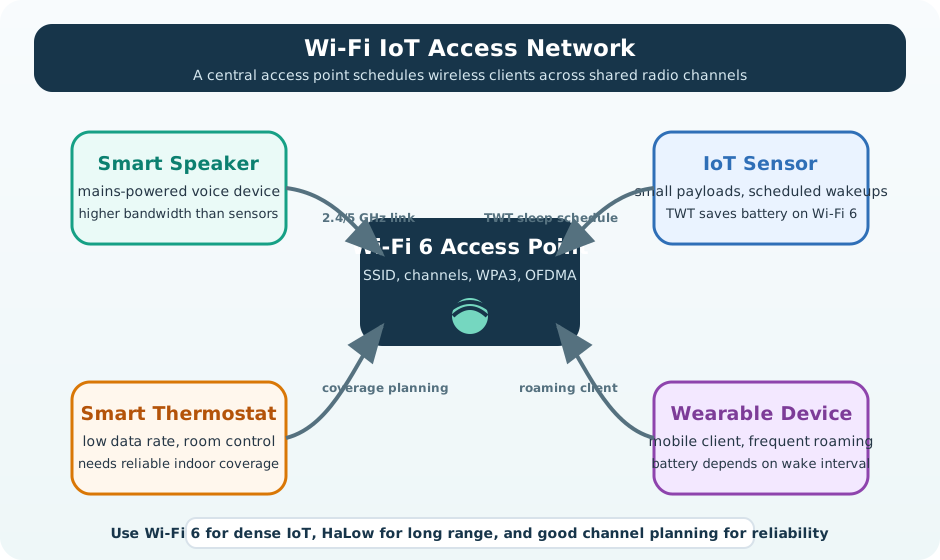
Planning a Wi-Fi deployment means balancing two goals that pull apart.
- Coverage asks “is there enough signal everywhere devices live?” — a common target is RSSI around −67 dBm for reliable real-time traffic.
Major section
Coverage and Capacity Are Different Goals (continued)
Capacity asks “can all the devices in one area actually get airtime?” A single high-power AP can cover a floor yet collapse under the load of hundreds of clients.
- That shrinks each cell, raises reuse of the 1/6/11 and 5/6 GHz channels, and gives each client a stronger, faster link.
- IoT adds a twist: many sensors are cheap single-antenna radios that cannot use the fastest modes, so they occupy airtime disproportionately.
- The plan therefore records the client mix, location, traffic pattern, and busy period for each group before it assigns APs or channels.
Major section
Phoebe's Field Notes: Why Gain Cannot Buy Coverage, Only Trade It
The mathematical gist.: With 20 dBm transmit power, 3 dBi gain gives 23 dBm EIRP and an idealised 315 m free-space distance to the chapter's −67 dBm target.
- Raising gain to 8 dBi gives 28 dBm EIRP and 559 m, a 1.78× range ratio.
Major section
Spatial Streams, MU-MIMO, and Beamforming
A practical evidence sheet should separate client capability from cell behavior.
- The IoT reality check: most sensors are single-stream devices.
- Beamforming still helps their link quality, but capacity planning must assume many slow single-stream clients, not a few fast laptops.
- When those two records disagree, the lower one controls the deployment approval.
Major section
Spatial Streams, MU-MIMO, and Beamforming (continued)
Worked example.: An AP advertising 4 spatial streams shares a channel with 30 single-stream sensors and 3 laptops.
- MU-MIMO and multiple streams accelerate the laptops, but the sensors still transmit one slow stream each; if they all report on a schedule, their combined airtime, not the laptops', sets the ceiling.
- The fix is OFDMA (pack the small sensor frames), band-steering laptops to 5/6 GHz, and staggering sensor reports — classic capacity engineering.
- If the plan claims MU-MIMO capacity, confirm that the AP profile, client capabilities, and observed traffic actually use simultaneous downlink groups.
Major section
Fast Roaming with 802.11k/v/r
Roaming quality, not raw coverage, is what makes mobile Wi-Fi IoT usable.
- The hard part is compatibility.
- Some clients ignore 802.11v steering requests, some embedded stacks support 802.11k neighbour reports but not 802.11r, and some security profiles make fast transition unavailable.
- The deployment plan should therefore name the exact client firmware, identity method, AP profile, and roam policy being approved.
Deck summary
Key takeaways
Planning a Wi-Fi deployment means balancing two goals that pull apart.
- Capacity asks “can all the devices in one area actually get airtime?” A single high-power AP can cover a floor yet collapse under the load of hundreds of clients.
- The mathematical gist.: With 20 dBm transmit power, 3 dBi gain gives 23 dBm EIRP and an idealised 315 m free-space distance to the chapter's −67 dBm target.
- A practical evidence sheet should separate client capability from cell behavior.
- Worked example.: An AP advertising 4 spatial streams shares a channel with 30 single-stream sensors and 3 laptops.
Retrieval practice
Recall check 1 of 5

Radio Remi says: answer from memory, then check your reasoning.
Q1A team says a Wi-Fi sensor deployment is ready because every sensor joined the network on a bench beside one access point. What is the strongest review response?
Show answer
Answer: C Deployment approval needs installed evidence, not only a successful lab join.
Retrieval practice
Recall check 2 of 5

Radio Remi says: answer from memory, then check your reasoning.
Q2A factory's Wi-Fi tools and sensors work overnight but lose service during shift changes. What should the deployment review investigate first?
Show answer
Answer: D Deployment plans should test the periods and routes where the service actually has to work.
Retrieval practice
Recall check 3 of 5

Radio Remi says: answer from memory, then check your reasoning.
Q3Why is a single high-power AP often a poor choice for a dense IoT deployment?
Show answer
Answer: C Coverage is not capacity; dense deployments need smaller cells and channel reuse, not one loud AP.
Retrieval practice
Recall check 4 of 5

Radio Remi says: answer from memory, then check your reasoning.
Q4How does downlink MU-MIMO increase a cell's capacity?
Show answer
Answer: B MU-MIMO multiplies capacity by transmitting to several clients simultaneously via spatial separation.
Retrieval practice
Recall check 5 of 5

Radio Remi says: answer from memory, then check your reasoning.
Q5What does 802.11r (Fast BSS Transition) contribute to roaming?
Show answer
Answer: D 11r removes the handshake delay at handoff, which is what keeps voice and control links from stalling.
Print reference
Answers
Answer key.
- C · Deployment approval needs installed evidence, not only a successful lab join.
- D · Deployment plans should test the periods and routes where the service actually has to work.
- C · Coverage is not capacity; dense deployments need smaller cells and channel reuse, not one loud AP.
- B · MU-MIMO multiplies capacity by transmitting to several clients simultaneously via spatial separation.
- D · 11r removes the handshake delay at handoff, which is what keeps voice and control links from stalling.