Wi-Fi & 802.11 · Study deck

Wi-Fi HaLow (802.11ah) for IoT

Run a plain site check.

Radio Remi is your guide for this deck.

wifi-halow802-11ahsub-ghz
Radio Remi, the module guide, in a scene from this chapter.
iotclass.org

After studying this chapter

Learning objectives

You will be able to:

  • explain what changes when Wi-Fi moves to a sub-1 GHz 802.11ah path
  • separate HaLow feature claims from installed deployment evidence
  • identify when HaLow-specific client and access point support is required
  • compare HaLow with conventional Wi-Fi, LPWAN, and cellular IoT paths without using one universal ranking
iotclass.org

Major section

In 60 Seconds

Wi-Fi HaLow is the Wi-Fi family path based on IEEE 802.11ah.

  • It uses sub-1 GHz license-exempt spectrum instead of the normal 2.4, 5, or 6 GHz Wi-Fi bands.
  • HaLow is not normal Wi-Fi with a longer antenna.
  • Existing 2.4, 5, or 6 GHz clients cannot connect to a HaLow access point unless they have a HaLow radio.
iotclass.org

Major section

Phoebe's Field Notes: Why the Same Antenna Gain Buys More at 915 MHz

The mathematical gist.: At 915 MHz the wavelength is 0.3279 m and a quarter wave is 8.20 cm, versus 0.125 m and 3.13 cm at 2.4 GHz.

  • Equal-gain ideal apertures differ by 6.88 times, the same 8.38 dB ratio found through Friis; moving within 902–928 MHz changes that ideal loss by only 0.247 dB end to end.

Numbers to remember

915 MHzThe mathematical gist.: At 915 MHz the wavelength is 0.3279 m
iotclass.org

Major section

HaLow Fit Map

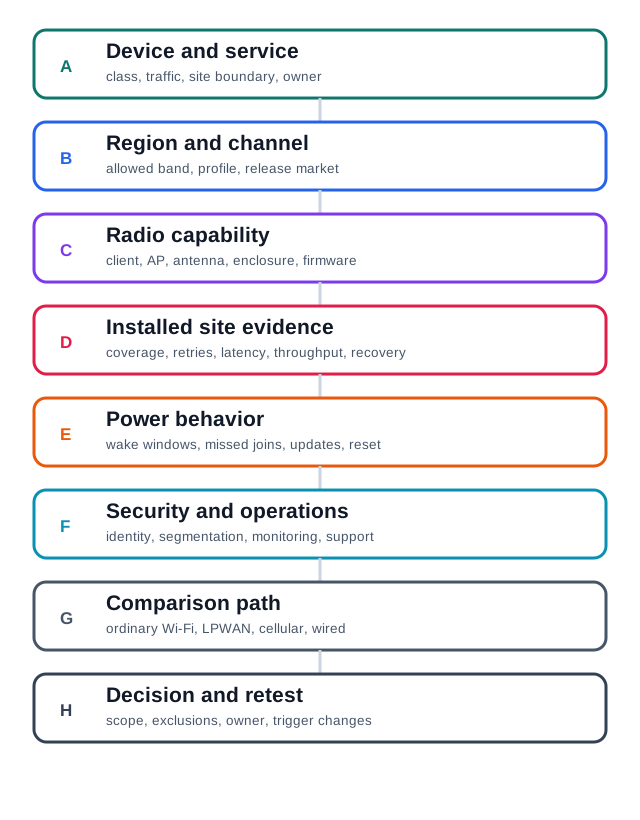
The map connects HaLow's sub-1 GHz advantages to the practical evidence required for a supportable service.

  • The walkthrough starts by asking whether ordinary Wi-Fi already meets the installed coverage and power requirement.
  • A failure at any checkpoint narrows or rejects the candidate before a costly field trial.
Wi-Fi HaLow fit map
Wi-Fi HaLow fit map
iotclass.org

Major section

HaLow Evidence Record

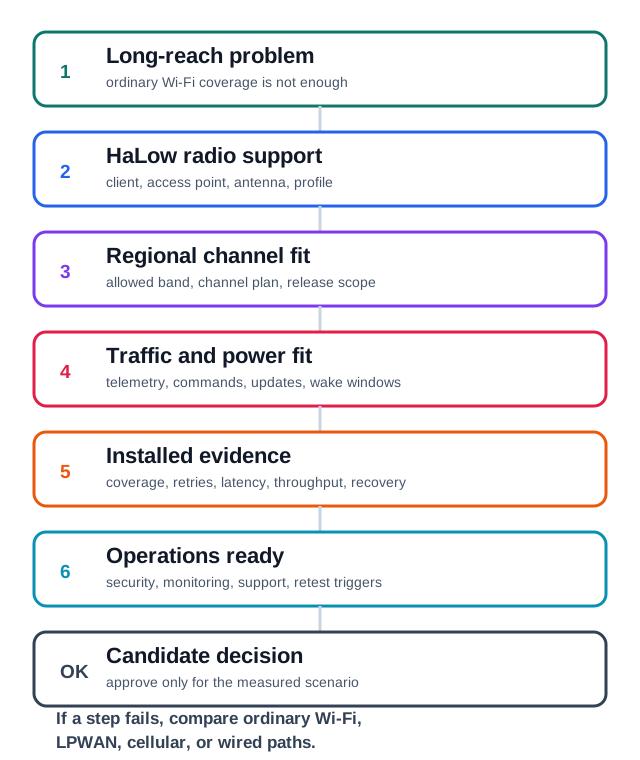
Long reach is only one input alongside radio support, regional rules, traffic, power, security, and operations.

  • The final retest trigger connects the radio decision to evidence that remains valid as conditions change.
Wi-Fi HaLow evidence record
iotclass.org

Major section

What HaLow Changes

HaLow changes the Wi-Fi review in five practical ways.

  • HaLow uses sub-1 GHz spectrum.
  • Lower frequency can help range and obstruction behavior, but it also brings regional channel, transmit, coexistence, and certification constraints.
  • Second, the client requirement changes.
  • Third, the capacity question changes.

Key terms

HaLow
HaLow is often reviewed against conventional Wi-Fi, LoRaWAN, cellular IoT, Thread, Zigbee, and wired backhaul.
iotclass.org

Major section

What HaLow Changes (continued)

Fourth, the power question changes.

  • A phone, laptop, 2.4 GHz Wi-Fi module, or ordinary Wi-Fi sensor cannot join a HaLow access point unless it includes a compatible HaLow radio path.
  • Fifth, the comparison set changes.
  • HaLow is often reviewed against conventional Wi-Fi, LoRaWAN, cellular IoT, Thread, Zigbee, and wired backhaul.
iotclass.org

Major section

Narrow Channels and Massive Association

If some devices need continuous diagnostics, local images, or fast firmware updates, they may need a different class, a second channel plan, or ordinary Wi-Fi kept beside HaLow.

  • HaLow's PHY uses narrow channels — 1, 2, 4, 8, or 16 MHz (regions with little sub-GHz spectrum use mainly 1 and 2 MHz).
  • A practitioner review should start with a device-class table rather than a radio slogan.
  • The field test should measure more than coverage.

Numbers to remember

16 MHzor 16 MHz (regions with little sub-GHz spectrum use mainly 1
iotclass.org

Major section

Narrow Channels and Massive Association (continued)

Narrow channels concentrate power and are robust over distance; the 1 MHz mode reaches farthest at sub-Mbit/s rates, while 16 MHz trades range for tens of Mbit/s.

  • For each class, record the message size, reporting interval, required downlink latency, update size, battery target, enclosure, antenna position, and support workflow.
  • A bench result from an exposed radio module is not release evidence for a sealed sensor mounted behind metal shelving.
  • Ordinary 2.4 GHz Wi-Fi cannot cover the range or the device count from one AP.
iotclass.org

Major section

RAW Tames Contention Among Thousands

Thousands of stations sharing one channel would collide constantly under ordinary CSMA/CA — the moment they all wake to report, contention explodes.

  • 802.11ah's key mechanism against this is the Restricted Access Window (RAW).
  • TWT protects the battery; RAW protects the shared channel.
  • Telemetry-only stations can tolerate long sleep intervals and narrow RAW windows.

Why it matters

This view matters because a long sleep interval is useful only when the station still receives a workable opportunity to contend and recover.

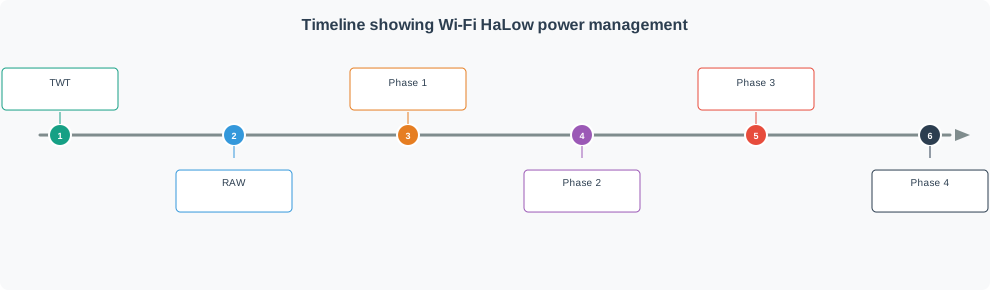
Wi-Fi HaLow scheduling contract: TWT determines when stations wake, RAW limits which stations contend, and missed-window recovery preserves the service requirement.
iotclass.org

Major section

RAW Tames Contention Among Thousands (continued)

The AP divides stations into groups and assigns each group its own time window; a station may only contend during its group's RAW slot.

  • RAW pairs with Target Wake Time (TWT), which lets each station negotiate exactly when to wake, so a sensor can sleep for minutes and rise only for its scheduled window.
  • Alarm devices need faster downlink reachability or a separate wake pattern.
  • Scheduled TWT wakeups keep every radio off between its windows.
iotclass.org

Major section

RAW Tames Contention Among Thousands (continued)

The access point can also buffer downlink frames and advertise which groups need to wake, so quiet sensors do not spend energy listening to every beacon as if they were always-active laptops.

  • The sequence shows that TWT reduces radio-on time while RAW reduces the number of simultaneous contenders; neither mechanism by itself proves that an alarm, downlink, or retry deadline will be met.
  • Firmware updates need a maintenance phase because the normal sensor window may be too small for large transfers.
  • Worked example.: At the top of each reporting cycle all 2000 soil sensors would otherwise contend at once.
iotclass.org

Deck summary

Key takeaways

Wi-Fi HaLow is the Wi-Fi family path based on IEEE 802.11ah.

  • The mathematical gist.: At 915 MHz the wavelength is 0.3279 m and a quarter wave is 8.20 cm, versus 0.125 m and 3.13 cm at 2.4 GHz.
  • The map connects HaLow's sub-1 GHz advantages to the practical evidence required for a supportable service.
  • Long reach is only one input alongside radio support, regional rules, traffic, power, security, and operations.
  • HaLow changes the Wi-Fi review in five practical ways.
iotclass.org

Retrieval practice

Recall check 1 of 6

Radio Remi says: answer from memory, then check your reasoning.

Q1A team wants its existing 2.4 GHz Wi-Fi sensors to join a new Wi-Fi HaLow access point. What is true?

AThey cannot join unless each has a HaLow (sub-1 GHz 802.11ah) radio
BThey join automatically since HaLow is just longer-range Wi-Fi
CThey join after a firmware update on the access point alone
DThey join as soon as the correct password is entered
Show answer

Answer: A Wi-Fi HaLow uses sub-1 GHz spectrum, so only devices with a HaLow radio can join a HaLow access point.

iotclass.org

Retrieval practice

Recall check 2 of 6

Radio Remi says: answer from memory, then check your reasoning.

Q2A team wants existing 2.4 GHz Wi-Fi sensors to join a new HaLow access point. What is the strongest review response?

AApprove it if the HaLow access point advertises the same SSID and security settings as the existing sensor network.
BUse a stronger antenna on the existing sensors and keep the same client radios.
CConfirm whether each client has a compatible HaLow radio, regional profile, antenna path.
DSkip the client check and focus only on access point range.
Show answer

Answer: C HaLow is part of the Wi-Fi family, but it requires compatible HaLow radios and regional support.

iotclass.org

Retrieval practice

Recall check 3 of 6

Radio Remi says: answer from memory, then check your reasoning.

Q3A field sensor sends a tiny status message a few times per day and does not need direct IP service at the endpoint. What should the review do first?

AApprove HaLow because native IP simplifies integration with local network tools and services.
BReject LPWAN because it is not ordinary Wi-Fi.
CChoose the technology with the largest advertised range.
DCompare HaLow against LPWAN and cellular IoT using traffic size.
Show answer

Answer: D HaLow is strongest when private IP reach and measured site behavior matter.

iotclass.org

Retrieval practice

Recall check 4 of 6

Radio Remi says: answer from memory, then check your reasoning.

Q4What is the main reason Wi-Fi HaLow (802.11ah) reaches farther than ordinary 2.4 GHz Wi-Fi?

AIt operates in sub-1-GHz spectrum
BIt transmits at 100x the power of normal Wi-Fi.
CIt uses 320 MHz channels for more range.
DIt runs in licensed cellular spectrum.
Show answer

Answer: A Moving to sub-GHz (~900 MHz) is what buys HaLow its range and penetration, at the cost of raw data rate -- its longer wavelength has lower path loss and better wall penetration.

iotclass.org

Retrieval practice

Recall check 5 of 6

Radio Remi says: answer from memory, then check your reasoning.

Q5How does 802.11ah support up to ~8191 stations per access point?

ABy giving each station a private 16 MHz channel on the AP.
BBy removing ACKs so thousands of devices can talk at once.
CBy using a 13-bit AID plus hierarchical TIM paging.
DBy moving overflow stations onto cellular backup links.
Show answer

Answer: C A 13-bit association ID allows up to 8191 stations, and hierarchical paging signals buffered traffic efficiently.

iotclass.org

Retrieval practice

Recall check 6 of 6

Radio Remi says: answer from memory, then check your reasoning.

Q6What problem does the Restricted Access Window (RAW) in 802.11ah solve?

AIt splits many stations into groups with separate contention windows.
BIt increases each station's data rate to clear the channel faster.
CIt encrypts management frames.
DIt bonds channels for more bandwidth.
Show answer

Answer: A RAW time-slices contention across groups, which is essential when thousands of devices share one channel.

iotclass.org

Print reference

Answers 1 of 2

Answer key.

  1. A · Wi-Fi HaLow uses sub-1 GHz spectrum, so only devices with a HaLow radio can join a HaLow access point.
  2. C · HaLow is part of the Wi-Fi family, but it requires compatible HaLow radios and regional support.
  3. D · HaLow is strongest when private IP reach and measured site behavior matter.
iotclass.org

Print reference

Answers 2 of 2

Answer key.

  1. A · Moving to sub-GHz (~900 MHz) is what buys HaLow its range and penetration, at the cost of raw data rate -- its longer wavelength has lower path loss and better wall penetration.
  2. C · A 13-bit association ID allows up to 8191 stations, and hierarchical paging signals buffered traffic efficiently.
  3. A · RAW time-slices contention across groups, which is essential when thousands of devices share one channel.
iotclass.org