Wireless and Optical Sensing for IoT · Study deck
Wi-Fi Channel-State Information for Presence and Motion Sensing
Radio Remi is helping a library keep lights on while people are studying.
Radio Remi is your guide for this deck.
After studying this chapter
Learning objectives
You will be able to:
- Explain how channel-state information describes amplitude and phase across Wi-Fi subcarriers.
- Build calibrated window features and evaluate them on held-out synthetic room data.
- Separate a detection result from evidence about people, rooms, radios, and privacy.
- Explain: Radio Remi is helping a library keep lights on while people are studying.
Major section
Start With the Story
Radio Remi is helping a library keep lights on while people are studying.
- A camera would collect more detail than the team needs.
- A motion sensor misses someone who sits still.
- Remi asks whether changes in the room's Wi-Fi path can support a simple occupied or empty decision.
Major section
Calibrate, window, and describe change
Calibration removes part of the static room and radio offset; it does not remove furniture changes, people outside the target zone, or radio drift.
- A threshold should include an uncertain band so borderline windows can be reviewed instead of forced into occupied or empty.
- Window duration controls how quickly the detector responds and how much short-term variation it averages.
- The calibration record should retain device, channel, placement, room state, and collection time.
Major section
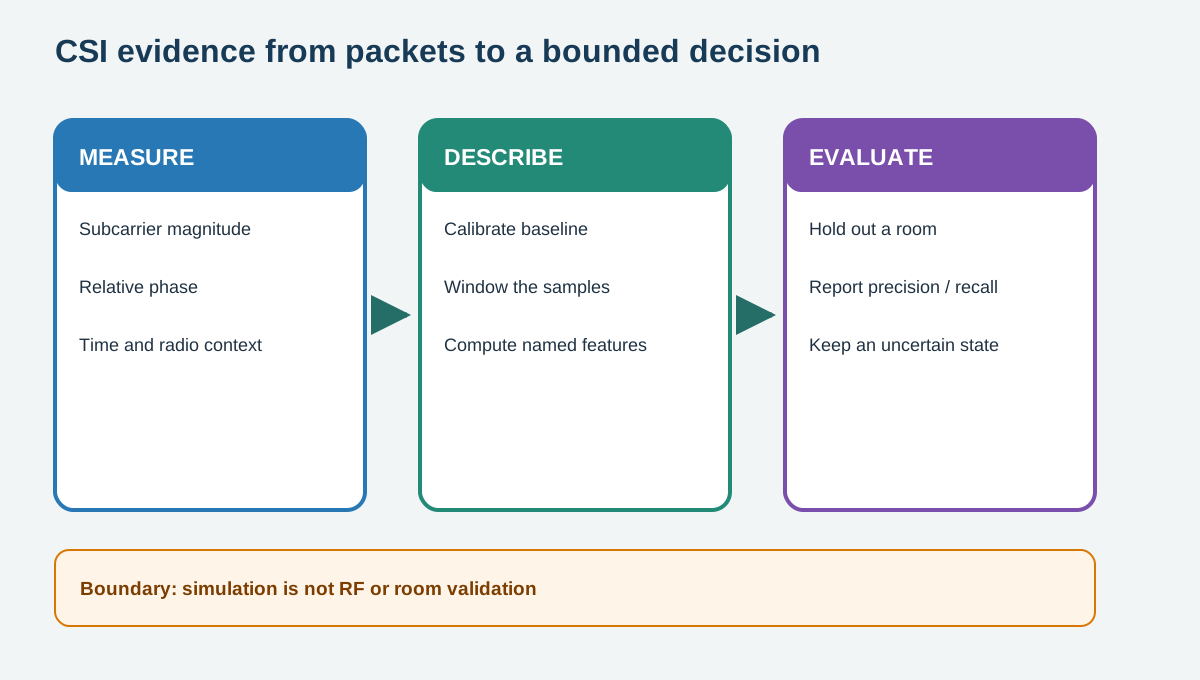
Read the sensing pipeline
The final card compares held-out predictions with labels and keeps uncertainty visible.
- The arrows show processing order, not proof that the final output is correct in every setting.
Major section
Summary
The useful result is a consented, calibrated decision that can abstain when the room no longer matches its evidence.
- That record lets a reviewer distinguish a repeatable motion cue from a lucky result or an unreported change in the room.
- CSI records per-subcarrier channel change, not a direct image of a person.
- Calibration, windowing, held-out rooms, and abstention keep the claim bounded.
- A simulated classifier teaches the pipeline but cannot validate an installed Wi-Fi sensing system.
Deck summary
Key takeaways
Radio Remi is helping a library keep lights on while people are studying.
- Calibration removes part of the static room and radio offset; it does not remove furniture changes, people outside the target zone, or radio drift.
- The final card compares held-out predictions with labels and keeps uncertainty visible.
- The useful result is a consented, calibrated decision that can abstain when the room no longer matches its evidence.
Retrieval practice
Recall check

Radio Remi says: answer from memory, then check your reasoning.
Q1Why should CSI data be split by room or time before evaluation?
Show answer
Answer: A To test whether the method survives conditions not copied into training.
Q2What is the safest action for a CSI window inside the uncertain threshold band?
Show answer
Answer: A Report no decision and gather more evidence.
Print reference
Answers
Answer key.
- A · To test whether the method survives conditions not copied into training.
- A · Report no decision and gather more evidence.