WiFi & Mobile Networks · Study deck
Wi-Fi Bands: Channels, DFS, and 6 GHz
More channels do not remove local rules or radar events.
Radio Remi is your guide for this deck.

After studying this chapter
Learning objectives
You will be able to:
- Explain: 6 GHz (Wi-Fi 6E/7) offers up to 1200 MHz where the full band is allowed, with wide-channel room for compatible clients and generally shorter reach than lower bands.
- Explain: It may need local infrastructure, IP access, high bursts, simple commissioning, or existing security controls, but the choice only works if power, coverage, airtime, and ownership evidence match the device job.
- Explain: In the worked strip, 80 MHz / 20 MHz = 4, so one 80 MHz channel consumes the space of four 20 MHz channels and leaves about one quarter as many independent choices.
Major section
Three Bands, Many Channels, Several Widths
Wi-Fi operates across three license-exempt bands where local rules permit, and each behaves differently for IoT.
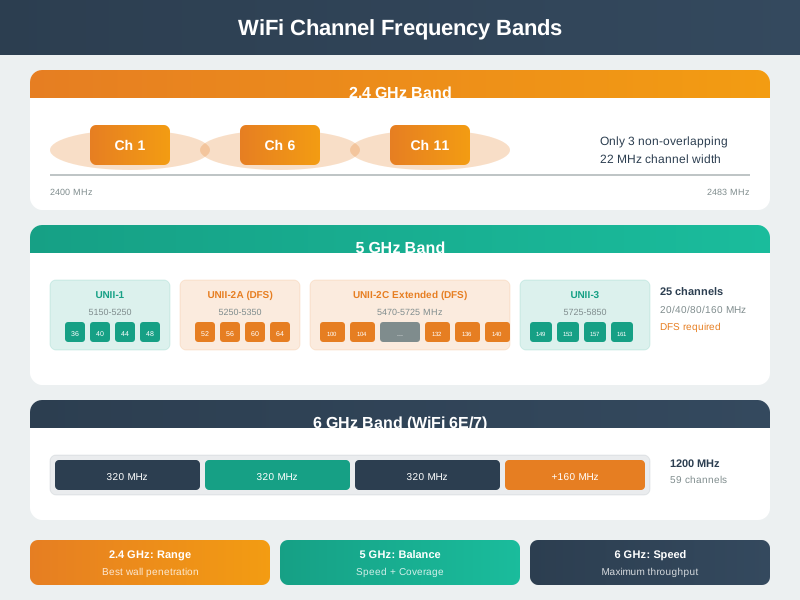
- 2.4 GHz generally reaches farthest and penetrates walls best but is crowded; channels 1, 6, and 11 are the usual non-overlapping 20 MHz planning set.
- 5 GHz has more channels and generally shorter reach.
- Channel width is the second half of the decision.
Major section
Three Bands, Many Channels, Several Widths (continued)
6 GHz (Wi-Fi 6E/7) offers up to 1200 MHz where the full band is allowed, with wide-channel room for compatible clients and generally shorter reach than lower bands.
- In the worked strip, 80 MHz / 20 MHz = 4, so one 80 MHz channel consumes the space of four 20 MHz channels and leaves about one quarter as many independent choices.
- A 5 GHz plan offers more reuse, but its mounts and DFS repair need proof.
- A narrow 20 MHz channel often gives a dense IoT site more predictable reuse than a wide channel that looks faster in a single-link test.
Major section
The 5 GHz UNII Sub-Bands and Channel Count
The 5 GHz band is organised into UNII sub-bands, each with its own rules.
- Channel width consumes these channels fast.
- In a dense site that means far less reuse and more co-channel contention.
- Channel 165 does not form another 80 MHz block.
- A useful field test has two views.
Major section
The 5 GHz UNII Sub-Bands and Channel Count (continued)
Worked example: In a plan allowing only UNII-1 and UNII-3 non-DFS channels, an installer sets every AP to 80 MHz and finds two non-overlapping 80 MHz blocks: 36–48 and 149–161.
- Adjacent APs still need a surveyed reuse plan; a channel change alone does not guarantee interference-free service.
- The best width is the narrowest one that meets the service objective while leaving enough clean reuse for the installed cell pattern.
- The spectrum view shows neighbouring Wi-Fi, partial overlap, non-Wi-Fi interference, and channel changes over time.
Major section
DFS Mechanics and the 6 GHz Power Classes
The hidden implementation detail is that a channel move is not just a radio event.
- This unlocks many extra channels but risks a mid-service channel change.
- Other markets can authorize different portions of the band and power classes, so check the local rules.
- Standard-power operation adds a location-aware coordination dependency.
Major section
DFS Mechanics and the 6 GHz Power Classes (continued)
Clients must hear the change, reassociate or follow the AP, refresh security state if needed, and rebuild the application path before the service timeout expires.
- UNII-2C offers many channels but they are DFS, so a passing weather radar could force a camera's AP to vacate mid-stream.
- For 6 GHz, the equivalent review is compatibility and operating scope.
- Without those limits, a clean spectrum label can turn into an operations problem.
Major section
Wi-Fi Fundamentals for IoT
The radio link is only one step between the freezer and the person who must act.
- An access point is the local unit that lets wireless devices join a wired or wider network.
- This first path test cannot predict every shared-air or roaming effect.
- Practitioner builds the fit record.
Major section
Wi-Fi Fundamentals for IoT (continued)
That promise is valuable when the device needs local services, cloud services, web APIs, dashboards, diagnostics, firmware updates, or richer data than a small sensor message.
- Firmware is the built-in software that controls a device: Record its version with the access point setup, time, signal result, message delay, loss, and recovery.
- Wi-Fi is a family of IEEE 802.11 wireless LAN technologies.
- An unknown site path sends the work to a coverage plan.
Major section
Wi-Fi Fundamentals for IoT (continued)
It may need local infrastructure, IP access, high bursts, simple commissioning, or existing security controls, but the choice only works if power, coverage, airtime, and ownership evidence match the device job.
- A vague need must be made clear before anyone debates Wi-Fi types.
- A weak traffic, power, or trust result sends it down that branch before the pilot can pass.
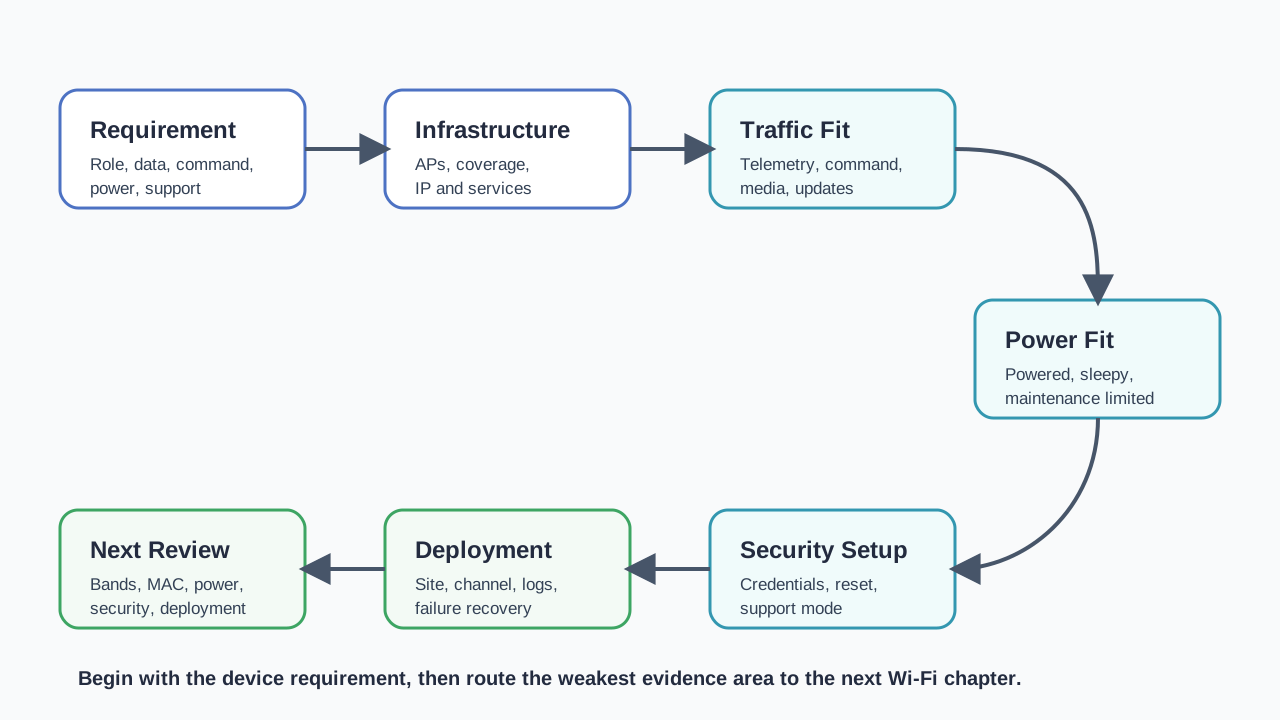
- A practical Wi-Fi review starts with the device workflow, not with a standards table.
Major section
Wi-Fi Fundamentals for IoT (continued)
This order turns a common network name into a bounded claim: Wi-Fi fits only the device, site, and use that the saved test record covers.
- The record should let another reviewer see why Wi-Fi is a fit, where the evidence came from, and what change would require retest.
- The difference is the amount of evidence available: early design may record assumptions and required tests, while a pilot should record installed observations and logs.
- A powered building controller needs a local dashboard for maintenance and a cloud path for status reports.
Major section
Wi-Fi Fundamentals for IoT (continued)
The review should not stop at "connected." It should record the AP owner, network policy, local API boundary, command authorization, reconnection behavior, and retest trigger for AP replacement, firmware update, credential rotation, or enclosure change.
- A small room sensor sends one short reading occasionally and is expected to run for a long maintenance interval.
- Wi-Fi may still be possible, but it is no longer a low-evidence choice.
- The review must measure wake, association, service, retry, sleep, failure recovery, support mode, and update behavior on representative hardware.
- Wi-Fi review is easier when each symptom is routed to the right layer.
Major section
Wi-Fi Fundamentals for IoT (continued)
If those measurements do not fit the maintenance requirement, a lower-power radio, a gateway-assisted design, or a different reporting schedule may be the better decision.
- A failed cloud publish can start in radio coverage, association, authentication, IP addressing, DNS, routing, transport security, application authorization, power state, or server behavior.
- Treating all of those as "Wi-Fi is broken" slows diagnosis.
- The overview decision should separate the layers enough that a future failure has a first place to look.
- It requires a clear evidence boundary between the radio link, the LAN service, the application path, and the product workflow.
Deck summary
Key takeaways
Wi-Fi operates across three license-exempt bands where local rules permit, and each behaves differently for IoT.
- 6 GHz (Wi-Fi 6E/7) offers up to 1200 MHz where the full band is allowed, with wide-channel room for compatible clients and generally shorter reach than lower bands.
- The 5 GHz band is organised into UNII sub-bands, each with its own rules.
- Worked example: In a plan allowing only UNII-1 and UNII-3 non-DFS channels, an installer sets every AP to 80 MHz and finds two non-overlapping 80 MHz blocks: 36–48 and 149–161.
Retrieval practice
Recall check 1 of 6

Radio Remi says: answer from memory, then check your reasoning.
Q1For a long-range, wall-penetrating IoT sensor link, which Wi-Fi band is generally the best fit, and why?
Show answer
Answer: B Its longer wavelength trades channel count for range and penetration, which suits reach-limited sensors.
Retrieval practice
Recall check 2 of 6
Radio Remi says: answer from memory, then check your reasoning.
Q2Why does using 80 MHz channels reduce the number of independent channels available for reuse?
Show answer
Answer: A Wider channels consume more spectrum each, leaving fewer independent channels for neighbouring APs to reuse.
Retrieval practice
Recall check 3 of 6
Radio Remi says: answer from memory, then check your reasoning.
Q3What must an AP do before and during use of a DFS channel in 5 GHz UNII-2?
Show answer
Answer: A DFS protects radar: check first, monitor continuously, and move off the channel on detection.
Retrieval practice
Recall check 4 of 6
Radio Remi says: answer from memory, then check your reasoning.
Q4A prototype joins Wi-Fi once beside a lab router. What does that prove?
Show answer
Answer: B A single connection is useful evidence, but it does not prove installed coverage, service reachability, traffic behavior, power, security, provisioning, or recovery.
Retrieval practice
Recall check 5 of 6
Radio Remi says: answer from memory, then check your reasoning.
Q5A powered IoT controller needs a technician dashboard and cloud status reports. Which Wi-Fi review record is strongest?
Show answer
Answer: C This ties Wi-Fi to the installed workflow and the evidence needed to support it.
Retrieval practice
Recall check 6 of 6
Radio Remi says: answer from memory, then check your reasoning.
Q6A device associates to Wi-Fi and receives an IP address, but its local dashboard cannot be opened. Which boundary should be reviewed next?
Show answer
Answer: D Association and IP service are already partially proven; the next boundary is whether the intended local service is reachable and authorized.
Print reference
Answers 1 of 2
Answer key.
- B · Its longer wavelength trades channel count for range and penetration, which suits reach-limited sensors.
- A · Wider channels consume more spectrum each, leaving fewer independent channels for neighbouring APs to reuse.
- A · DFS protects radar: check first, monitor continuously, and move off the channel on detection.
- B · A single connection is useful evidence, but it does not prove installed coverage, service reachability, traffic behavior, power, security, provisioning, or recovery.
Print reference
Answers 2 of 2
Answer key.
- C · This ties Wi-Fi to the installed workflow and the evidence needed to support it.
- D · Association and IP service are already partially proven; the next boundary is whether the intended local service is reachable and authorized.