Wi-Fi & 802.11 · Study deck

Wi-Fi Certification and Compliance

Certification work manages evidence.

Radio Remi is your guide for this deck.

wifi-certificationregulatory-evidencewifi-alliance
Radio Remi, the module guide, in a scene from this chapter.
iotclass.org

After studying this chapter

Learning objectives

You will be able to:

  • Separate IEEE standards, Wi-Fi Alliance certification, regional radio authorization, and site acceptance
  • Identify the product evidence needed before a Wi-Fi feature claim can be trusted
  • Explain why a certified radio module does not automatically certify every host product
  • Review Wi-Fi security and onboarding claims for IoT devices
iotclass.org

Major section

In 60 Seconds

Wi-Fi certification has three evidence lanes.

  • IEEE 802.11 defines the technical family.
  • Regional radio approval checks whether one product setup may be sold in a target market.
  • That setup includes the radio, antenna, firmware, enclosure, and labels.
  • None of these lanes alone proves that a device will work well at its real site.
iotclass.org

Major section

In 60 Seconds (continued)

The goal is not to memorize every program name or channel table.

  • A standard says how a technology should behave.
  • Radio approval says whether one setup may transmit in one market.
  • Passing one question does not answer the other three.
  • The old radio report may no longer fit.
iotclass.org

Major section

Standard, Certification, and Regulation Are Three Things
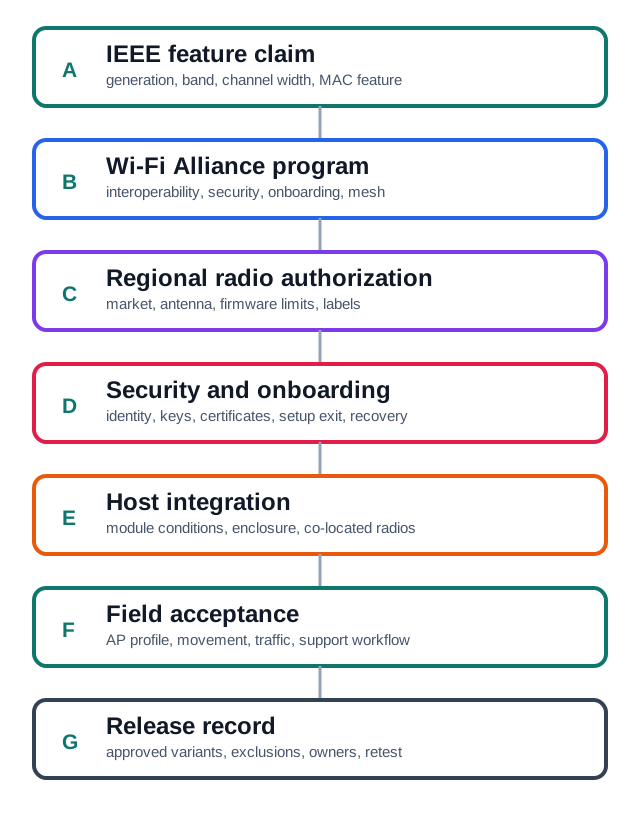
The IEEE writes the 802.11 standard, the Wi-Fi Alliance runs certification programs for interoperability, and government regulators authorize transmission within market-specific rules.

  • The first three lanes answer specification, interoperability, and legal-transmission questions; none proves that the assembled IoT product works safely in its installed service.
  • That separation also protects maintenance.
Wi-Fi evidence lanes separate IEEE feature claims, Wi-Fi Alliance programs, and regional radio authorization from security, host integration, field acceptance, and release control.
iotclass.org

Major section

Standard, Certification, and Regulation Are Three Things (continued)

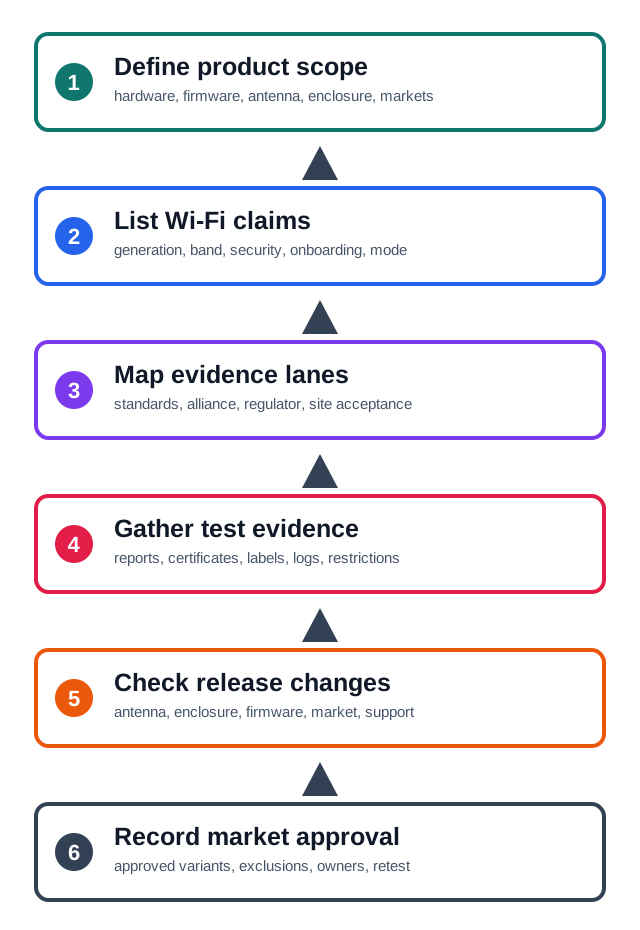
The map connects institutional evidence to the chapter's bounded-release rule: each claim needs its own artifact, scope, owner, and retest trigger.

  • The review record should name the evidence lane, the artifact, and the product scope.
  • For example, a WPA3 claim may point to a Wi-Fi Alliance program result, while legal shipment points to a market authorization report tied to a specific antenna, enclosure, firmware lock, label, and user instruction set.
  • The same product can pass one lane and remain unapproved in another.
iotclass.org

Major section

Generation Names and Feature Certifications

An IoT device datasheet that says “Wi-Fi 6, WPA3, Easy Connect” is claiming three separate certifications.

  • The row should say whether the capability is implemented in the device, certified by a named program, enabled in the shipping firmware, allowed in the target markets, and validated with the intended AP or controller profile.
  • A feature that is only present in the chipset data sheet is not the same as a feature approved in the final product.
  • The release record should state which host variants inherit module evidence and which variants need another lab or engineering review.
iotclass.org

Major section

Regulatory Domains, EIRP, and DFS Compliance

Regulatory rules are what actually constrain a shipping radio, and they differ by region.

  • A device carries a regulatory domain that sets which channels it may use and at what EIRP (equivalent isotropically radiated power).
  • DFS is a hard compliance requirement, not a feature toggle: on those channels a device must perform a channel-availability check before transmitting and must vacate within seconds if it detects radar.
  • The practical control is a release-state ledger.

Numbers to remember

5 GHzsold for the US enables 5 GHz channels
iotclass.org

Major section

Regulatory Domains, EIRP, and DFS Compliance (continued)

If those controls move from factory firmware to cloud policy or installer tooling, the compliance evidence must move with them.

  • For a real product, the authority is the current regulator record, test-lab report, certification program result, and the exact product configuration being shipped.
  • The chapter can teach the review pattern; the release file must carry the current market-specific facts.
  • Worked example.: An access point tested and sold for the US enables 5 GHz channels and power levels the FCC allows.
iotclass.org

Deck summary

Key takeaways

Wi-Fi certification has three evidence lanes.

  • The goal is not to memorize every program name or channel table.
  • The IEEE writes the 802.11 standard, the Wi-Fi Alliance runs certification programs for interoperability, and government regulators authorize transmission within market-specific rules.
  • The map connects institutional evidence to the chapter's bounded-release rule: each claim needs its own artifact, scope, owner, and retest trigger.
  • An IoT device datasheet that says “Wi-Fi 6, WPA3, Easy Connect” is claiming three separate certifications.
iotclass.org

Retrieval practice

Recall check 1 of 6

Radio Remi says: answer from memory, then check your reasoning.

Q1Wi-Fi certification work has three distinct evidence lanes. Which set names them correctly?

AMarketing approval, sales approval, and legal sign-off
BIEEE 802.11 standards, Wi-Fi Alliance certification.
COnly the Wi-Fi Alliance logo program by itself
DOnly the retailer's shelf-listing requirements
Show answer

Answer: B Wi-Fi certification spans IEEE 802.11 standards, Wi-Fi Alliance certification, and regional radio authorization.

iotclass.org

Retrieval practice

Recall check 2 of 6

Radio Remi says: answer from memory, then check your reasoning.

Q2A product team says a Wi-Fi module certificate proves the finished sensor can ship in every target market. What is the strongest review response?

AAccept it if the finished sensor uses the same module part number shown on the certificate.
BRequest a complete new radio test campaign before reviewing the supplied module certificate or its integration conditions.
CCheck whether the host uses the approved antenna, enclosure conditions, firmware controls.
DApprove the product if it connects to a test AP in the office.
Show answer

Answer: C Certification evidence must be tied to the final product configuration, not only to a radio component.

iotclass.org

Retrieval practice

Recall check 3 of 6

Radio Remi says: answer from memory, then check your reasoning.

Q3A fleet requires individual device removal after loss or return. Which security evidence is most relevant?

AA shared WPA-Personal passphrase printed in the installation guide.
BA higher headline Wi-Fi generation number.
CA stronger local signal measurement at the device location.
DPer-device identity with enrollment and revocation evidence.
Show answer

Answer: D Security approval should include the identity lifecycle, not only the access method name.

iotclass.org

Retrieval practice

Recall check 4 of 6

Radio Remi says: answer from memory, then check your reasoning.

Q4What does Wi-Fi Alliance 'Wi-Fi CERTIFIED' testing primarily verify?

AThat the device has legal transmit approval in every market.
BThat claimed Wi-Fi features interoperate with certified gear.
CThat the IEEE 802.11 standard text needs no revision.
DThat the product delivers the highest possible throughput.
Show answer

Answer: B The Wi-Fi Alliance certifies interoperability and feature support; it does not write the standard or grant legal transmission rights.

iotclass.org

Retrieval practice

Recall check 5 of 6

Radio Remi says: answer from memory, then check your reasoning.

Q5A datasheet lists 'Wi-Fi 6, WPA3, Wi-Fi Easy Connect.' What does that imply about certification?

AThey are separate certifications for radio, security, and onboarding.
BWPA3 and Easy Connect are automatically granted once Wi-Fi 6 passes.
CWi-Fi 6 is a regulatory approval, not a certification.
DAll three refer to the same IEEE amendment.
Show answer

Answer: A Generation, security, and feature programs (such as onboarding) are distinct and each is tested independently; a product certifies each capability it claims.

iotclass.org

Retrieval practice

Recall check 6 of 6

Radio Remi says: answer from memory, then check your reasoning.

Q6Why must a Wi-Fi device lock its channels and power to a regulatory domain even if it is Wi-Fi CERTIFIED?

ABecause the certification test fixes a global power and channel profile.
BRegulators set region-specific channel, EIRP, and DFS rules.
CBecause channel numbers mean different frequencies in each country.
DBecause DFS radar checks can substitute for regional power limits.
Show answer

Answer: B Certification and regulatory approval are separate; the radio must respect local EIRP and DFS rules to be legal.

iotclass.org

Print reference

Answers 1 of 2

Answer key.

  1. B · Wi-Fi certification spans IEEE 802.11 standards, Wi-Fi Alliance certification, and regional radio authorization.
  2. C · Certification evidence must be tied to the final product configuration, not only to a radio component.
  3. D · Security approval should include the identity lifecycle, not only the access method name.
  4. B · The Wi-Fi Alliance certifies interoperability and feature support; it does not write the standard or grant legal transmission rights.
iotclass.org

Print reference

Answers 2 of 2

Answer key.

  1. A · Generation, security, and feature programs (such as onboarding) are distinct and each is tested independently; a product certifies each capability it claims.
  2. B · Certification and regulatory approval are separate; the radio must respect local EIRP and DFS rules to be legal.
iotclass.org