Wi-Fi & 802.11 · Study deck
Wi-Fi 6E and Wi-Fi 7 for IoT
Use a simple upgrade review.
Radio Remi is your guide for this deck.

After studying this chapter
Learning objectives
You will be able to:
- explain what Wi-Fi 6E and Wi-Fi 7 change for IoT deployments
- separate 6 GHz spectrum evidence from ordinary Wi-Fi upgrade claims
- decide when Target Wake Time, OFDMA, Multi-Link Operation, wider channels, and preamble puncturing matter
- identify why 6 GHz coverage and client support must be tested in the installed environment
Major section
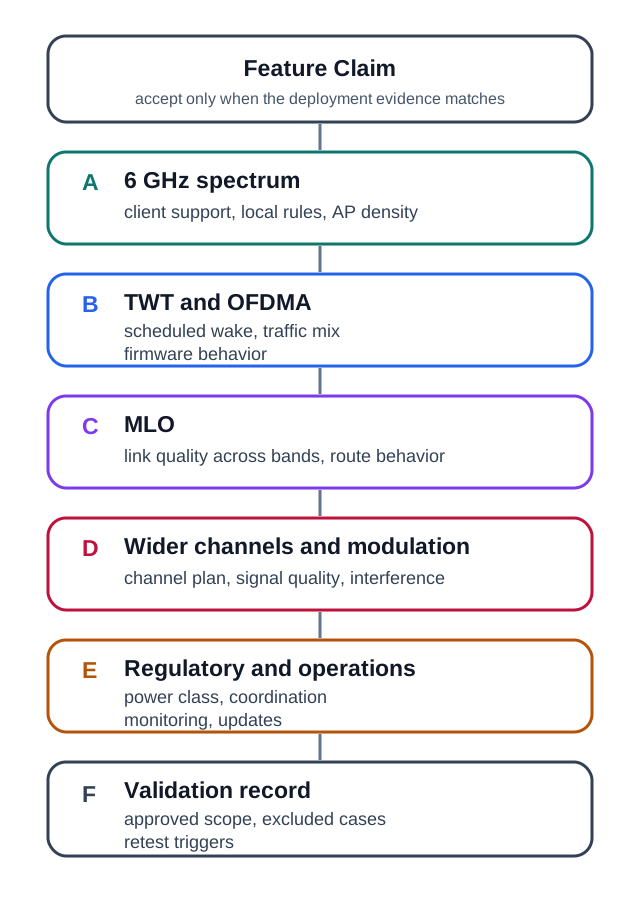
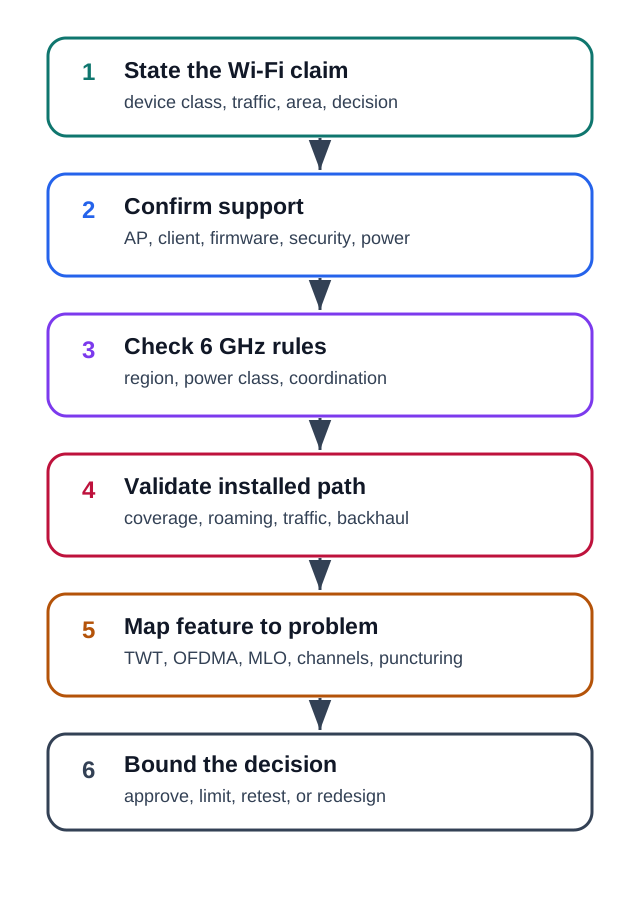
Evidence Route
The route prevents a feature name from substituting for an end-to-end result.
- Local 6 GHz power and location rules constrain which design can be installed.
- The named feature is accepted last, after a controlled comparison shows that it improves the original service or power problem under those installed conditions.
Major section
Feature Evidence Map
This turns a standards feature into a bounded deployment claim that can be retested.
- The map is walked feature by feature.
- Wider channels and higher modulation are then tested against interference, signal quality, and wired backhaul rather than assumed to raise application capacity.
- Regulatory coordination and power class remain gates throughout.
Major section
Scenario 3: Mobile Robot Control
Claim: Wi-Fi 7 MLO is enough to approve wireless control for mobile robots.
- MLO is a useful candidate feature, not an approval by itself.
- The review must test each robot route with the real AP layout, traffic mix, motion pattern, and failure behavior.
- If the control loop needs bounded latency under faults, the recommendation may require a separate control network, wired safety layer, private cellular path, or application-level fallback in addition to Wi-Fi.
Major section
A New Band and Two New Generations
Wi-Fi 7 (802.11be) is the next step on the same bands, chasing extreme throughput and low latency with wider channels, denser modulation, and the ability to use several links at once.
- For IoT the headline is not peak speed but the room to breathe: clean 6 GHz spectrum and more efficient multiplexing reduce the contention that hurts dense sensor fleets.
- The installed decision still starts with the same evidence discipline as any other wireless choice.
- A 6 GHz-capable product must be paired with AP radios, firmware, security policy, and local rules that allow the band in the intended deployment.
Major section
OFDMA and Resource Units
The efficiency feature Wi-Fi 6/6E brought for many small devices is OFDMA (orthogonal frequency-division multiple access).
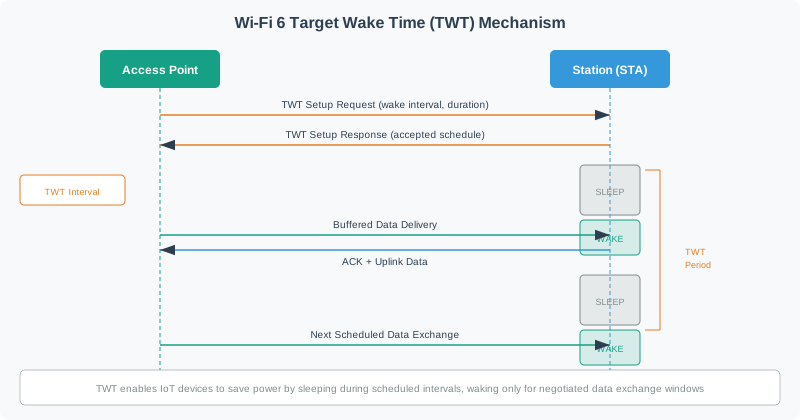
- Target Wake Time bounds when the client should contend or receive, while OFDMA can divide the available transmission opportunity among several clients.
- Target Wake Time is the matching power-side record.
Major section
Wi-Fi 7's 320 MHz, 4096-QAM, and Multi-Link
Preamble puncturing lets an AP still use a wide channel when a slice of it is occupied, by “punching out” the busy sub-channel instead of abandoning the whole width.
- For an industrial controller, MLO's reliability mode — sending on two bands so a hit on one does not stall the flow — can matter more than raw speed.
- That benefit is conditional.
- Channel width and modulation need the same boundary.
Major section
Wi-Fi 7's 320 MHz, 4096-QAM, and Multi-Link (continued)
A design that aggregates links for video throughput should also prove wired backhaul, switch capacity, and airtime isolation.
- A design that duplicates control frames should prove the failure behavior: which traffic is duplicated, how duplicates are handled, what latency tail was measured, and what fallback occurs when one band disappears.
- A 320 MHz channel can be a poor choice in a crowded or partially blocked environment if it reduces reuse or hides a backhaul limit.
- 4096-QAM is a close, clean-link feature; it is not an argument for distant battery nodes.
Major section
Wi-Fi 7's 320 MHz, 4096-QAM, and Multi-Link (continued)
Preamble puncturing is useful only when the interference pattern is known and the remaining channel still meets the application requirement.
- Worked example.: A robot on a busy 5 GHz channel suffers occasional latency spikes when the channel is grabbed by video traffic.
- With Wi-Fi 7 MLO it also links on 6 GHz; the controller duplicates latency-critical frames across both links, so a spike on 5 GHz is masked by the 6 GHz copy.
- The win is not a bigger number — it is a tighter latency tail from using two links at once.
Major section
Summary
Wi-Fi 6E and Wi-Fi 7 are valuable IoT tools when their features solve a measured problem.
- 6 GHz can provide cleaner spectrum and more planning room for capable clients.
- Wi-Fi 7 can improve multi-link behavior, channel flexibility, and high-quality link capacity.
- Those benefits are not automatic.
Deck summary
Key takeaways
The route prevents a feature name from substituting for an end-to-end result.
- This turns a standards feature into a bounded deployment claim that can be retested.
- Claim: Wi-Fi 7 MLO is enough to approve wireless control for mobile robots.
- Wi-Fi 7 (802.11be) is the next step on the same bands, chasing extreme throughput and low latency with wider channels, denser modulation, and the ability to use several links at once.
- The efficiency feature Wi-Fi 6/6E brought for many small devices is OFDMA (orthogonal frequency-division multiple access).
Retrieval practice
Recall check 1 of 6

Radio Remi says: answer from memory, then check your reasoning.
Q1A team says Wi-Fi 7 APs will automatically improve every battery-powered sensor in a building. What is the strongest review response?
Show answer
Answer: D Wi-Fi generation upgrades do not automatically improve every IoT device.
Retrieval practice
Recall check 2 of 6

Radio Remi says: answer from memory, then check your reasoning.
Q2A powered vision gateway supports 6 GHz and sends high-rate bursts to local compute. What evidence is still needed before approving Wi-Fi 6E or Wi-Fi 7?
Show answer
Answer: A A high-rate Wi-Fi 6E/7 IoT design must validate the complete path from client and RF coverage through AP, channel plan, wired uplink, and traffic policy.
Retrieval practice
Recall check 3 of 6

Radio Remi says: answer from memory, then check your reasoning.
Q3A robotics team says Wi-Fi 7 MLO is enough to approve wireless control because it can use multiple links. What is the best review response?
Show answer
Answer: B Wi-Fi 7 MLO should be reviewed as a candidate feature.
Retrieval practice
Recall check 4 of 6

Radio Remi says: answer from memory, then check your reasoning.
Q4What most distinguishes the 6 GHz band used by Wi-Fi 6E from the 2.4 GHz band?
Show answer
Answer: C Excluding legacy devices keeps 6 GHz clean and gives Wi-Fi 6E lots of non-overlapping wide channels.
Retrieval practice
Recall check 5 of 6

Radio Remi says: answer from memory, then check your reasoning.
Q5Why does OFDMA (Wi-Fi 6) help a dense fleet of IoT sensors sending small frames?
Show answer
Answer: D OFDMA packs multiple small transmissions into RUs of a single frame, which is ideal for many tiny IoT payloads.
Retrieval practice
Recall check 6 of 6

Radio Remi says: answer from memory, then check your reasoning.
Q6How can Wi-Fi 7's Multi-Link Operation (MLO) help a latency-sensitive IoT device rather than just raising throughput?
Show answer
Answer: A MLO's reliability mode uses simultaneous links to tighten the latency tail, valuable for control traffic.
Print reference
Answers 1 of 2
Answer key.
- D · Wi-Fi generation upgrades do not automatically improve every IoT device.
- A · A high-rate Wi-Fi 6E/7 IoT design must validate the complete path from client and RF coverage through AP, channel plan, wired uplink, and traffic policy.
- B · Wi-Fi 7 MLO should be reviewed as a candidate feature.
- C · Excluding legacy devices keeps 6 GHz clean and gives Wi-Fi 6E lots of non-overlapping wide channels.
Print reference
Answers 2 of 2
Answer key.
- D · OFDMA packs multiple small transmissions into RUs of a single frame, which is ideal for many tiny IoT payloads.
- A · MLO's reliability mode uses simultaneous links to tighten the latency tail, valuable for control traffic.