Connected Health and Wearables · Study deck
Wearable IoT: Placement and Adoption Evidence
A wrist sensor that moves or irritates skin will produce weak data and poor use.
Ada is your guide for this deck.

After studying this chapter
Learning objectives
You will be able to:
- Explain: Quick Decision Framework: When evaluating wearable design, ask: "Would a user still wear this after a week?" If comfort, battery, or aesthetics fail the daily wear test, no amount of sensor accuracy matters.
- Explain: Must be comfortable: Discomfort can discourage use; Endeavour Partners’ 2014 survey found roughly one-third of studied wearable consumers stopped use within six months, without isolating comfort as the cause. (survey).
- Explain: I'm not as accurate as the machines at the hospital, but I can tell Sammy if she's sleeping better or worse than last week.".
Major section
Key Concepts
Photoplethysmography (PPG): Optical heart rate sensing detecting blood volume changes under the skin using an LED and photodetector.
- Continuous Glucose Monitor (CGM): Subcutaneous sensor measuring interstitial glucose every 5 minutes, eliminating finger-prick tests for diabetes management.
- Form Factor Constraint: Physical size and weight limit that directly constrains battery capacity, sensor count, and achievable battery life.
- Wearable IoT represents one of the fastest-growing consumer technology markets, with a projected $1.6 trillion business opportunity (Morgan Stanley).
Major section
Wearables Basics
Wearables are IoT devices you wear on your body - smartwatches, fitness trackers, smart glasses, health monitors.
- Must be comfortable: Discomfort can discourage use; Endeavour Partners’ 2014 survey found roughly one-third of studied wearable consumers stopped use within six months, without isolating comfort as the cause. (survey).
- Data privacy: Biometric data (heart rate, location, sleep) is deeply personal.
- Key Lesson: Wearables must solve the "wear test" - if users take it off after a week, all the smart features are worthless.
Major section
MVU: Minimum Viable Understanding
Device-specific validation: Wearable sensor performance depends on the device, task, population, and reference method.
- Validate every trend metric against the reference method and communicate its limits.
- Quick Decision Framework: When evaluating wearable design, ask: "Would a user still wear this after a week?" If comfort, battery, or aesthetics fail the daily wear test, no amount of sensor accuracy matters.
- Validate Trends Separately: A rolling average can reduce some random variation, but it does not automatically correct bias or classification errors.
Major section
For Kids: Meet the Sensor Squad!
She didn't need to know the exact minutes.
- Wearable sensors are like tiny superheroes riding on your wrist -- they watch over you all day and night!
- Sammy just got a brand new smartwatch, and the tiny sensors inside were SO excited for their first day on the job!
- That's what we do best!".
Major section
For Kids: Meet the Sensor Squad! (continued)
During PE class, Sammy started running, and Steppy the Accelerometer bounced with excitement. "I can feel EVERY movement!
- Heartbeat Harry (the PPG sensor) was a tiny light that glowed green against Sammy's wrist. "I shine a green light through your skin and watch how it bounces back!
- When your heart beats, more blood flows through, and my light changes a tiny bit.
- When Sammy's arm swings forward -- that's one step!
Major section
For Kids: Meet the Sensor Squad! (continued)
I count every single heartbeat -- that's how I know your heart rate is 72 beats per minute right now.
- But I have to be honest -- sometimes when Sammy waves her arms while talking, I accidentally count those as steps too.
- When Sammy stops moving AND her heart slows down, I know she's falling asleep.
- If Sammy turns on GPS for a run, I'll be empty by lunchtime!".
Major section
For Kids: Meet the Sensor Squad! (continued)
I'm not as accurate as the machines at the hospital, but I can tell Sammy if she's sleeping better or worse than last week.".
- By morning, Battery Bob was getting worried. "I started at 100% yesterday, but all that sensing used up my energy!
- I'll keep going to bed at the same time!".
- She just needed to know the TREND is going up.
Major section
Wearables Must Pass the Wear Test
Sensors, dashboards, and models are secondary to comfort, battery life, trust, privacy, and a clear reason to keep the device on the body.
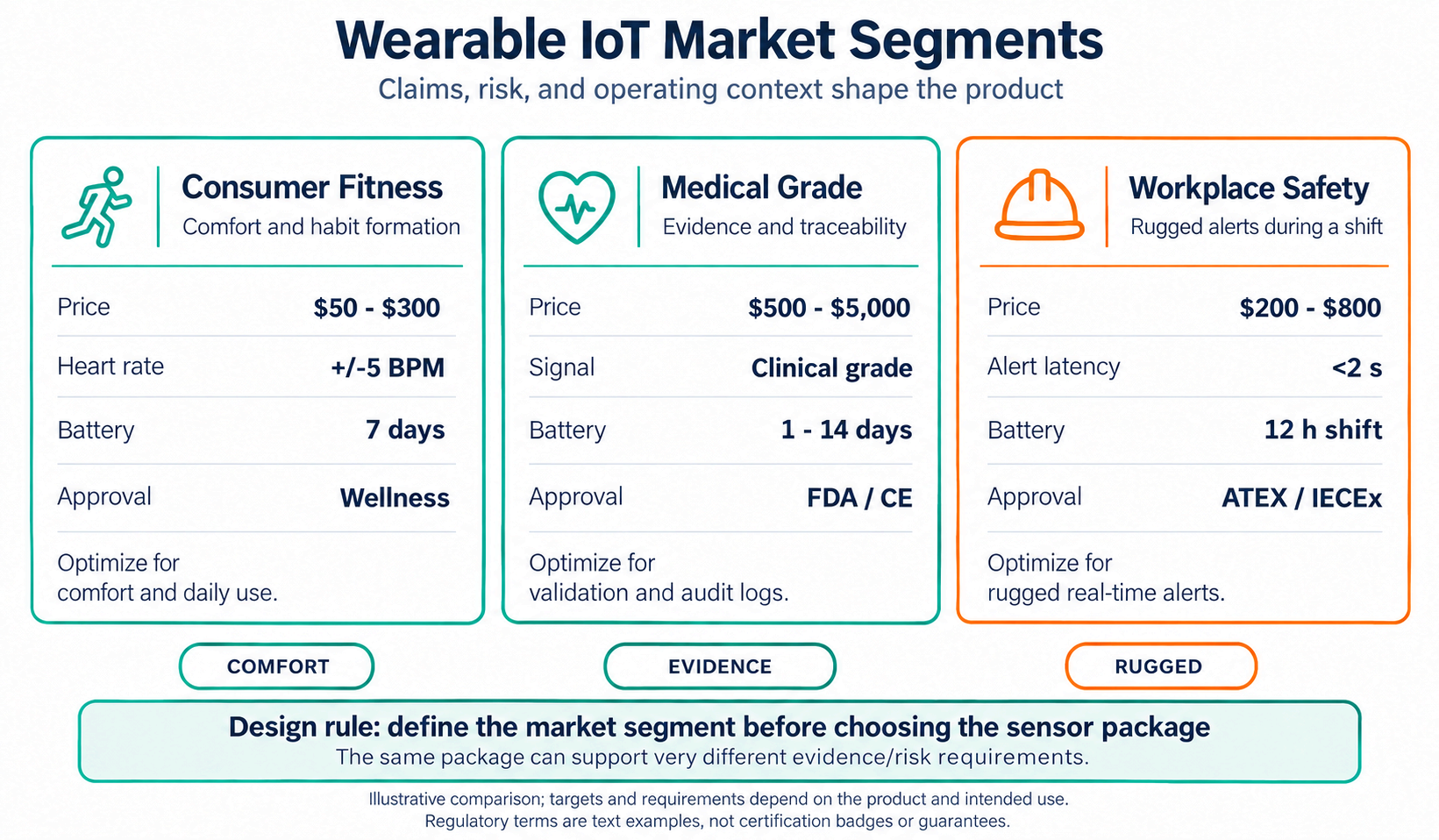
- The answer determines sensor placement, validation depth, user messaging, and regulatory risk.
- The wear test has several parts.
- Accuracy also depends on where the device sits on the body.
Major section
Wearables Must Pass the Wear Test (continued)
A watch, ring, patch, chest strap, earbud, textile, or CGM can all collect useful data, but each placement changes accuracy, social acceptability, charging habits, skin contact, and what claims the product can safely make.
- Behavioral comfort covers charging routines, notification load, setup effort, and whether the device makes the user feel monitored rather than supported.
- Social comfort covers appearance, workplace acceptability, cultural expectations, and whether a visible health device reveals information the user would rather keep private.
- Wrist PPG is convenient but vulnerable to motion, loose fit, tattoos, skin tone, and cold-weather perfusion changes.
Major section
Wearables Must Pass the Wear Test (continued)
Chest ECG straps can capture cleaner cardiac signals but are less acceptable for all-day wear.
- Rings may improve overnight comfort for some users but have smaller batteries and different optical geometry.
- CGM patches measure interstitial glucose rather than blood glucose and need careful messaging about lag, alarms, and treatment decisions.
- For beginners, the key point is that wearables turn human adoption into an engineering requirement.
Major section
Match Sensors to Placement and Claim
The platform path may include BLE, ANT+, smartphone apps, Apple HealthKit, Google Health Connect, cloud APIs, HL7 FHIR for clinical integration, or a research export pipeline.
- A practitioner should run placement and artifact tests before polishing the app.
- Battery testing should use real feature combinations.
- Continuous PPG, SpO2, GPS, always-on display, haptics, audio, LTE, and frequent BLE sync can turn an advertised multi-day device into a daily-charge product.

Deck summary
Key takeaways
Photoplethysmography (PPG): Optical heart rate sensing detecting blood volume changes under the skin using an LED and photodetector.
- Wearables are IoT devices you wear on your body - smartwatches, fitness trackers, smart glasses, health monitors.
- Device-specific validation: Wearable sensor performance depends on the device, task, population, and reference method.
- She didn't need to know the exact minutes.
- During PE class, Sammy started running, and Steppy the Accelerometer bounced with excitement. "I can feel EVERY movement!
Retrieval practice
Recall check 1 of 3

Ada says: answer from memory, then check your reasoning.
Q1Users stop wearing a technically capable tracker after a week. What should the design team review first?
Show answer
Answer: A The wear test concerns whether people keep the device on their bodies.
Retrieval practice
Recall check 2 of 3
Ada says: answer from memory, then check your reasoning.
Q2Users want discreet night monitoring and dislike a wrist display. What should the design team compare?
Show answer
Answer: C Placement choice should be tested against both wearer preference and evidence.
Retrieval practice
Recall check 3 of 3
Ada says: answer from memory, then check your reasoning.
Q3A wrist device moves from wellness trends to a stronger care claim. What must its review reconsider?
Show answer
Answer: C The chapter links the supported action to form factor, evidence, and risk.
Print reference
Answers
Answer key.
- A · The wear test concerns whether people keep the device on their bodies.
- C · Placement choice should be tested against both wearer preference and evidence.
- C · The chapter links the supported action to form factor, evidence, and risk.