Actuators & Control · Study deck
Visual and Audio Actuators: Displays and Buzzers
An OLED can show rich detail but uses memory and a shared bus.
Motor Max is your guide for this deck.

After studying this chapter
Learning objectives
You will be able to:
- Explain: A 2 kHz passive-buzzer alert has a period of 1 / 2000 = 0.0005 s, or 500 microseconds; a 50% square wave is high for about 250 microseconds and low for about 250 microseconds.
- Explain: If a small OLED draws 20 mA from a 3.3 V rail while lit, the display load is 3.3 V x 0.020 A = 0.066 W.
- Explain: The first pixel reads its color instruction, then passes the rest of the message down the chain -- like a game of telephone, but it actually works perfectly!".
Major section
Musical Note Frequency Reference
Active buzzers have built-in oscillators, so the controller supplies an on/off command rather than an audio-frequency waveform.
- Applying rated power starts its internal oscillator and fixed tone; firmware controls timing and pattern, while a passive buzzer is required when pitch itself must carry information.

Major section
Bedside Feedback Actuators
Scenario: A team is designing bedside monitors for a clinical ward.
- Each monitor tracks several patient readings and must draw staff attention to urgent conditions while avoiding constant, low-value beeping.
- A local high-visibility LED or strobe is simpler to verify.
- That separation keeps urgent states noticeable while reducing unnecessary sound.
Major section
For Kids: Meet the Actuator Crew!
"Time for the Output Show!" announced the LED, glowing all the colors of the rainbow. "We're the actuators that you can SEE and HEAR!".
- She started dim, then slowly grew brighter and brighter. "Max controls my brightness with PWM -- the same trick he uses for motors!
- Even though there are 30 of us, Max only needs ONE wire to talk to all of us.
- I can even play songs!".
Major section
For Kids: Meet the Actuator Crew! (continued)
The first pixel reads its color instruction, then passes the rest of the message down the chain -- like a game of telephone, but it actually works perfectly!".
- "And I'm the screen!" said OLED Olivia, displaying a smiley face. "I can show Sammy's temperature readings, draw pictures, and even make progress bars.
- I use tiny organic light-emitting dots -- each pixel makes its own light, so I'm super bright and clear!".
- the battery whispered, "Just remember, all those pretty lights use MY energy.
Major section
Deep Dive: Feedback Loads, Perception, and Timed LEDs
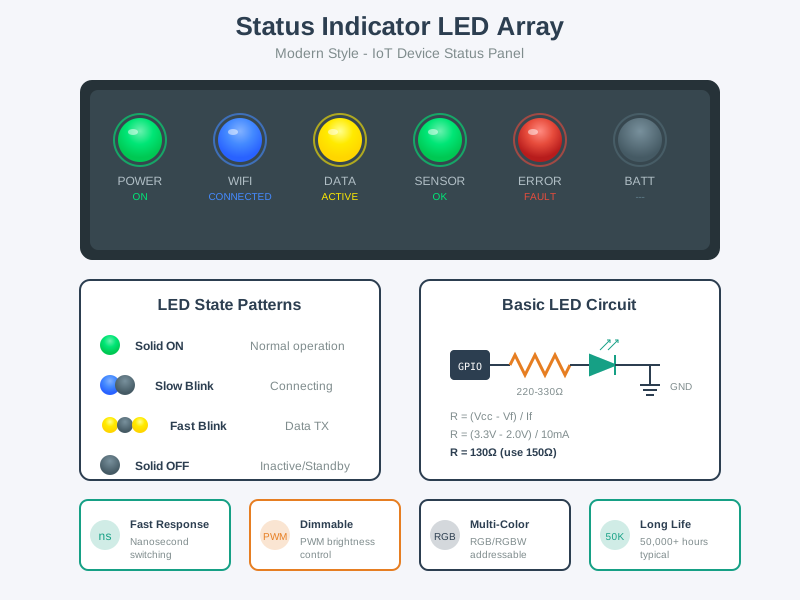
The panel encodes several user-facing states, while the companion circuit exposes the GPIO, resistor, LED, and return path that make each indication electrically safe.
- The panel decides what a person can distinguish; the resistor and return path decide whether the controller can drive the chosen LED safely.
- Displays need the same budget discipline.
Major section
Deep Dive: Feedback Loads, Perception, and Timed LEDs (continued)
That pairing connects perception, timing, and electrical load rather than treating feedback as decoration.
- LEDs, displays, and buzzers are simple only at the user interface.
- Electrically, each one still has a load path and a control signal.
- Choosing 150 ohms gives I = 1.3 / 150 = 0.0087 A, or 8.7 mA.
Major section
Deep Dive: Feedback Loads, Perception, and Timed LEDs (continued)
A buzzer interrupts attention, but repeated audio becomes annoying and may be masked by the environment.
- The resistor dissipates 1.3 V x 0.0087 A = 0.011 W, so a small signal resistor has margin.
- The design decision is not only electrical.
- Feedback actuators differ in noticeability, power, and information density.
Major section
Deep Dive: Feedback Loads, Perception, and Timed LEDs (continued)
Left on for 24 hours, that is 0.066 W x 24 h = 1.58 Wh before regulator losses.
- At 25% PWM duty cycle, the average LED current is about 8.7 mA x 0.25 = 2.2 mA.
- A single green LED is excellent for a healthy status, but poor for a fault that must be noticed across a room.
- On a small battery device, that can dominate the energy budget.
Major section
Deep Dive: Feedback Loads, Perception, and Timed LEDs (continued)
Strong products combine channels: quiet visual status for normal operation, stronger visual patterns for warnings, and audio only when the state needs immediate attention.
- If a small OLED draws 20 mA from a 3.3 V rail while lit, the display load is 3.3 V x 0.020 A = 0.066 W.
- Buzzers split into two kinds that are often confused.
- That timing issue is separate from the power issue.
Major section
Deep Dive: Feedback Loads, Perception, and Timed LEDs (continued)
A lower 500 Hz warning tone has a period of 1 / 500 = 0.002 s, or 2 ms.
- An active buzzer has an internal oscillator and produces one fixed tone when powered.
- A passive piezo or magnetic buzzer needs the controller to supply an audio-frequency waveform.
- The controller changes pitch by changing the period, not by changing the supply voltage.
Major section
Deep Dive: Feedback Loads, Perception, and Timed LEDs (continued)
A 2 kHz passive-buzzer alert has a period of 1 / 2000 = 0.0005 s, or 500 microseconds; a 50% square wave is high for about 250 microseconds and low for about 250 microseconds.
- Each pixel contains a driver chip, reads the first 24 bits as its green, red, and blue values, and forwards the rest downstream.
- A 30-pixel strip therefore needs 30 pixels x 24 bits = 720 bits, or 720 x 1.25 = 900 microseconds, plus the reset interval.
- An interrupt that pauses the GPIO waveform halfway through a bit can corrupt the data seen by every later pixel.
Major section
4. Active Buzzer and Passive Buzzer Confusion
Active buzzers contain an internal oscillator and produce a fixed tone when voltage is applied (just connect VCC and GND).
- Passive buzzers require an external oscillating signal.
- They look identical externally and share the same package styles.
- Testing with a DC supply: active buzzers beep immediately; passive buzzers are silent.
Deck summary
Key takeaways
Active buzzers have built-in oscillators, so the controller supplies an on/off command rather than an audio-frequency waveform.
- Scenario: A team is designing bedside monitors for a clinical ward.
- "Time for the Output Show!" announced the LED, glowing all the colors of the rainbow. "We're the actuators that you can SEE and HEAR!".
- The first pixel reads its color instruction, then passes the rest of the message down the chain -- like a game of telephone, but it actually works perfectly!".
- That pairing connects perception, timing, and electrical load rather than treating feedback as decoration.
Retrieval practice
Recall check 1 of 6

Motor Max says: answer from memory, then check your reasoning.
Q1What is the key difference between an active buzzer and a passive buzzer?
Show answer
Answer: B An active buzzer contains an oscillator and produces a fixed tone when powered.
Retrieval practice
Recall check 2 of 6

Motor Max says: answer from memory, then check your reasoning.
Q2How do addressable LED strips (NeoPixels/WS2812B) differ from regular RGB LEDs?
Show answer
Answer: B Each addressable pixel contains a small driver.
Retrieval practice
Recall check 3 of 6

Motor Max says: answer from memory, then check your reasoning.
Q3An IoT factory safety system needs to alert workers of a chemical leak. The alert must be perceivable in a noisy 95 dB environment where workers wear hearing protection. Which combination of actuators is most effective?
Show answer
Answer: C Critical alerts in noisy industrial spaces should not depend on one sensory channel.
Retrieval practice
Recall check 4 of 6

Motor Max says: answer from memory, then check your reasoning.
Q4A smart home uses RGB LED strips for ambient lighting. The system creates "sunrise" by gradually transitioning from dim red to bright white over 30 minutes. Using PWM with 8-bit resolution (256 levels), users report visible "steps" in brightness during the dim red phase. What causes this?
Show answer
Answer: A Human brightness perception follows a logarithmic (Weber-Fechner) law.
Retrieval practice
Recall check 5 of 6

Motor Max says: answer from memory, then check your reasoning.
Q5Complete the code to play a tone on a piezo buzzer:
Show answer
Answer: A A piezo buzzer uses PWM where freq() sets the tone pitch and duty(512) provides 50% duty cycle for maximum volume.
Retrieval practice
Recall check 6 of 6

Motor Max says: answer from memory, then check your reasoning.
Q6A chain of WS2812 addressable LEDs shows the first few pixels correctly but garbles colors further down the strip. What is the most likely cause?
Show answer
Answer: A WS2812 pixels use a clockless single-wire protocol that encodes bits by pulse width.
Print reference
Answers 1 of 2
Answer key.
- B · An active buzzer contains an oscillator and produces a fixed tone when powered.
- B · Each addressable pixel contains a small driver.
- C · Critical alerts in noisy industrial spaces should not depend on one sensory channel.
- A · Human brightness perception follows a logarithmic (Weber-Fechner) law.
- A · A piezo buzzer uses PWM where freq() sets the tone pitch and duty(512) provides 50% duty cycle for maximum volume.
Print reference
Answers 2 of 2
Answer key.
- A · WS2812 pixels use a clockless single-wire protocol that encodes bits by pulse width.