Design Methodology · Study deck
Virtual Hardware: Evidence Transfer
Saying code ran in a named tool is not test evidence.
Blueprint Bina is your guide for this deck.

After studying this chapter
Learning objectives
You will be able to:
- Explain: For: Transfer From Simulation to Hardware, these labelled responsibilities give A simulation pass should feed a controlled hardware-transfer gate, not replace it its place in the running narrative.
- Explain: A first virtual run might use an ESP32 or Arduino Uno in Wokwi with a DHT22 or DS18B20-style temperature input, one LED, and serial logging.
- Explain: Those advantages do not establish supply stability, sensor accuracy, pull-up sizing, interrupt jitter, radio coexistence, current peaks, thermal behavior, enclosure effects, or component variation.
- Explain: The better claim tests firmware handling and leaves sensor accuracy to calibration evidence.
Major section
Define the Model Boundary
Simulation quality depends on the model boundary.
- The model boundary describes what the simulator represents and what it leaves out.
- Expected order of transactions, device address use, command framing, and basic response handling.
- Display text, LED behavior, button state transitions, alarm states, and serial command flow.
Major section
Simulation Pass Is Not Release
Simulation can clear a development gate.
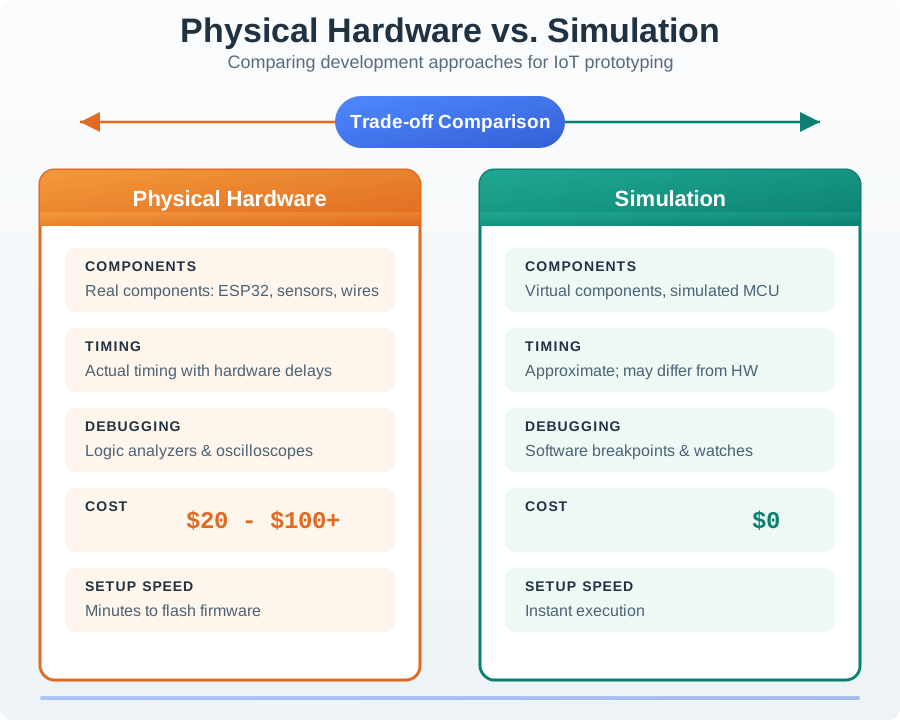
- The left Physical Hardware column names ESP32 boards, sensors, and wires, while the right: Simulation column uses virtual components and a simulated microcontroller; those are different evidence surfaces even when the same firmware logic runs.
- Those advantages do not establish supply stability, sensor accuracy, pull-up sizing, interrupt jitter, radio coexistence, current peaks, thermal behavior, enclosure effects, or component variation.
Try it: Simulation Pass Is Not Release in the chapter
Major section
Build a Repeatable Virtual Circuit
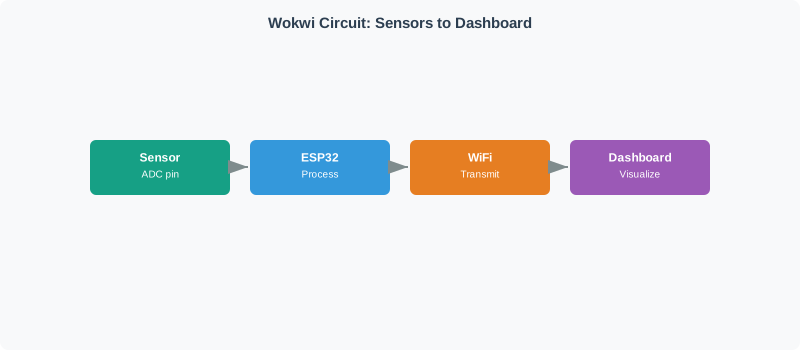
A virtual circuit should be treated like source code.
- It should be reviewable, versioned, and tied to a design assumption.
- This path can keep pin maps, source version, test inputs, logs, and pass notes repeatable.
- A reviewer needs the board target, build flags, wire names, test values, and link faults to repeat the run.
Major section
Build a Repeatable Virtual Circuit (continued)
The lower edge then limits the claim.
- A model can test control flow, but not ADC error, Wi-Fi behavior, current peaks, or the real screen link.
- Wiring Pin map Keep virtual wiring aligned with the schematic, datasheet pin names, board variant, pullup plan, and connector assignment.
- Evidence Run record Save logs, screenshots, waveform exports, pass/fail notes, and known limitations in the same run folder.
Major section
Interpret Simulation Evidence Carefully
The better claim tests firmware handling and leaves sensor accuracy to calibration evidence.
- Simulation evidence is strongest when the claim is phrased narrowly.
- "The firmware enters the fault state when the virtual I2C sensor is missing.".
- The better claim separates sequence evidence from physical timing evidence.
Try it: Interpret Simulation Evidence Carefully in the chapter
Major section
Transfer From Simulation to Hardware
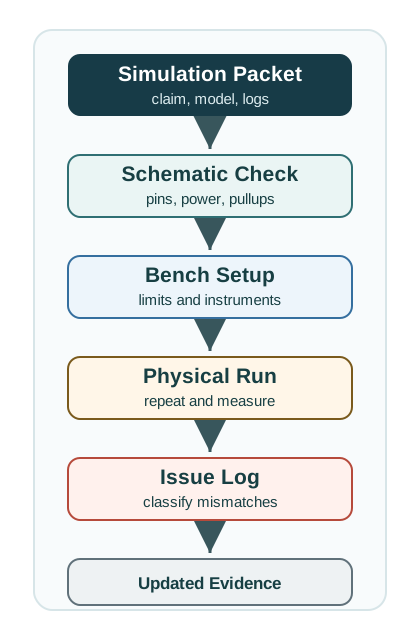
For: Transfer From Simulation to Hardware, these labelled responsibilities give A simulation pass should feed a controlled hardware-transfer gate, not replace it its place in the running narrative.
- Bench setup: Prepare power limits, serial logging, logic analyzer channels, sensor inputs, and safe actuator handling.
Try it: Transfer From Simulation to Hardware in the chapter
Major section
Incremental Examples
A first virtual run might use an ESP32 or Arduino Uno in Wokwi with a DHT22 or DS18B20-style temperature input, one LED, and serial logging.
- The simulation claim is narrow: the firmware enters normal, warning, alarm, and sensor-missing states and prints the expected diagnostic message.
- A Raspberry Pi Pico or RP2040 firmware build may use an I2C BME280 or SHT31 sensor model, an OLED display, and a button.
- The virtual circuit can test the pin map, state transitions, wrong I2C address handling, missing-device timeout, display text, and repeated button input.
Major section
Virtual Sensor Node Review
A team is building a small sensor node that reads a digital sensor, displays a status indicator, and sends an event to a gateway.
- The physical board is not ready, but firmware work can start.
- Virtual circuit uses the same named GPIO pins as the schematic draft and records the bus address.
- Serial log shows the node starts safely with sensor present, sensor absent, and invalid reading.
- Simulated disconnect produces retry limit, fault indicator, and no unsafe output.
Deck summary
Key takeaways
Simulation quality depends on the model boundary.
- For: Transfer From Simulation to Hardware, these labelled responsibilities give A simulation pass should feed a controlled hardware-transfer gate, not replace it its place in the running narrative.
- A first virtual run might use an ESP32 or Arduino Uno in Wokwi with a DHT22 or DS18B20-style temperature input, one LED, and serial logging.
Retrieval practice
Recall checks 1–2 of 3

Blueprint Bina says: answer from memory, then check your reasoning.
Q1What specifies the firmware behaviour a virtual hardware experiment is meant to test?
Show answer
Answer: B The claim states which firmware behavior the virtual experiment is intended to test.
Q2A virtual board simulation shows that firmware enters a fault state when a sensor is missing. Which conclusion is strongest?
Show answer
Answer: D Simulation evidence should be phrased by claim.
Retrieval practice
Recall check 3 of 3
Blueprint Bina says: answer from memory, then check your reasoning.
Q3A simulated waveform shows the intended order of SPI transactions. What must still be checked on physical hardware before release?
Show answer
Answer: B Simulation can show intended sequence and firmware behavior.
Print reference
Answers
Answer key.
- B · The claim states which firmware behavior the virtual experiment is intended to test.
- D · Simulation evidence should be phrased by claim.
- B · Simulation can show intended sequence and firmware behavior.