Human-Centred IoT Design · Study deck
IoT UX Pitfalls and Safer Patterns
Picture a person tapping a heater control twice because the first tap looks ignored.
UX Uma is your guide for this deck.
After studying this chapter
Learning objectives
You will be able to:
- Explain: In the state diagram Figure: Safer interface patterns expose current, Command state includes pending, failed, queued, and rejected, while: Device state separately covers offline, busy, low power, and unsafe.
- Explain: Users need to know what the system believes, where that state came from, how fresh it is, which role can act, and what recovery path is available.
- Explain: Command handlers should treat retry and duplicate suppression deliberately, especially for toggles, locks, pumps, heaters, and other controls where repeating an action changes the physical world.
- Explain: Pattern quality depends on the implementation exposing enough truth to the interface.
Major section
Start Simple
Latency means the delay between an action and its visible result.
- The deeper sections pair authority, feedback, recovery, consent, automation, and support pitfalls with safer patterns.
- “If a tired person at 2am can’t use it, the feature doesn’t exist yet — design for the worst moment, not the demo.”.
- Through this chapter, Uma pairs each pitfall with its safer pattern: where the state contract breaks, and what makes the fix provable.
Major section
Broken State Contracts
The app says a command was sent, but the device has not acted.
- A dashboard shows a green value, but the reading is stale.
- A voice assistant accepts a command, but the room or role is ambiguous.
- A support agent sees a different state name from the one the user sees.
- Safer patterns make the contract visible.
Major section
Broken State Contracts (continued)
Users need to know what the system believes, where that state came from, how fresh it is, which role can act, and what recovery path is available.
- The same pattern should work across local device controls, companion apps, dashboards, notifications, voice responses, and support tools.
- A pitfall review should therefore identify the broken contract before proposing screen changes.
- Dashboard overload often means the decision hierarchy is missing, not that the page needs smaller charts.
Major section
Broken State Contracts (continued)
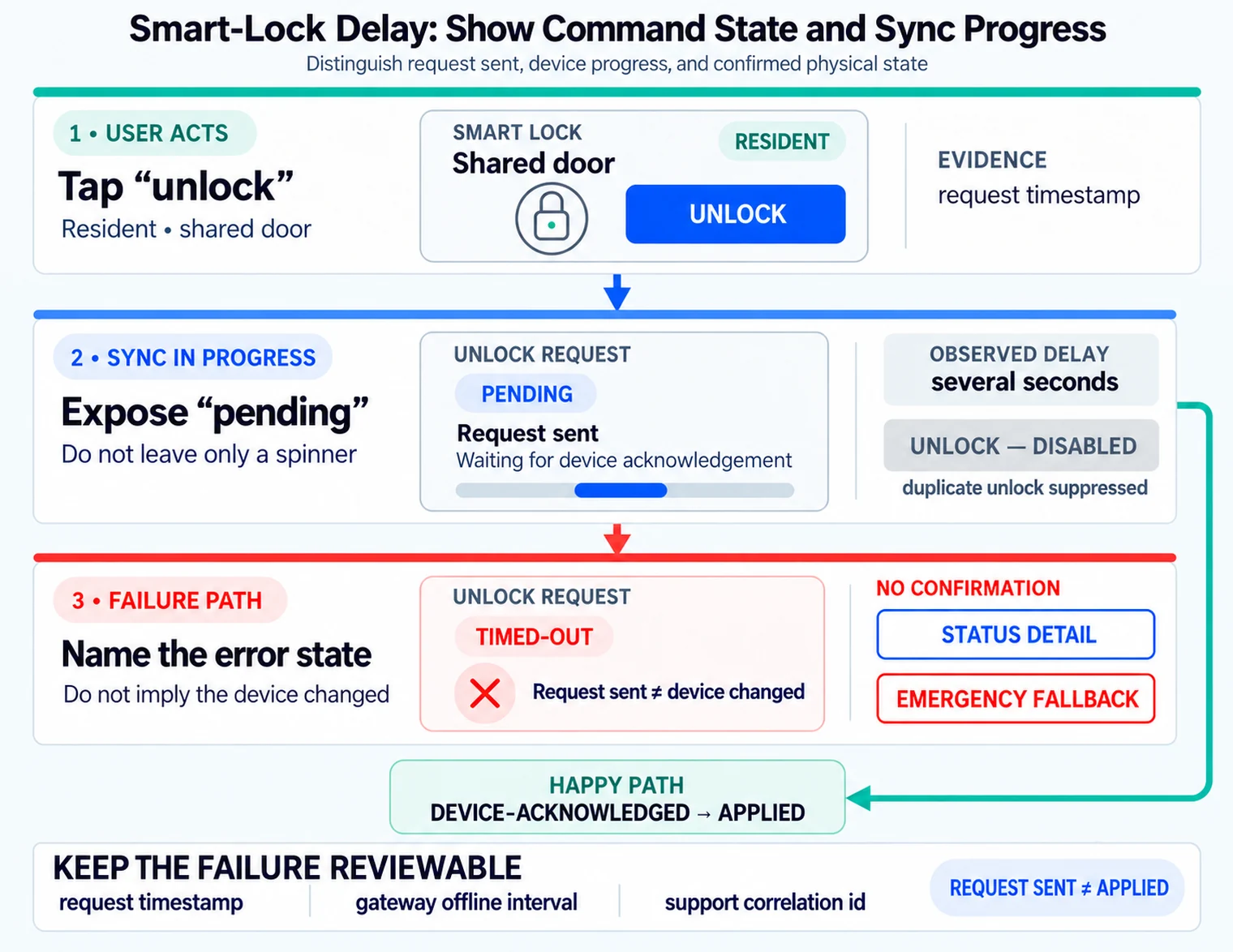
Latency denial means the command path needs distinct sent, pending, applied, failed, and duplicate-suppressed states.
- Permission confusion means sensing, control, sharing, retention, and revocation are not explained in task language.
- The safer pattern is the smallest repeatable rule that makes the next action reliable.
- For example, a stale reading should keep the last value visible while exposing timestamp, source, confidence, and recommended action.
Major section
Diagnose Before Choosing Patterns
For permission confusion, map what is sensed, controlled, shared, remembered, and revocable by role.
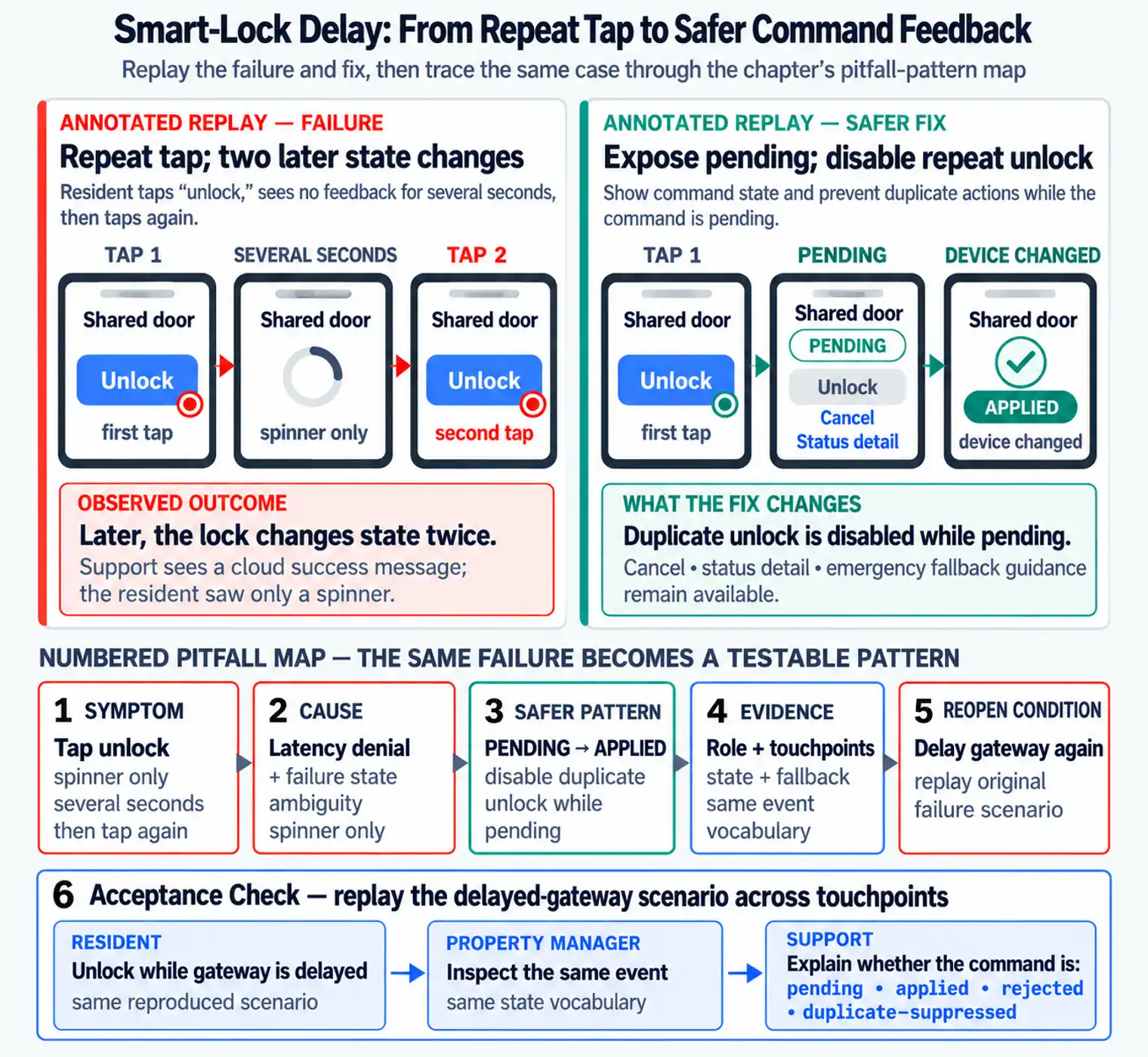
- If users tap twice, the cause might be missing pending feedback, a slow device path, an idempotency bug, a disabled button that has no explanation, or a cloud acknowledgement arriving before the device state changes.
- The safer pattern depends on the mechanism.
- If the pattern cannot be tested against the original scenario, it is still only a proposal.
Major section
Diagnose Before Choosing Patterns (continued)
For an alert-fatigue problem, inspect event threshold, duplicate suppression, quiet-hours handling, acknowledgement ownership, escalation rule, and whether the alert changes the next action.
- A practical triage row should include the affected role, entry context, surface, expected state, observed state, available fallback, accessibility path, privacy implication, and support vocabulary.
- A resident might use the app while a lock reader shows local feedback and support sees the same command id.
- A facility operator might acknowledge an urgent alert from a dashboard while a mobile notification changes state.
- A caregiver might pause reminders locally while the owner account sees who paused them and when they resume.
Major section
Safer Patterns Need Hooks
Pattern quality depends on the implementation exposing enough truth to the interface.
- The UI should consume those hooks as product states, not internal debris.
- A pending command can disable duplicate actions while still offering cancel or status details.
- A stale sensor value can keep the old reading visible while marking timestamp, source, and recommended action.
Major section
Safer Patterns Need Hooks (continued)
Device shadows or digital twins should distinguish desired state from reported state.
- A muted alert can show owner, duration, and escalation behavior.
- A support console can use the same state vocabulary as the app so users are not asked to translate engineering terms.
- Permission records should separate role, scope, device, location, expiry, revocation, and audit reason.
Major section
Safer Patterns Need Hooks (continued)
The contract needs stable names across firmware, cloud services, mobile code, dashboards, and support tooling.
- Event streams should carry sequence numbers or timestamps so the UI can ignore stale updates.
- Command handlers should treat retry and duplicate suppression deliberately, especially for toggles, locks, pumps, heaters, and other controls where repeating an action changes the physical world.
- Retention and access rules matter because the evidence that helps support diagnose a failure can also expose occupancy, health, or security behavior.
Major section
Diagnose Pitfalls First
A pitfall is a repeated design failure pattern.
- A state mismatch makes two surfaces report different truths, while a complex setup strands progress without a safe return point.
- The multi-user branch shows how one person's action can surprise another when ownership and history are hidden.
- Each path ends in frustration, but the corrective pattern differs.
Major section
Pitfall Pattern Map
A recurring interface failure should produce more than a warning in a design review.
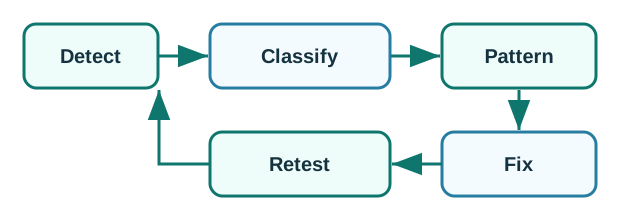
- In the state diagram Figure: Safer interface patterns expose current, Command state includes pending, failed, queued, and rejected, while: Device state separately covers offline, busy, low power, and unsafe.
Major section
Pitfall Triage Record
A resident taps unlock, sees only a spinner during a gateway delay, and taps again.
- The lock later changes state twice, while support sees a cloud success that does not explain the resident's view.
- The triage record keeps the affected role, context, severity, likely cause, and chosen pattern together.
- The fix needs a visible pending or confirmed command state and a way to avoid an unsafe repeat.
Major section
Incremental Examples
A dashboard shows many room sensors, equipment states, and alerts.
- Operators say the dashboard is accurate but hard to use.
- Fails when: the rule has a different name on the wall control, the app, and support — one role's pause looks like another role's silence.
- One-role design between resident, guest, property manager, installer, and support.
Major section
Common Mistakes When Applying Patterns
Pattern copying: using a pattern because it sounds familiar, not because it fits the symptom.
- False confirmation: showing "sent" as if it means "device changed.".
- One-role design: fixing the owner experience while ignoring guest, operator, maintainer, or support roles.
- No scenario follow-up: assuming a pattern works because it is a known pattern.
Deck summary
Key takeaways
Latency means the delay between an action and its visible result.
- The app says a command was sent, but the device has not acted.
- Users need to know what the system believes, where that state came from, how fresh it is, which role can act, and what recovery path is available.
- Latency denial means the command path needs distinct sent, pending, applied, failed, and duplicate-suppressed states.
- For permission confusion, map what is sensed, controlled, shared, remembered, and revocable by role.
Retrieval practice
Recall check 1 of 3
UX Uma says: answer from memory, then check your reasoning.
Q1A team is reviewing a delayed smart-lock command where users tap twice and the lock changes state twice. Which review record best supports a safer pattern?
Show answer
Answer: D A reviewable IoT UX decision ties the person, task, context, touchpoints, connected states, feedback, recovery, constraints, validation evidence, and stale-issue condition together before the design is trusted.
Retrieval practice
Recall check 2 of 3
UX Uma says: answer from memory, then check your reasoning.
Q2A user taps a smart light command, sees no response, taps again, and the light toggles twice. Which pattern best prevents this?
Show answer
Answer: D Latency denial is fixed by visible command states, confirmation, and recovery behavior.
Retrieval practice
Recall check 3 of 3
UX Uma says: answer from memory, then check your reasoning.
Q3A light responds slowly, so a resident taps twice and reverses the command. Which pattern addresses this?
Show answer
Answer: C Visible command state prevents uncertain repeated input.
Print reference
Answers
Answer key.
- D · A reviewable IoT UX decision ties the person, task, context, touchpoints, connected states, feedback, recovery, constraints, validation evidence, and stale-issue condition together before the design is trusted.
- D · Latency denial is fixed by visible command states, confirmation, and recovery behavior.
- C · Visible command state prevents uncertain repeated input.