RFID, NFC & UWB · Study deck
UWB Ranging Techniques
Picture a cart moving between two marked points while four systems report different distances.
Radio Remi is your guide for this deck.

After studying this chapter
Learning objectives
You will be able to:
- Explain: In SS-TWR, device A sends a poll, device B replies after a known processing delay, and A computes distance from the round-trip time minus B's reply delay.
- Explain: Subtracting leaves 20 ns for the round trip; halving gives 10 ns of one-way flight time, or about 3.0 m at 0.3 m per ns.
- Explain: Single-sided TWR assumes the responder delay measured on one device's clock is directly comparable with the elapsed time measured on the other device's clock.
- Explain why DS-TWR reduces sensitivity to clock-rate mismatch.
Major section
In 60 Seconds · Eddie's Math Bridge: Bandwidth And Ranging Resolution
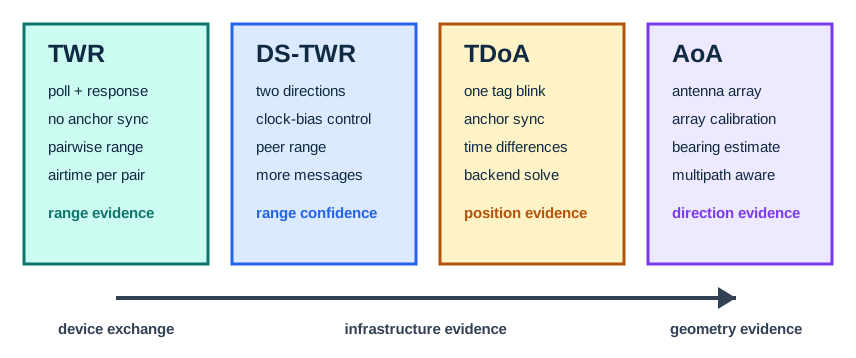
Two-way ranging (TWR) measures a round trip between two devices and subtracts responder delay.
- Double-sided TWR adds a reverse exchange so clock-rate error has less influence.
- Angle of arrival (AoA) uses antenna arrays to estimate direction and is usually combined with range or TDoA evidence.
Major section
Ranging Is Evidence · Method Choice Is a Clock and Airtime Budget
UWB does not directly output truth.
- It produces timestamp, channel, and geometry evidence that a positioning engine or application policy may use.
- TWR uses a poll and response for pairwise range without synchronizing all anchors, but each pair consumes airtime.
- TDoA: A tag blink is timestamped by synchronized anchors.
Major section
Two-Way Ranging
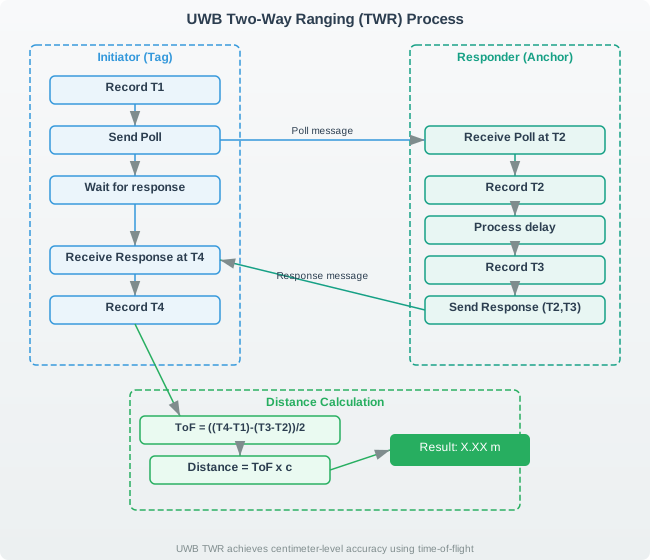
The responder delay is T3:T2.
- The initiator's elapsed time is T4:T1.
- where c is the speed of light in air for the required engineering precision.
- The initiator sends a poll at T1 and receives the response at T4.
Major section
Two-Way Ranging (continued)
The responder records receipt at T2 and reply at T3, so the calculation removes its processing delay from the round trip before estimating time of flight.
- A mathematically consistent exchange can still be biased by antenna delay or an obstructed path, so the application should use the range with a quality check.
- Subtracting leaves 20 ns for the round trip; halving gives 10 ns of one-way flight time, or about 3.0 m at 0.3 m per ns.
- Antenna delay, clock behavior, calibration, and channel quality must be checked before an application trusts the distance for access or safety.
Major section
Double-Sided TWR
Single-sided TWR assumes the responder delay measured on one device's clock is directly comparable with the elapsed time measured on the other device's clock.
- Small clock-rate differences can matter when reply delays are long or timing quality is weak.
- DS-TWR adds a reverse exchange or a final message so the ranging engine has timing measurements from both sides.
- DS-TWR does not make measurements perfect.
Major section
Time Difference of Arrival
TDoA changes the architecture.
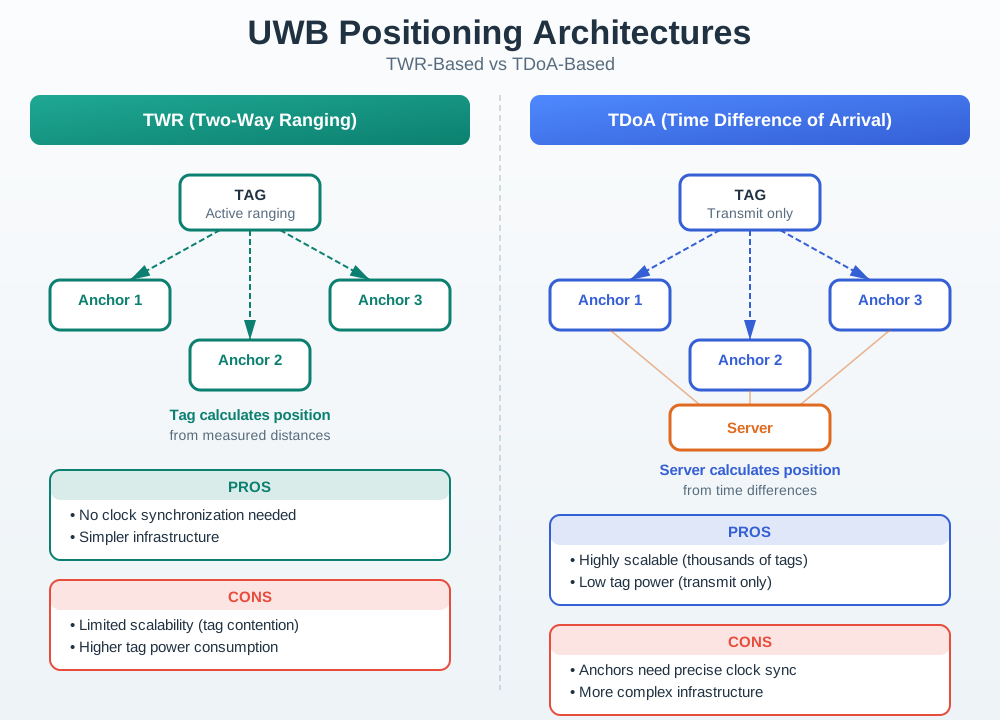
- The tag transmits a blink, and multiple anchors timestamp the arrival.
- The positioning engine compares arrival-time differences, so it can estimate a location from hyperbolic constraints.
- The tag does not need to range separately with every anchor, but the anchor network must maintain time alignment and good geometry.
Major section
Time Difference of Arrival (continued)
Poor geometry can amplify otherwise small timing errors.
- Poor synchronization directly becomes bad range-difference evidence.
- In TWR, the tag exchanges messages with anchors and can calculate ranges without a shared anchor clock, but many tags create contention and power cost.
- That changes the main risk from pairwise airtime to anchor timing and calibration.
Major section
Angle of Arrival · Measurement Quality
It also creates new failure modes: array calibration, device orientation, polarization, body blockage, and reflections can bias the angle estimate.
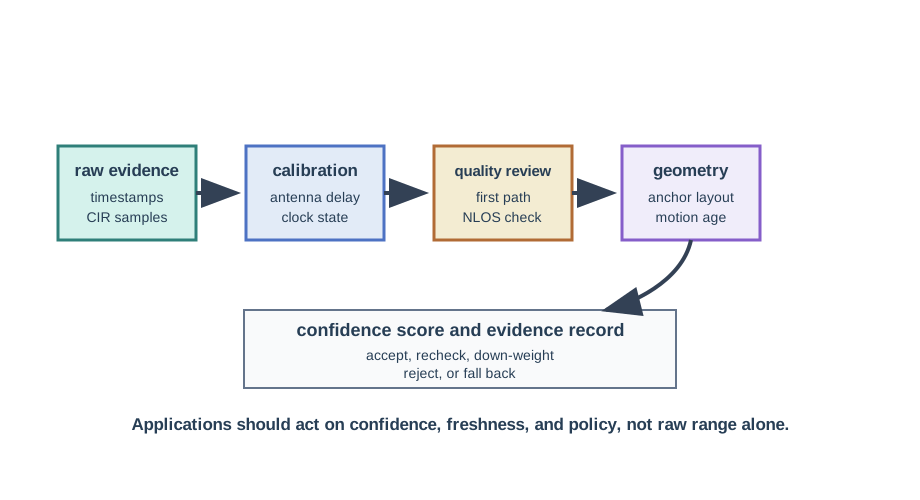
- Every ranging technique needs a quality gate before an application acts.
- Good systems do not only store a distance or coordinate; they store enough evidence to explain why the measurement was accepted, down-weighted, retried, or rejected.
Major section
Technique Selection · Example Selection Reasoning
A tool cabinet only needs to know whether one authorized device is near the correct side of the cabinet at checkout time.
- A factory-wide asset map with many tags may fit TDoA if the site can maintain synchronized anchors and confidence monitoring.
- A robot docking system might combine range with AoA if direction helps resolve approach angle.
- None of these choices is complete until the installed environment proves the evidence quality.
Major section
Capacity and Failure-Mode Review
Acceptance testing should mirror the decision.
- The practical split is two-way versus one-way timing.
- TWR needs a back-and-forth with each anchor, which costs airtime per tag but needs no synchronized infrastructure.
- A design review that names those checks is stronger than one that only cites an accuracy headline.
Major section
Clock Drift Error Budget · Common Pitfalls
In SS-TWR, device A sends a poll, device B replies after a known processing delay, and A computes distance from the round-trip time minus B's reply delay.
- The catch is that the reply delay is measured on B's clock while the round trip is measured on A's clock.
- Those crystals never run at exactly the same frequency.
- The cost is one more message and more energy per range.
Major section
Summary
TWR estimates distance from a bidirectional exchange and does not require synchronized anchors.
- TDoA can support managed multi-tag systems when synchronized anchors and backend quality monitoring are available.
- AoA adds direction evidence, usually as a complement to range or time-difference measurements.
- UWB ranging results should be handled as evidence with confidence, freshness, geometry, and fallback rules.
Major section
Key Takeaway · Concept Relationships
UWB ranging quality depends on timing method, anchor geometry, line of sight, multipath, calibration, and validation against the required accuracy.
- Wide bandwidth supports precise timestamp evidence.
- AoA adds direction evidence through antenna geometry.
- CIR review helps distinguish first-path evidence from reflections.
- Application policy decides whether evidence is strong enough to accept, retry, down-weight, or fall back.
Deck summary
Key takeaways
Two-way ranging (TWR) measures a round trip between two devices and subtracts responder delay.
- UWB does not directly output truth.
- The responder delay is T3:T2.
- The responder records receipt at T2 and reply at T3, so the calculation removes its processing delay from the round trip before estimating time of flight.
- Single-sided TWR assumes the responder delay measured on one device's clock is directly comparable with the elapsed time measured on the other device's clock.
Retrieval practice
Recall check 1 of 4

Radio Remi says: answer from memory, then check your reasoning.
Q1Many tags must send brief location signals. Which ranging approach needs synchronized anchors?
Show answer
Answer: D Its anchors compare timestamps from each tag signal.
Q2What does double-sided two-way ranging (DS-TWR) add over basic two-way ranging?
Show answer
Answer: C DS-TWR adds a reverse exchange so clock-rate error has much less influence on the distance estimate.
Retrieval practice
Recall check 2 of 4
Radio Remi says: answer from memory, then check your reasoning.
Q3A ranging trace has a strong late echo but a weak early path. What should the reviewer do?
Show answer
Answer: C A strong reflection may be later than the direct path.
Retrieval practice
Recall check 3 of 4
Radio Remi says: answer from memory, then check your reasoning.
Q4In a UWB TWR exchange, the initiator records T1 = 0 ns and T4 = 220 ns. The responder records T2 = 10 ns and T3 = 210 ns. Using c = 0.3 m/ns, what distance should the initiator calculate?
Show answer
Answer: A TWR subtracts responder delay, then divides the remaining round-trip flight time by two before converting to distance.
Retrieval practice
Recall check 4 of 4
Radio Remi says: answer from memory, then check your reasoning.
Q5An SS-TWR system shows a ranging error that grows with the responder's reply delay. What is the cause, and which method reduces it?
Show answer
Answer: A SS-TWR error comes from inter-device clock frequency offset scaling the responder's reply delay; DS-TWR times a round trip on each side and cancels the first-order offset, while TDoA instead needs synchronised anchors.
Print reference
Answers 1 of 2
Answer key.
- D · Its anchors compare timestamps from each tag signal.
- C · DS-TWR adds a reverse exchange so clock-rate error has much less influence on the distance estimate.
- C · A strong reflection may be later than the direct path.
- A · TWR subtracts responder delay, then divides the remaining round-trip flight time by two before converting to distance.
Print reference
Answers 2 of 2
Answer key.
- A · SS-TWR error comes from inter-device clock frequency offset scaling the responder's reply delay; DS-TWR times a round trip on each side and cancels the first-order offset, while TDoA instead needs synchronised anchors.