RFID, NFC & UWB · Study deck
How UWB Measures Distance
A forklift and a worker badge exchange precisely timed UWB packets so the system can estimate separation.
Radio Remi is your guide for this deck.

After studying this chapter
Learning objectives
You will be able to:
- Explain why UWB's wide bandwidth improves timing resolution without implying higher transmit power, given that regulators cap power spectral density rather than total power
- Convert a timing error into a range error using the c is approximately 0.3 m/ns rule for one-way and round-trip timing
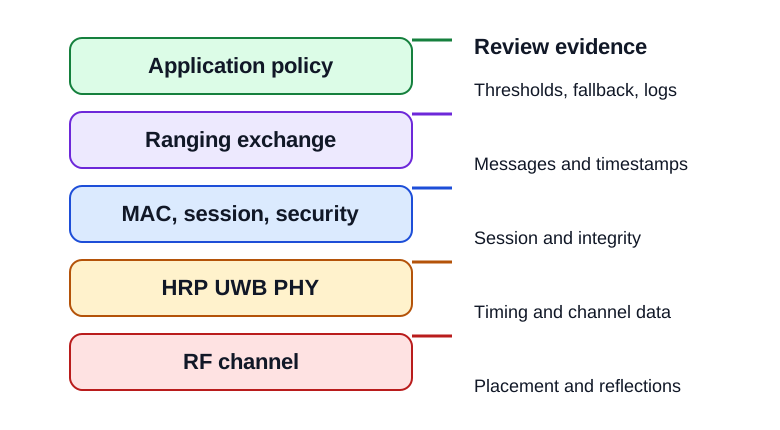
- Trace the UWB evidence chain from wideband signal to timing to range to position to application policy, and identify what each layer does and does not prove
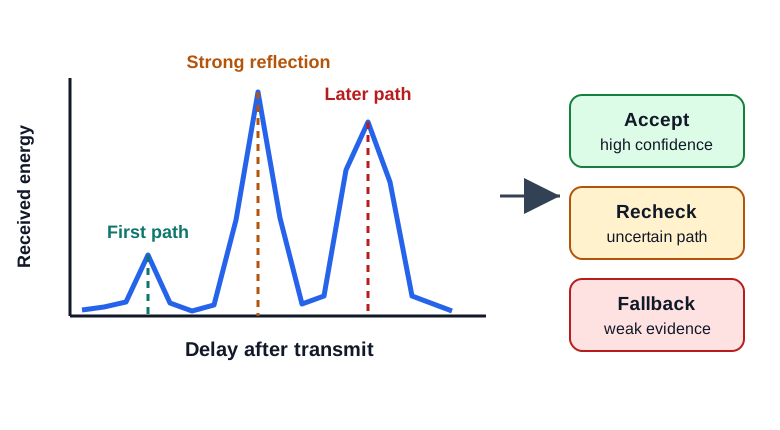
- Distinguish first-path timing evidence from a stronger multipath reflection when reviewing channel impulse response quality
Major section
Follow the First Path Into a Range Estimate
A broad signal supports finer separation of closely spaced arrivals, helping the receiver distinguish an early direct path from later reflections.
- In, follow packets and timestamps into time-of-flight, distance, and then position. Figure: UWB fundamentals should keep the evidence chain visible adds the evidence kept at each layer.
Major section
Follow the First Path Into a Range Estimate (continued)
A metal obstruction may weaken the direct arrival until a reflected path looks dominant; choosing that later peak inflates range.
- Distance from one-way time of flight is (d=c\Delta t).
- A measured 10 ns flight gives (3.0\times10^8\ \mathrm{m/s}\times10\times10^{-9}\ \mathrm{s}=3.0\ \mathrm{m}).
- Multiple well-positioned anchors provide intersecting constraints for location.
Major section
Follow the First Path Into a Range Estimate (continued)
Two-way ranging uses several timestamps to reduce clock-offset effects, so its exact formula must match the packet exchange.
- Poor geometry can amplify small range errors, especially when anchors lie nearly on one line or one side of the tag.
- UWB accuracy depends on radio, antenna delay calibration, anchor geometry, firmware, environment, and line of sight.
- The stack matters because a plausible coordinate can hide a weak first-path decision or unsynchronized anchor.
Major section
Start With the Story
Bandwidth is the span of radio frequencies used by a signal.
- The system must decide which door it passed, not just report that some radio energy was heard.
- A body, metal shelf, wall, poor clock, or reflected path can shift the result.
- This door story cannot make location automatic.
- The installed scene needs calibration and known failure rules.
Major section
Start With the Story (continued)
More fixed points can improve shape, yet they add cost, setup work, and more places for bad data.
- The deeper work explains the distance claim; it does not turn radio timing into magic.
- UWB is useful when distance evidence matters.
- A tag near a door, tool, forklift, phone, or robot is not just "near"; the system needs timing, channel quality, geometry, confidence, and security boundaries to make that claim meaningful.
Major section
Eddie's Math Bridge: Budget UWB First-Path Margin
Wide bandwidth is useful here because it changes time resolution, not because it promises a stronger transmitter.
- At 6,489.6 MHz and 10 m, free-space loss is 68.7 dB, leaving −83.0 dBm at the receiver: about 2 dB above a −85 dBm sensitivity.
Major section
Summary
Wide bandwidth supports fine timing evidence, but channel quality, antenna delay, mounting, obstruction, and firmware still shape the result.
- Range evidence becomes position only through geometry, calibration, synchronization or peer exchange, filtering, confidence handling, and retest discipline.
- Security-sensitive UWB decisions need secure-ranging context, freshness, confidence thresholds, fallback, logs, and ownership.
- A useful review record names the evidence boundary and the changes that reopen the decision.
Deck summary
Key takeaways
A broad signal supports finer separation of closely spaced arrivals, helping the receiver distinguish an early direct path from later reflections.
- A metal obstruction may weaken the direct arrival until a reflected path looks dominant; choosing that later peak inflates range.
- Two-way ranging uses several timestamps to reduce clock-offset effects, so its exact formula must match the packet exchange.
- Bandwidth is the span of radio frequencies used by a signal.
- More fixed points can improve shape, yet they add cost, setup work, and more places for bad data.
Retrieval practice
Recall check 1 of 3

Radio Remi says: answer from memory, then check your reasoning.
Q1A team says UWB is ready because one tag produced a precise-looking distance value during a demo. What should the review say?
Show answer
Answer: D One precise-looking value proves little; the review still needs timing, channel quality, calibration, geometry, confidence, policy, owner, and retest evidence.
Retrieval practice
Recall check 2 of 3

Radio Remi says: answer from memory, then check your reasoning.
Q2A UWB asset tracker works in an open lab, but the production site has metal racks, moving people, and different tag mounting. What evidence is missing before approval?
Show answer
Answer: D The gap is installed geometry and channel evidence: anchor positions, tag mounting, line-of-sight quality, multipath indicators, confidence handling, fallback, owner, and retest triggers.
Retrieval practice
Recall check 3 of 3

Radio Remi says: answer from memory, then check your reasoning.
Q3A UWB system reports a plausible position after one anchor is moved, but the confidence logic still uses the old geometry record. Which review action is strongest?
Show answer
Answer: D A moved anchor invalidates the geometry record, so treat it as a retest trigger: refresh geometry, rerun channel and range checks, review confidence, and keep affected policy decisions unapproved until the evidence is current.
Print reference
Answers
Answer key.
- D · One precise-looking value proves little; the review still needs timing, channel quality, calibration, geometry, confidence, policy, owner, and retest evidence.
- D · The gap is installed geometry and channel evidence: anchor positions, tag mounting, line-of-sight quality, multipath indicators, confidence handling, fallback, owner, and retest triggers.
- D · A moved anchor invalidates the geometry record, so treat it as a retest trigger: refresh geometry, rerun channel and range checks, review confidence, and keep affected policy decisions unapproved until the evidence is current.