RFID, NFC & UWB · Study deck
UWB Applications and Security
UWB means ultra wideband radio, a method that uses very short pulses across a wide range of frequencies.
Radio Remi is your guide for this deck.

After studying this chapter
Learning objectives
You will be able to:
- Explain: The timing arithmetic explains why policy cannot stop at "near." Radio waves travel at roughly 300,000,000 m/s, so 1 ns of one-way flight time is about 0.30 m.
- Explain: The practitioner question is not "Did we get a range?" It is "Can this range be trusted enough for this action?" Signal strength offers little defense because strength is not distance.
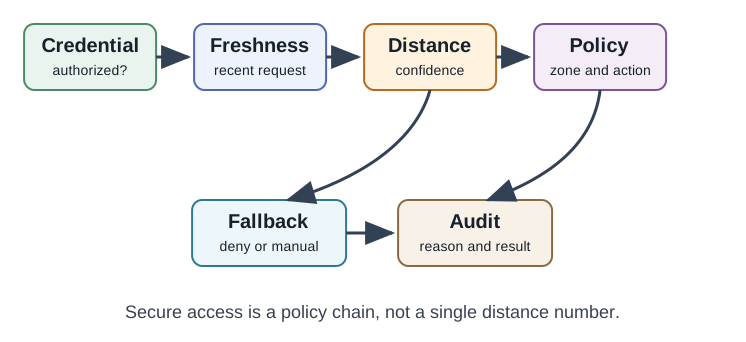
- Build a UWB secure-access evidence chain (credential, freshness, distance evidence, policy, fallback, audit) and explain why a nearby credential is not sufficient authorization by itself
Major section
In 60 Seconds
A distance estimate must be fresh, tied to the right identity, and inside a clear policy.
- Ultra-wideband is a radio method that uses very short pulses across a wide range of frequencies; it is shortened to UWB.
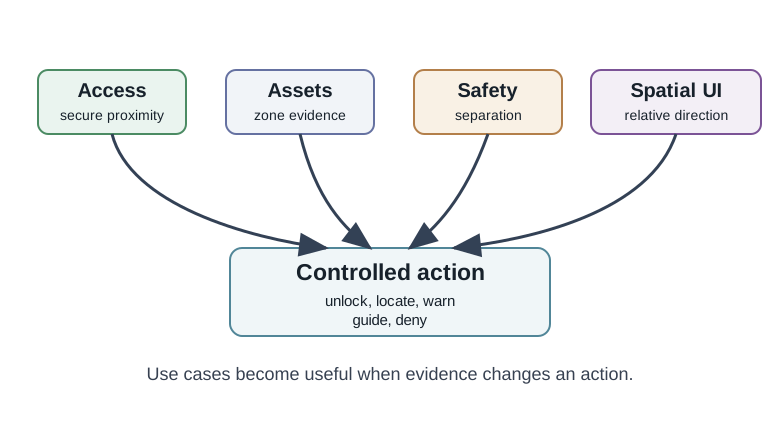
- UWB applications succeed when distance or position evidence changes an action: unlock, locate, warn, guide, count, or deny.
- Security is not automatic.
Major section
Secure Ranging as Decision Evidence
The reason UWB is useful in cars, phones, badges, locks, tools, and warehouse tags is not just centimeter-class positioning under good conditions.
- A robust UWB application joins four checks: credential authorization, time-bounded ranging evidence, policy rules for the physical zone, and a fallback when confidence is low.
- A phone presents a valid credential, then the cabinet receives a UWB result of 0.74 m with a fresh timestamp and normal confidence.
- The distance number did not become false; it became insufficient for the action.
- That helps resist false-proximity claims, but the application still owns privacy, logging, operator override, and retest rules.
Major section
Application Fit
The main reason to choose UWB is not that it is new or precise.
- The reason is that an application has a decision that depends on trusted physical evidence.
- Access control needs secure proximity before an unlock.
- Asset tracking needs a reliable zone position before a locate event.
- The shared UWB radio does not make these thresholds interchangeable.
Major section
Application Fit (continued)
A safety zone needs separation evidence before warning or denying motion, while a spatial interface needs relative direction before guiding a user.
- A location estimate useful for a dashboard may still be too weak for an access or safety decision.
- Each family should name the action it controls.
- A location estimate that does not change an action is usually not enough reason to add UWB.
Major section
Secure Access Evidence Chain
Secure access requires more than a short distance estimate.
- The system has to prove the credential is authorized, the ranging exchange is fresh, the measured proximity fits the policy, and the fallback path is safe.
- The credential first identifies an authorized claimant, and freshness checks whether the request is current.
Major section
Relay Resistance
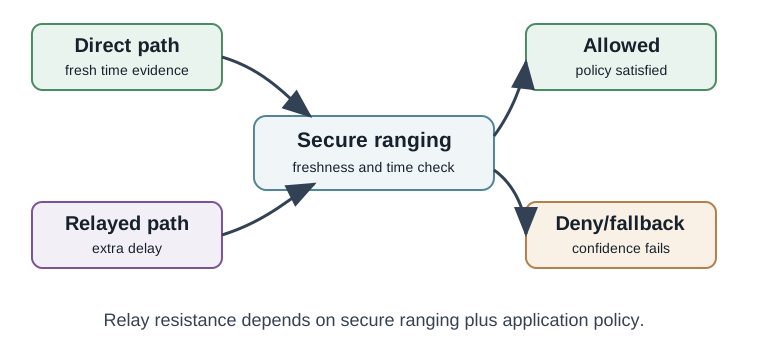
Relay attacks try to make a far credential appear nearby by forwarding messages through another link.
- Extra path and processing delay should make the credential appear farther away, not closer.
- Secure ranging checks freshness and time, but application policy still decides whether confidence is high enough to allow access.
- The direct path can pass when its proof and policy agree.
Major section
Why RSSI Proximity Fails and ToF Needs Protection
In a door pilot, run 50 authorized attempts from inside the allowed side and 50 denied attempts from the outside side.
- If the allowed side produces 48/50 fresh, high-confidence ranges below 1.2 m, and the outside side produces 0/50 accepted unlock decisions, the boundary rule is behaving.
- Keeping every raw coordinate forever can create privacy and governance risk without improving the operational decision.
- The practitioner question is not "Did we get a range?" It is "Can this range be trusted enough for this action?" Signal strength offers little defense because strength is not distance.
Major section
STS, Timing, and Acceptance Policy
Ordinary relays usually add delay, which should make a credential look farther away.
- The IEEE 802.15.4z Scrambled Timestamp Sequence is a cryptographically generated pseudo-random sequence embedded in the ranging exchange.
- The receiver timestamps energy that correlates with the expected STS, so a forged pulse that does not match should be rejected.
- The dangerous distance-reduction attack is different: it tries to make the receiver timestamp an early signal and therefore subtract distance.
Major section
STS, Timing, and Acceptance Policy (continued)
The timing arithmetic explains why policy cannot stop at "near." Radio waves travel at roughly 300,000,000 m/s, so 1 ns of one-way flight time is about 0.30 m.
- STS protection is meant to make that early signal unpredictable and unusable.
- If the credential is authorized, the side-of-door evidence matches, and confidence is high, the policy may allow the action.
- If an attack path or poor geometry adds enough delay to report 3.8 m, the result should be denied as too far.
Major section
Safety and Privacy
UWB can support safety workflows, but it should not be the only guard for a hazardous process unless the safety case explicitly supports that role.
- Position evidence can be blocked, delayed, stale, or interpreted incorrectly.
- Privacy review is also required.
- Fine location evidence can reveal work patterns, personal movement, sensitive visits, or asset usage.
Major section
Operating Control Loop
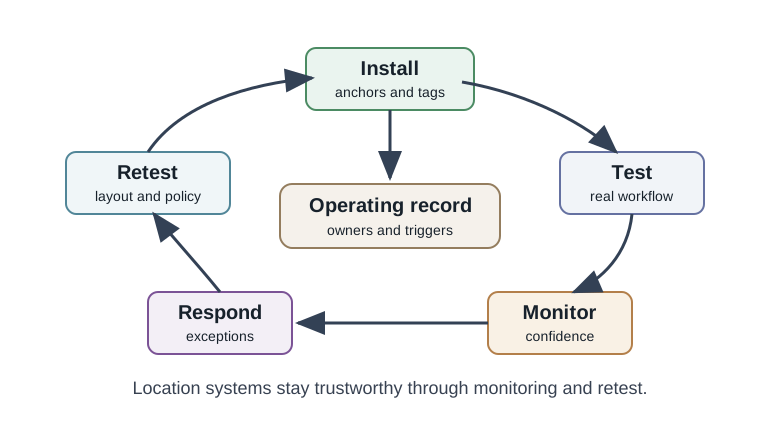
UWB applications need operations discipline after installation.
- Monitoring should expose confidence, stale results, and exceptions so an operator can tell when a location claim weakens.
- Response rules decide whether to warn, deny, or use a manual path.
- A layout, policy, or equipment change triggers the same scenarios again, with an owner and result in the operating record.
Major section
Common Mistakes
Forgetting privacy: Fine location evidence requires retention, access, consent, and purpose controls.
- Skipping authorization: A nearby credential still has to be allowed to perform the action.
- Ignoring the wrong side of a boundary: Near a door is not the same as being on the permitted side.
- No retest plan: Moved anchors, layout changes, and new materials can change behavior.
Deck summary
Key takeaways
A distance estimate must be fresh, tied to the right identity, and inside a clear policy.
- The reason UWB is useful in cars, phones, badges, locks, tools, and warehouse tags is not just centimeter-class positioning under good conditions.
- The main reason to choose UWB is not that it is new or precise.
- A safety zone needs separation evidence before warning or denying motion, while a spatial interface needs relative direction before guiding a user.
- Secure access requires more than a short distance estimate.
Retrieval practice
Recall check 1 of 3

Radio Remi says: answer from memory, then check your reasoning.
Q1How should a UWB position estimate be treated in a secure access decision?
Show answer
Answer: C UWB position is evidence with confidence and fallback rules for a decision, not a magic location label.
Retrieval practice
Recall check 2 of 3
Radio Remi says: answer from memory, then check your reasoning.
Q2Why does IEEE 802.15.4z STS make UWB secure ranging stronger than RSSI-based proximity for relay-resistant access?
Show answer
Answer: D IEEE 802.15.4z STS makes the valid pulse sequence unpredictable. That helps the receiver reject forged early pulses, while RSSI-only proximity remains vulnerable to relays, amplifiers, antennas, and orientation effects.
Retrieval practice
Recall check 3 of 3
Radio Remi says: answer from memory, then check your reasoning.
Q3A UWB door system confirms that an authorized phone is nearby, but the confidence is low and the phone appears near the wrong side of the doorway. What should the application do?
Show answer
Answer: D UWB access control should combine authorization, fresh secure ranging, confidence, boundary policy, and fallback handling.
Print reference
Answers
Answer key.
- C · UWB position is evidence with confidence and fallback rules for a decision, not a magic location label.
- D · IEEE 802.15.4z STS makes the valid pulse sequence unpredictable. That helps the receiver reject forged early pulses, while RSSI-only proximity remains vulnerable to relays, amplifiers, antennas, and orientation effects.
- D · UWB access control should combine authorization, fresh secure ranging, confidence, boundary policy, and fallback handling.