Emerging Paradigms · Study deck
Practice: UAV Missions and Avoidance
Start with a mission that moves, loses energy, and changes its radio path while it works.
Blueprint Bina is your guide for this deck.

After studying this chapter
Learning objectives
You will be able to:
- Match common UAV mission patterns to coverage, inspection, relay, transit, and search objectives.
- Explain a detect-and-avoid loop using sensing, prediction, risk classification, maneuver selection, verification, and fallback.
- Build a coverage record that separates footprint, track spacing, overlap policy, route length, energy gate, and readiness records.
- Avoid brittle mission decisions based on rated endurance, endpoint-only return, or generic separation values.
Major section
Minimum Viable Understanding
A mission pattern is only useful when it matches the records the task needs.
- Avoidance is a decision loop, not a single sensor or a single distance number.
- Separation, altitude, airspace, and operating rules must come from the applicable operating context and local approval process.
- Coverage plans should record assumptions about footprint, overlap, turns, dwell, wind, and skipped areas.
Major section
Mission Pattern Selection
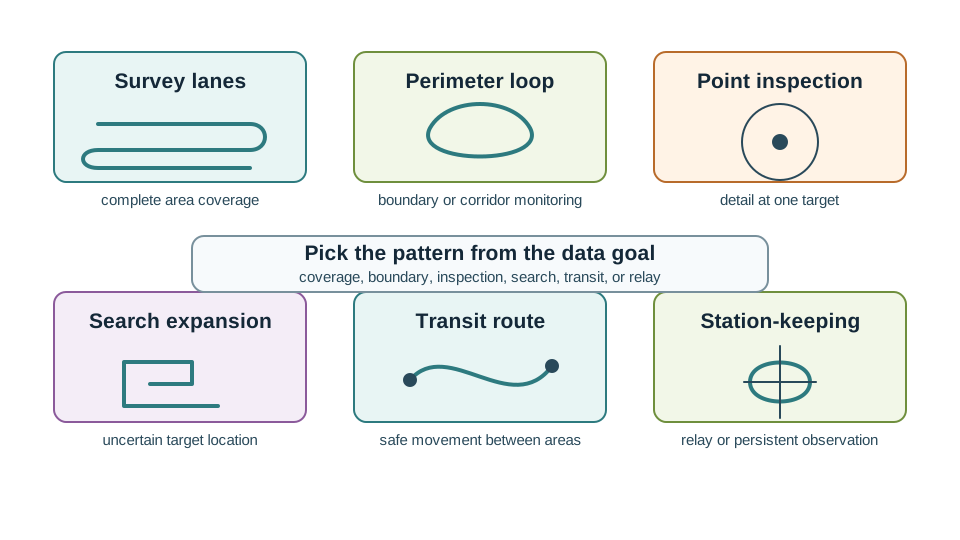
The same area may need different paths depending on whether the goal is mapping, inspection, relay, search, delivery, or repeated monitoring.
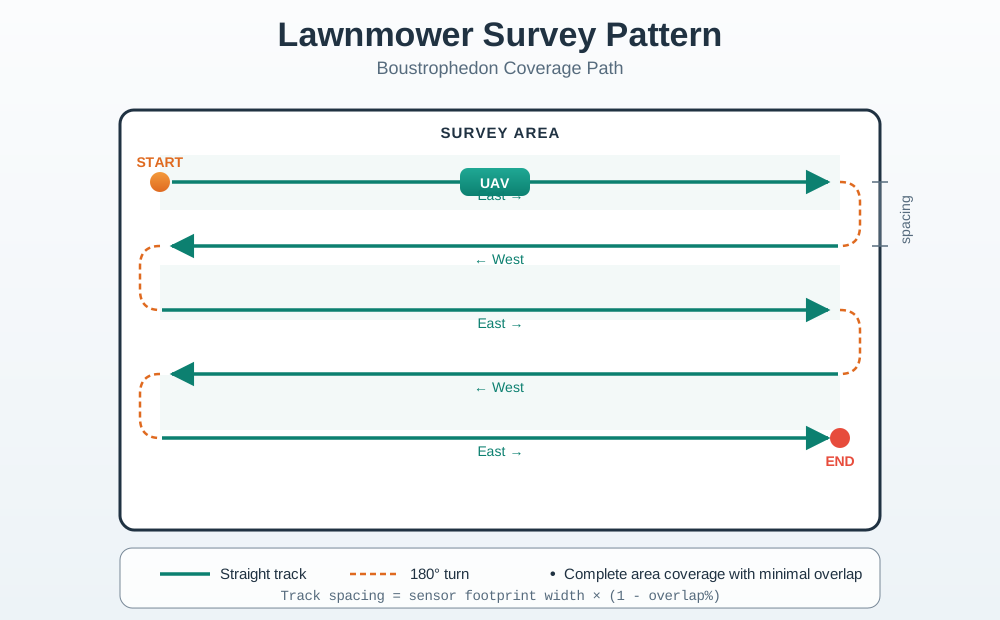
- Parallel lanes provide systematic area coverage.
- Planning risk: turns, wind drift, terrain change, and weak overlap assumptions can create gaps.
- Planning risk: the route may over-serve easy segments and under-serve high-risk turns or occluded areas.
Major section
Mission Pattern Selection (continued)
Short approach, dwell, orbit, or spiral patterns gather focused records at a site.
- Planning risk: dwell time can erode reserve and may expose the aircraft to obstacles or local wind effects.
- Expanding square, sector, or probability-weighted paths grow from a starting region.
- Planning risk: a simple geometric expansion can ignore updated information or blocked areas.
Major section
Detect-And-Avoid Loop
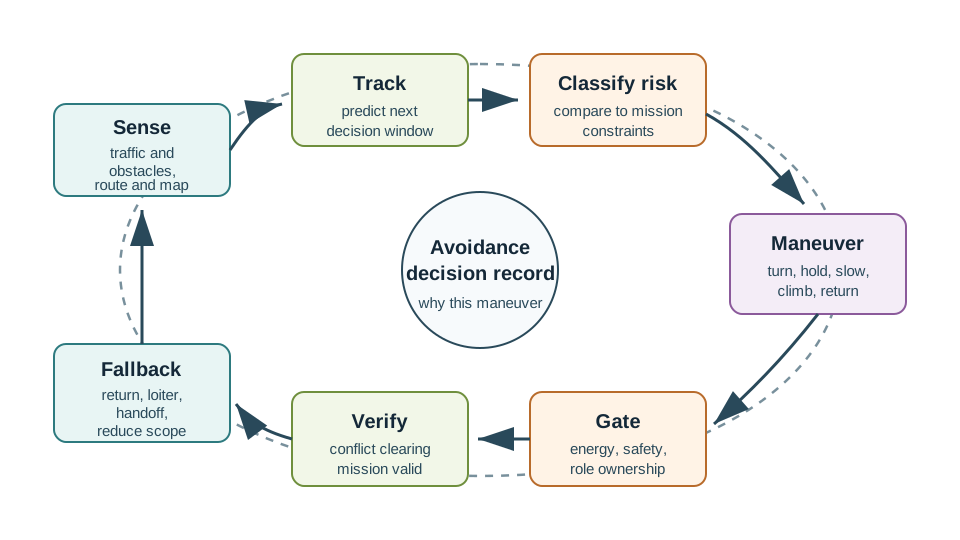
Detect-and-avoid should be treated as a bounded loop with named records and fallback behavior.
- The exact sensors and separation thresholds depend on aircraft, operating context, approval basis, environment, and mission risk.
- The traceable structure is more durable than any single universal number.
Major section
Coverage Record
Coverage planning should produce a record that another planner can inspect.
- The core calculation is simple, but the assumptions around it matter.
- Track spacing should follow the ground footprint and the planned overlap fraction; tighter overlap means closer lanes and more flight time.
- Narrower spacing improves coverage margin but adds distance and turns; wider spacing saves energy but risks gaps.
Major section
Utility-Corridor Inspection
A team must inspect a corridor after a storm.
- The required records are damage location and passable access route, not high-resolution mapping of every surface.
- The mission record lists mandatory segments, optional extra photos, blocked areas, return points, and dwell limits.
- If wind or conflict records increase, the aircraft skips optional close-up photos before the return gate is threatened.
Major section
Mission Readiness Checklist
Pattern fit: The chosen pattern matches the data goal and does not over-collect low-value data.
- Avoidance basis: The plan states the relevant conflict sources, operating limits, separation basis, and fallback behavior.
- Coverage record: Footprint, overlap, path spacing, route estimate, quality gate, and skipped-area handling are documented.
- Communication and role state: Gateway reachability, handoff ownership, and lost-link behavior are defined before launch.
Major section
UAV Mission Avoidance Pitfalls
Using a favorite pattern for every mission.: Survey lanes are useful for coverage, but they can be wasteful for boundary inspection, point inspection, or relay work.
- Treating avoidance as one sensor.: A sensor is only part of the loop.
- The plan also needs prediction, risk classification, maneuver choice, energy gate, verification, and fallback.
- Hardcoding separation values without context.: Separation and altitude assumptions must be tied to the operating context, approval basis, route, aircraft, and environment.
Major section
Concept Relationships
Avoidance decisions should leave a record of detected conflict, selected maneuver, rejected maneuver, safety gate, energy gate, and fallback action.
- Coverage is not only path length.
- It also depends on footprint, overlap, ground relief, data quality, skipped areas, and re-fly policy.
- Optional photos, extra passes, and long station-keeping should be cut before return energy is threatened.
Deck summary
Key takeaways
A mission pattern is only useful when it matches the records the task needs.
- The same area may need different paths depending on whether the goal is mapping, inspection, relay, search, delivery, or repeated monitoring.
- Short approach, dwell, orbit, or spiral patterns gather focused records at a site.
- Detect-and-avoid should be treated as a bounded loop with named records and fallback behavior.
- Coverage planning should produce a record that another planner can inspect.
Retrieval practice
Recall check 1 of 3

Blueprint Bina says: answer from memory, then check your reasoning.
Q1A UAV must inspect a long fence line after high winds, needing repeated boundary records and short close-ups at damage, not a full field map. Which mission pattern is the best starting point?
Show answer
Answer: A A fence-line inspection with repeated boundary records and close-ups fits a perimeter or racetrack route with point-inspection dwells.
Retrieval practice
Recall check 2 of 3

Blueprint Bina says: answer from memory, then check your reasoning.
Q2A UAV must inspect a long fence line after high winds. The team needs repeated boundary records and short close-up checks at damaged sections, not a full map of the surrounding field. Which mission pattern is the best starting point?
Show answer
Answer: B Pattern choice should follow the data goal.
Retrieval practice
Recall check 3 of 3

Blueprint Bina says: answer from memory, then check your reasoning.
Q3Place each UAV mission artifact where it lives so you can prove coverage while retaining a safe obstacle fallback.
Show answer
Answer: A Separate mission and pattern design, measured coverage and avoidance, and fallback proof so you can distinguish planned intent from safe observed execution.
Print reference
Answers
Answer key.
- A · A fence-line inspection with repeated boundary records and close-ups fits a perimeter or racetrack route with point-inspection dwells.
- B · Pattern choice should follow the data goal.
- A · Separate mission and pattern design, measured coverage and avoidance, and fallback proof so you can distinguish planned intent from safe observed execution.