Emerging Paradigms · Study deck

UAV Energy-Aware Mission Planning

Start with a mission that moves, loses energy, and changes its radio path while it works.

Blueprint Bina is your guide for this deck.

trajenergyplanning
Blueprint Bina, the module guide, in a scene from this chapter.
iotclass.org

After studying this chapter

Learning objectives

You will be able to:

  • Build a UAV energy budget from measured pack, route, payload, dwell-time, climb, and return records.
  • Separate usable mission energy from reserve energy and return-to-home energy.
  • Explain why the farthest reachable point, not just the final waypoint, controls the return reserve.
  • Choose energy-aware route adjustments without hiding safety, payload, or data-collection trade-offs.
iotclass.org

Major section

In 60 Seconds

Energy-aware mission planning decides whether a UAV should fly the whole mission, shorten it, split it, hand off work, or return early.

  • A defensible plan records the energy budget, the reserve gates, the route assumptions, the abort trigger, and the records that will be checked after the flight.

Numbers to remember

222 Wh10.0 Ah pack holds 222 Wh at nameplate
20%but a 20% reserve leaves 177.6 Wh for planned work.
177.6 Whbut a 20% reserve leaves 177.6 Wh for planned work.
A rectangular LiPo battery pack with a balance connector and main power leads
iotclass.org

Major section

In 60 Seconds (continued)

The mathematical gist.: A 22.2 V, 10.0 Ah pack holds 222 Wh at nameplate, but a 20% reserve leaves 177.6 Wh for planned work.

  • With 40 mΩ internal resistance, 25 A cruise causes 1.00 V sag while a 45 A climb causes 1.80 V, leaving 20.4 V and less cutoff headroom.
  • After a two-week gap at 2% monthly self-discharge, about 9,899 mAh remains.
  • Mission planning must check both stored energy and the worst-current segment.
iotclass.org

Major section

How This Chapter Fits

Trajectory control asks how the aircraft should move.

  • Energy-aware mission planning asks whether the aircraft should keep accepting that motion plan.
  • It sits between mission design and in-flight control: the planner sets the budget and reserve gates, while the controller checks those gates whenever route, link, weather, payload, or safety records change.
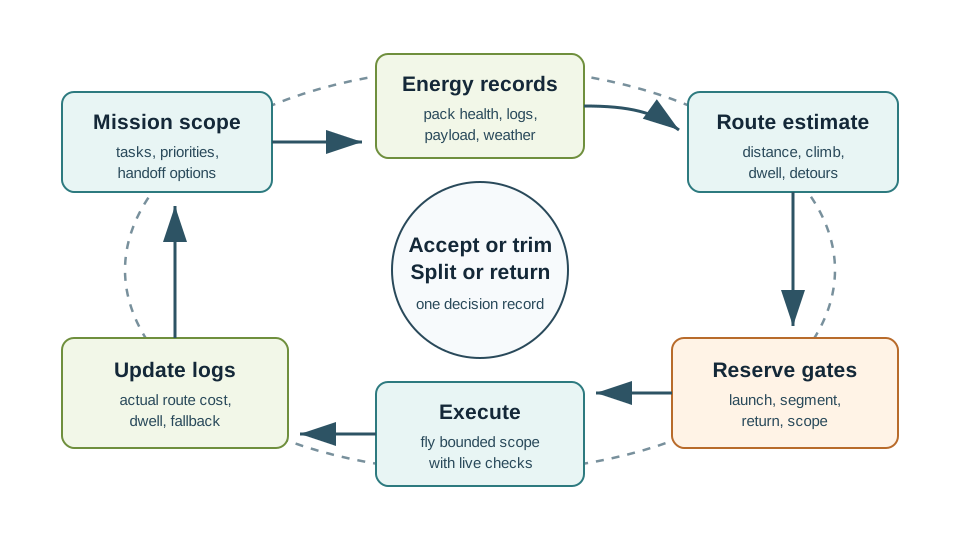
  • The overview depth layer shows the energy-aware planning loop that anchors mission scope, measured energy records, route estimate, reserve gates, execution with live checks, and post-flight updates.
iotclass.org

Major section

Energy Budget Record

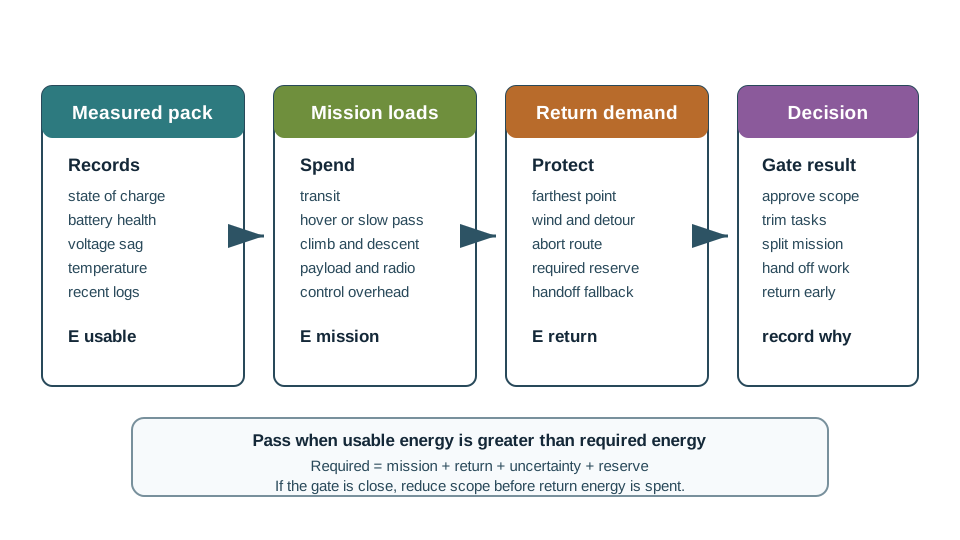
An energy plan should be written as a record, not as a single remaining-battery number.

  • The record separates what the mission is allowed to spend from what must remain available for return, uncertainty, and fallback.
  • The plan is acceptable only when the measured usable pack energy is greater than the required energy for the current mission scope.

Key terms

If the inequality
If the inequality is close, the correct action is not to hope that the battery lasts.
UAV energy budget record showing measured battery state, derating records, mission loads, return requirement, reserve gate, and decision outcome.
iotclass.org

Major section

Reserve Gates

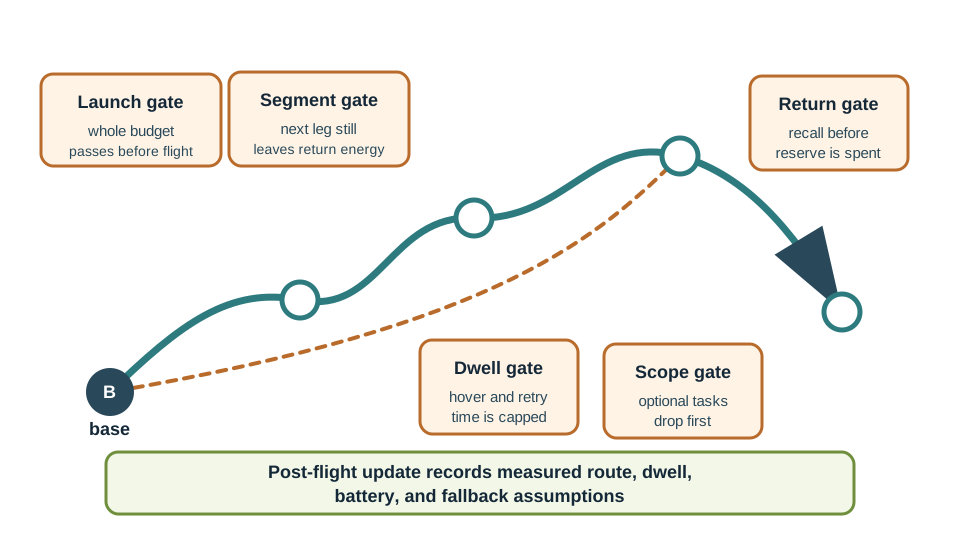
Launch gate: the aircraft does not launch unless the route, reserve, return, and uncertainty budget all pass.

  • Segment gate: each new segment must leave enough energy to return from the worst reachable point after the segment starts.
  • Dwell gate: hovering, slow passes, repeated photos, and link retries have a time limit tied to the energy budget.

Why it matters

They prevent the mission from spending return energy on optional work.

UAV route reserve gates showing launch, segment, dwell, scope, return, and post-flight update checks along a mission route.
iotclass.org

Major section

Route Planning Decisions

Visit nearby tasks together when this reduces route length and repeated climb.

  • Energy-aware routing is not just shortest-path routing.
  • A shorter route can still be worse when it forces repeated climbs, slow passes in poor wind, long hover periods, or weak-link retries.
  • In a multi-UAV mission, hand off only when the receiving aircraft also has a valid reserve record.
iotclass.org

Major section

Worked Example: Inspection Mission Scope

The planning team has recent measured logs from the same airframe and payload.

  • The numbers below are not universal platform values; they are the team's measured planning inputs for this specific setup.
  • Measured usable energy: The battery record shows usable pack energy after health and weather adjustment.
  • Dwell tasks: Two photo points require short stable dwell.
iotclass.org

Major section

Worked Example: Inspection Mission Scope (continued)

The planner keeps a separate reserve instead of treating the whole pack as spendable.

  • Base route: The base route includes outbound travel, waypoint-to-waypoint travel, return distance from the farthest reachable point, and a small route-uncertainty allowance.
  • The thermal sweep is useful but optional, so it is placed behind a scope gate.
  • If live energy drops faster than expected, the thermal sweep is skipped before return energy is threatened.
iotclass.org

Major section

UAV-WSN Data Collection

In UAV-assisted wireless sensor networks, the aircraft may act as a data mule, temporary gateway, or emergency collector.

  • Energy planning must balance route efficiency with data urgency.
  • Sensors with full or time-critical buffers may need earlier collection.
  • The route should record why urgency justifies extra travel.
  • The skipped-node list becomes part of the mission record.

Why it matters

Dense deployments can reduce flight cost by collecting through a cluster head or temporary relay, but this shifts energy and reliability assumptions to the ground network.

iotclass.org

Major section

UAV Energy Planning Pitfalls

Letting optional work consume mandatory return energy.: Optional sweeps, extra photos, and extended relay service should have explicit scope gates.

  • Planning from rated flight time.: Rated endurance is useful for screening platforms, but mission planning needs measured logs for the actual aircraft, payload, route, battery condition, and weather window.
  • Treating reserve as a percentage only.: A percentage can be a policy, but the operational question is whether the aircraft can return from the worst active point while still preserving required margin.
  • Failing to update the next plan.: Post-flight logs should update route cost, dwell cost, wind sensitivity, battery health assumptions, and fallback timing.
iotclass.org

Major section

Readiness Checklist

Measured records: The budget is based on recent logs or controlled measurements, not only on a datasheet.

  • Worst return point: The return requirement is checked from the farthest reachable point in the active mission, not only from the final waypoint.
  • Dwell limit: Every hover, retry, slow pass, or station-keeping task has a maximum allowed time.
  • Scope order: The plan clearly identifies which tasks are mandatory, optional, skipped first, or handed off.
iotclass.org

Major section

Concept Relationships

The energy budget limits which route segments, dwell tasks, and optional collections can be accepted.

  • It must survive optional work, link retries, and route detours.
  • Payload energy is not only watts.
  • Energy planning improves when each flight leaves measured records about actual route cost, dwell cost, battery behavior, and fallback triggers.
iotclass.org

Deck summary

Key takeaways

Energy-aware mission planning decides whether a UAV should fly the whole mission, shorten it, split it, hand off work, or return early.

  • The mathematical gist.: A 22.2 V, 10.0 Ah pack holds 222 Wh at nameplate, but a 20% reserve leaves 177.6 Wh for planned work.
  • Trajectory control asks how the aircraft should move.
  • An energy plan should be written as a record, not as a single remaining-battery number.
  • Launch gate: the aircraft does not launch unless the route, reserve, return, and uncertainty budget all pass.
iotclass.org

Retrieval practice

Recall check 1 of 4

Blueprint Bina says: answer from memory, then check your reasoning.

Q1A UAV roof inspection finishes the required photos with reserve still valid, but wind has increased and the optional thermal sweep would require extra dwell at the farthest active point. What is the most defensible energy-planning action?

ASkip or hand off the optional sweep, preserve the return reserve, and record the wind and dwell evidence.
BFly the optional sweep as planned, because finishing the required photos means the remaining energy is free to spend.
CApprove the sweep, because the vendor's rated flight time still looks comfortably higher than the planned mission time.
DDelay the return decision until the aircraft reports a low-battery warning from the farthest active point.
Show answer

Answer: A Optional work should sit behind a scope gate so the mission preserves return feasibility; updating the next mission budget after landing turns the wind and dwell evidence into learning.

iotclass.org

Retrieval practice

Recall check 2 of 4

Blueprint Bina says: answer from memory, then check your reasoning.

Q2A roof-inspection UAV has enough measured energy for required photos, but the optional thermal sweep would leave return reserve too close from the farthest active point. Which first record keeps the mission-scope decision traceable?

ARecord measured usable energy, route and dwell costs, return energy from the worst active point, the reserve gate, and the skipped optional sweep.
BApprove the thermal sweep, because the final waypoint sits close to base and the aircraft will end its route with a short hop home.
CUse rated flight time from the vendor sheet because it is simpler than measuring route, dwell, payload, weather, and battery behavior.
DFly every planned task in the original order, then let the aircraft's low-battery warning decide during the flight which remaining work gets skipped.
Show answer

Answer: A A traceable energy-aware mission decision separates required work from optional work, checks return feasibility from the worst active point, and records the scope gate before reserve is spent.

iotclass.org

Retrieval practice

Recall check 3 of 4

Blueprint Bina says: answer from memory, then check your reasoning.

Q3A UAV route has enough energy for its planned waypoints if the team ignores return-to-home from the farthest active point. The final waypoint is close to base, but a middle waypoint is much farther away. What should the planner do?

AApprove the mission as planned, because the final waypoint sits close to base so the flight ends with an easy return
BCheck return energy from the farthest reachable point and shorten, split, or hand off the mission if the reserve gate fails
CUse the vendor's rated flight time to decide whether the route is acceptable, since it already includes a safety margin
DKeep flying the planned route until the low-battery warning appears, then start the return leg from wherever the aircraft happens to be
Show answer

Answer: B Energy-aware planning keeps return feasible throughout the mission.

iotclass.org

Retrieval practice

Recall check 4 of 4

Blueprint Bina says: answer from memory, then check your reasoning.

Q4Place each UAV energy-planning artifact where it lives so you can reject unsafe routes and improve the next estimate.

AMission scope
BGround truth label
CFirmware version
DPacket checksum
Show answer

Answer: A Separate mission definition, evidence-based cost prediction, and reserve and learning controls so you can plan an auditable flight with a protected energy margin.

iotclass.org

Print reference

Answers 1 of 2

Answer key.

  1. A · Optional work should sit behind a scope gate so the mission preserves return feasibility; updating the next mission budget after landing turns the wind and dwell evidence into learning.
  2. A · A traceable energy-aware mission decision separates required work from optional work, checks return feasibility from the worst active point, and records the scope gate before reserve is spent.
  3. B · Energy-aware planning keeps return feasible throughout the mission.
iotclass.org

Print reference

Answers 2 of 2

Answer key.

  1. A · Separate mission definition, evidence-based cost prediction, and reserve and learning controls so you can plan an auditable flight with a protected energy margin.
iotclass.org