Emerging Paradigms · Study deck

UAV Trajectory Control

Picture a small aircraft carrying a medicine pack across a flooded area.

Blueprint Bina is your guide for this deck.

trajcontrol
Blueprint Bina, the module guide, in a scene from this chapter.
iotclass.org

After studying this chapter

Learning objectives

You will be able to:

  • Explain how UAV trajectory control connects mission objectives, network records, safety constraints, and energy reserve.
  • Compare waypoint shift, orbit center shift, radius change, dwell-time control, altitude adjustment, and station-keeping.
  • Distinguish a network problem from an energy, payload, gateway, or safety problem before moving the aircraft.
  • Build a trajectory adjustment record with selected and rejected actions.
iotclass.org

Major section

Start Simple

The pilot and flight system must decide whether to continue, change course, hand off the link, or return.

  • A smooth path on a screen is not proof that the real flight has room to recover.
  • This opening does not approve an airframe or route.
  • If any answer is no, the flight plan is not ready.
iotclass.org

Major section

Minimum Viable Understanding

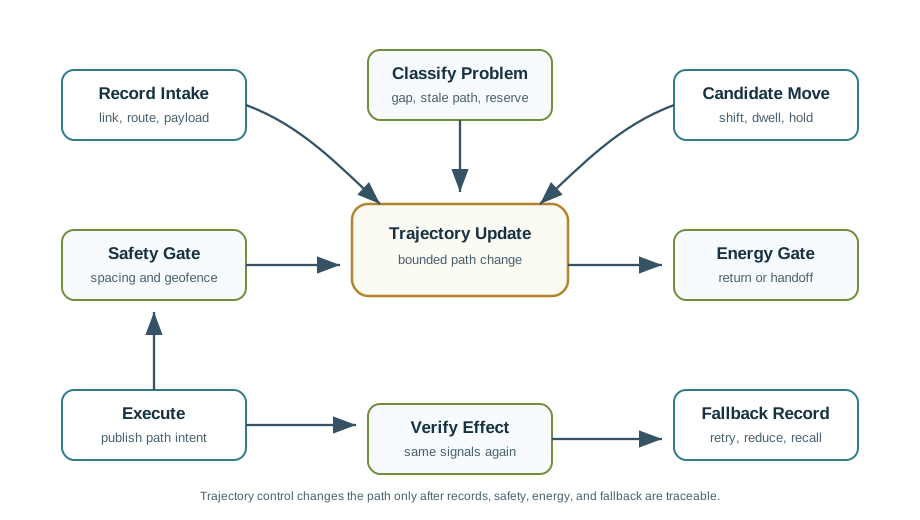
A trajectory is not just a path; it is a time-ordered motion plan tied to mission records.

  • Trajectory changes should not be triggered by one weak metric alone.
  • Link, gateway, payload, energy, safety, and mission context must be checked together.
  • A safe controller separates fast flight stabilization from slower mission-level path adjustment.
iotclass.org

Major section

Adjustment Strategies

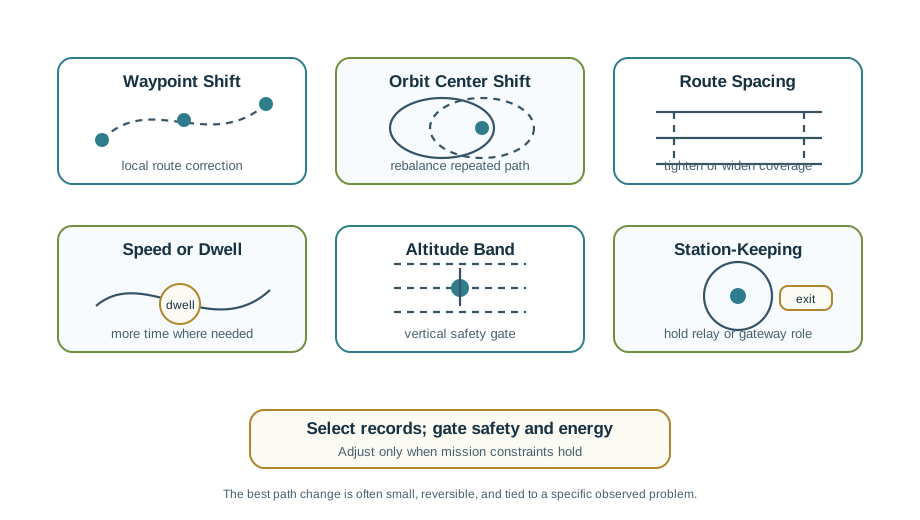
Trajectory control is not one algorithm.

  • Fadlullah et al. (2016) describe a dynamic trajectory-control algorithm that grounds the orbit-center-shift and route-spacing-change strategies above in one concrete trigger: each UAV's own relay-queue occupancy.
UAV trajectory strategy map comparing waypoint shift, orbit center shift, route spacing, speed or dwell change, altitude band, and station-keeping with their record triggers and check risks.
iotclass.org

Major section

FANET Radius and Load Lab

The calculations below are an explicit teaching model, not measurements from the slides. -->.

  • A single UAV can act as one aerial gateway, while a multi-UAV FANET can distribute sensing and relay work.
  • A star keeps coordination simple but makes the center aircraft a dependency; a mesh offers alternate aerial paths but spends more airtime on coordination.
  • Neither topology removes intermittent links, ground-gateway limits, or the need for a safe local fallback.

Try it: FANET Radius and Load Lab in the chapter

iotclass.org

Major section

Trajectory Decision Record

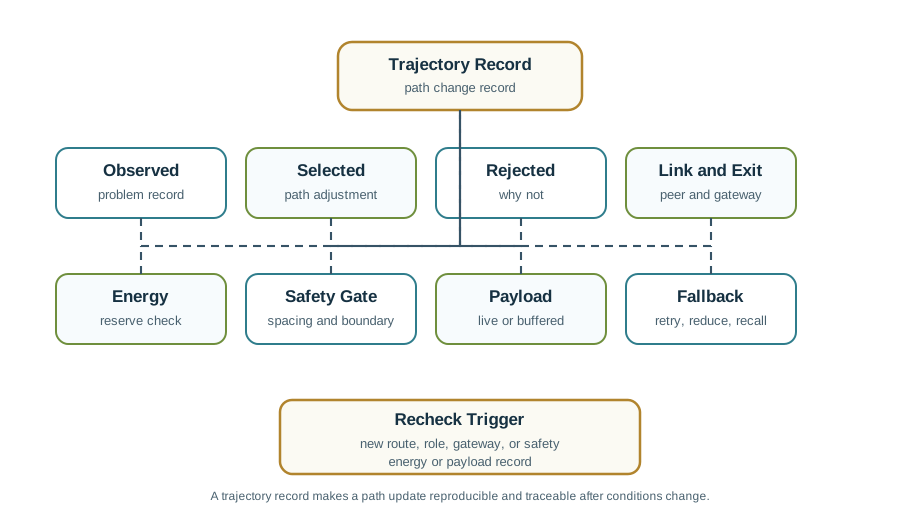
The trajectory decision record is the artifact that prevents path changes from becoming untraceable behavior.

  • It should be compact enough to update during testing and precise enough to audit after a mission.
UAV trajectory decision record showing observed problem, selected adjustment, rejected adjustment, link state, gateway state, energy reserve, safety gate, payload state, fallback action, and recheck trigger.
iotclass.org

Deck summary

Key takeaways

The pilot and flight system must decide whether to continue, change course, hand off the link, or return.

  • A trajectory is not just a path; it is a time-ordered motion plan tied to mission records.
  • Trajectory control is not one algorithm.
  • The calculations below are an explicit teaching model, not measurements from the slides. -->.
  • The trajectory decision record is the artifact that prevents path changes from becoming untraceable behavior.
iotclass.org

Retrieval practice

Recall check 1 of 5

Blueprint Bina says: answer from memory, then check your reasoning.

Q1A corridor relay UAV improves urgent status after a short dwell, but the same dwell starts shrinking return reserve and increasing a buffered image queue. What should the next trajectory-control record do?

AKeep the bounded dwell only while reserve and gateway gates remain valid, and mark bulk images as buffered or pending.
BIncrease the dwell time until every buffered image has uploaded live, since the dwell already improved urgent status.
CMove the entire route toward the weak segment, because the first bounded adjustment helping proves a bigger move helps more.
DIgnore the shrinking reserve trend until the aircraft raises its low-battery warning during flight.
Show answer

Answer: A The record keeps the useful adjustment but prevents it from hiding energy, gateway, and payload risk; it should also name the handoff or recall trigger.

iotclass.org

Retrieval practice

Recall check 2 of 5

Blueprint Bina says: answer from memory, then check your reasoning.

Q2A utility inspection UAV has stale urgent status near one corridor end, a working gateway-facing leg, a growing but delay-tolerant image queue, and enough reserve only for a bounded adjustment. Which first record keeps the trajectory decision traceable?

ARecord the observed stale status, selected waypoint or dwell adjustment, rejected full-route expansion, and gateway state.
BRecord a full racetrack expansion to revisit the stale corridor end sooner, with the growing image queue retained for a later gateway upload.
CKeep the path unchanged for the rest of the mission, because a growing image queue that can wait proves the route is healthy.
DMove toward the weak segment without checking gateway reachability, return reserve, separation, or what happens if the records do not improve.
Show answer

Answer: A A traceable trajectory-control decision classifies traffic, preserves the working exit path, rejects a plausible but unsafe adjustment, checks energy and safety gates, and records fallback plus recheck behavior.

iotclass.org

Retrieval practice

Recall check 3 of 5

Blueprint Bina says: answer from memory, then check your reasoning.

Q3Place each trajectory-control field where it lives so you can diagnose a weak path, authorise a bounded correction, and preserve a safe escape.

AObserved problem
BPayload state
CSelected adjustment
DSafety gate
Show answer

Answer: A The three regions separate diagnose path, authorise adjustment, and preserve escape so you can change a UAV trajectory without hiding mission evidence or safety limits.

iotclass.org

Retrieval practice

Recall check 4 of 5

Blueprint Bina says: answer from memory, then check your reasoning.

Q4A UAV relay route is producing stale urgent status near one end of a corridor, but its gateway-facing leg is working well. Bulk imagery can wait. What is the best first trajectory-control response?

AMake a bounded waypoint or dwell adjustment near the weak segment while preserving the gateway-facing leg
BExpand the whole route immediately so the UAV covers every corridor area for longer on each lap
CIgnore the gateway-facing leg during the adjustment, because the observed issue sits only at the far end of the corridor
DKeep the path unchanged, because a route able to buffer imagery is meeting the mission's delivery needs
Show answer

Answer: A Trajectory control should classify traffic needs and make a bounded path adjustment that preserves gateway, safety, energy, and fallback records.

iotclass.org

Retrieval practice

Recall check 5 of 5

Blueprint Bina says: answer from memory, then check your reasoning.

Q5Why should a trajectory update record a rejected adjustment?

AIt shows that the team considered a plausible alternative and rejected it based on records, not habit
BIt removes the need to run separate safety and energy gate checks on the adjustment that is finally selected
CIt proves that the selected adjustment will keep working for the remainder of the mission window
DIt satisfies mission paperwork requirements, although it adds nothing to later engineering decisions
Show answer

Answer: A A trajectory decision record should explain both the selected adjustment and a plausible rejected option so future teammates can evaluate the trade-off.

iotclass.org

Print reference

Answers 1 of 2

Answer key.

  1. A · The record keeps the useful adjustment but prevents it from hiding energy, gateway, and payload risk; it should also name the handoff or recall trigger.
  2. A · A traceable trajectory-control decision classifies traffic, preserves the working exit path, rejects a plausible but unsafe adjustment, checks energy and safety gates, and records fallback plus recheck behavior.
  3. A · The three regions separate diagnose path, authorise adjustment, and preserve escape so you can change a UAV trajectory without hiding mission evidence or safety limits.
iotclass.org

Print reference

Answers 2 of 2

Answer key.

  1. A · Trajectory control should classify traffic needs and make a bounded path adjustment that preserves gateway, safety, energy, and fallback records.
  2. A · A trajectory decision record should explain both the selected adjustment and a plausible rejected option so future teammates can evaluate the trade-off.
iotclass.org