Emerging Paradigms · Study deck

UAV Swarm Coordination

Picture three aircraft mapping a flooded field when one loses its link.

Blueprint Bina is your guide for this deck.

swarmcoordination
Blueprint Bina, the module guide, in a scene from this chapter.
iotclass.org

After studying this chapter

Learning objectives

You will be able to:

  • Compare centralized, distributed, and leader-follower UAV swarm coordination models.
  • Explain how task allocation, formation control, and collision avoidance interact.
  • Identify the records a UAV must share before another aircraft can trust its role or task state.
  • Design fallback behavior for stale links, lost leaders, low energy, and payload backlog.
iotclass.org

Major section

Start Simple

The others must not guess that its area is complete.

  • They need a clear rule for reassignment, collision space, and return.
  • A gateway means a device or service that joins two message paths.
  • A payload means the useful reading, image, or command carried inside a message.
  • A swarm coordinates roles; it does not become one mind.
iotclass.org

Major section

Minimum Viable Understanding

A UAV swarm is a coordinated mission system, not simply a group of aircraft in the same area.

  • Centralized control is easiest to supervise, but depends heavily on the ground link and controller availability.
  • Distributed coordination is more resilient to individual aircraft loss, but it consumes bandwidth and requires disciplined state sharing.
  • Leader-follower control is useful for formations, but the design must define leader replacement.
iotclass.org

Major section

Coordination Models

No coordination model is best in every mission.

  • The right choice depends on link reliability, mission dynamics, operator oversight, failure tolerance, and how quickly aircraft must react.
  • The ground station assigns tasks, approves role changes, and can give operators a clear mission picture.
  • Each UAV shares current state with nearby peers and the group updates task ownership from local records.
iotclass.org

Major section

Coordination State Records
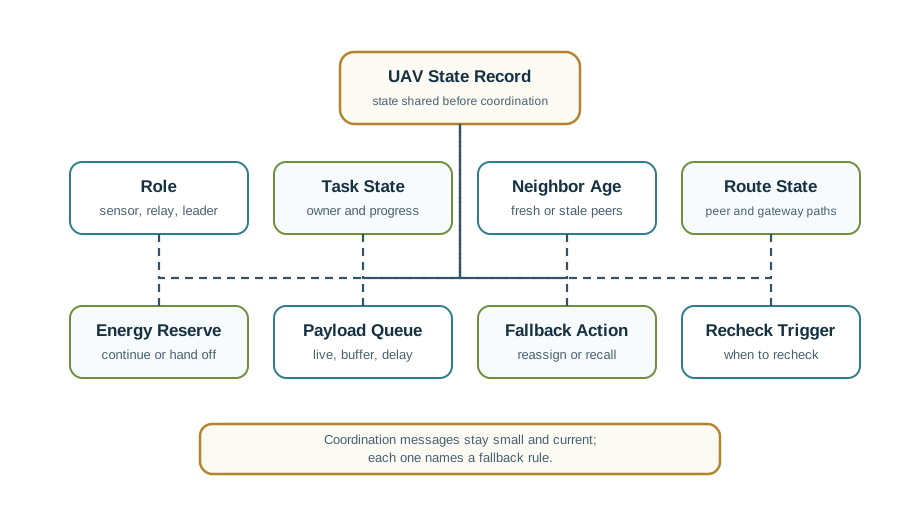
A coordination message should be small enough to send often, but specific enough to support a decision.

  • Neighbor freshness: When peer position, link quality, and role information were last heard.
  • Route state: Whether the aircraft has a current path to peers, a leader, a relay, or a gateway.
UAV swarm state record showing UAV id, role, task owner, neighbor freshness, link state, route state, energy reserve, payload queue, and fallback action.
iotclass.org

Major section

Task Allocation Loop

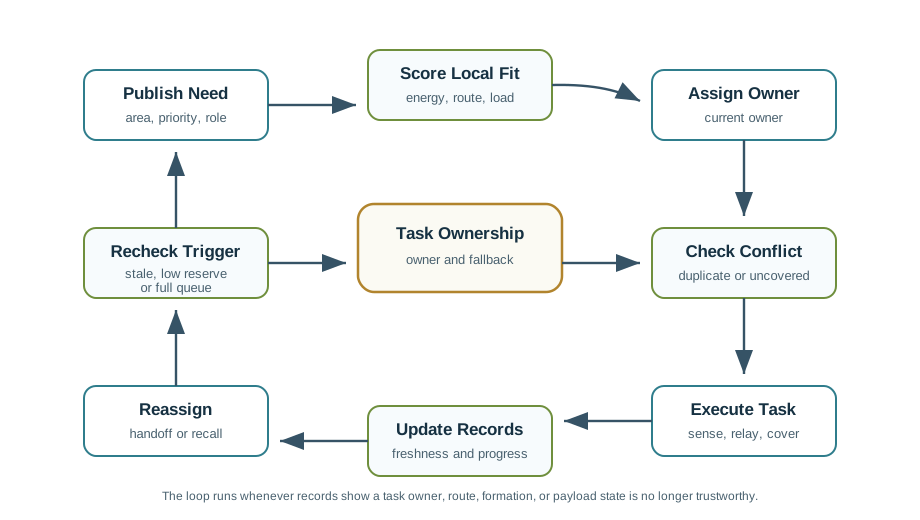
Task allocation is the process of deciding which UAV owns each mission task.

  • In a search, the task may be a grid cell.
  • In a relay mission, it may be a temporary relay position.
  • In an inspection mission, it may be an asset segment, image set, or gateway handoff.
UAV swarm task allocation loop showing task publication, local scoring, owner assignment, conflict check, mission execution, record update, and reassignment when conditions change.
iotclass.org

Major section

Formation Control

Formation control keeps aircraft in useful relative positions.

  • Many swarm controllers can be described as local agreement rules.
  • Coverage and allocation algorithms add the mission layer by deciding which area, role, or resource each aircraft should own.
  • The check record is lane width, overlap, neighbor freshness, and what happens when one lane drops out.
iotclass.org

Major section

Formation Control (continued)

Useful when tasks are cells or zones.

  • These methods can degrade gracefully when the communication graph weakens, but only if the record names neighbour freshness, graph assumptions, convergence criteria, and the fallback for stale or missing peers.
  • Useful when a leader provides a path reference and followers preserve spacing.
  • Useful when the group must preserve a communication path.
iotclass.org

Major section

Coordination Readiness Checklist

Mission intent: The swarm has a specific service, not just a flight pattern.

  • Selected model: The design states whether control is centralized, distributed, leader-follower, or a deliberate hybrid.
  • Rejected model: The design records at least one plausible model that was rejected and why.
  • Task ownership: Every task has an owner, conflict rule, and reassignment rule.
iotclass.org

Deck summary

Key takeaways

The others must not guess that its area is complete.

  • A UAV swarm is a coordinated mission system, not simply a group of aircraft in the same area.
  • No coordination model is best in every mission.
  • A coordination message should be small enough to send often, but specific enough to support a decision.
  • Task allocation is the process of deciding which UAV owns each mission task.
iotclass.org

Retrieval practice

Recall check 1 of 5

Blueprint Bina says: answer from memory, then check your reasoning.

Q1A standby UAV can reach an uncovered search lane, but its image queue is nearly full and gateway freshness is weak. Urgent status from the lane is still required. Which coordination record is most defensible?

AAssign the standby UAV only for urgent status or reduced sensing, buffer bulk imagery, and record the weak gateway path.
BAssign the standby UAV to full sensing at its normal rate, because lane reachability is the record that proves it can take the task.
CLeave the lane uncovered and wait for the original owner to reconnect, since reassignment records only add coordination traffic.
DSend every remaining UAV to the lane together, because duplicate coverage removes the need to track gateway freshness at all.
Show answer

Answer: A The record coordinates ownership, payload pressure, gateway freshness, traffic priority, and fallback instead of treating reachability as enough; it should also set a handoff or return trigger.

iotclass.org

Retrieval practice

Recall check 2 of 5

Blueprint Bina says: answer from memory, then check your reasoning.

Q2A four-UAV search sweep loses one lane owner, the remaining UAVs still hear each other, the ground link is weak, and bulk imagery can wait. Which first record keeps the coordination decision traceable?

ARecord the uncovered lane, current peer freshness, candidate owners, selected reassignment, and rejected duplicate coverage.
BKeep the original sweep plan and lane map unchanged, because a coordination plan written before launch stays valid for the whole mission.
CAssign every remaining UAV to the missing lane at once, since duplicate coverage is the surest way to get the area revisited.
DStream the buffered imagery to the ground team first, because bulk data shows the sweep is working better than short status notes.
Show answer

Answer: A A traceable swarm coordination decision updates task ownership from current peer, link, energy, payload, and fallback records instead of trusting the original formation diagram.

iotclass.org

Retrieval practice

Recall check 3 of 5

Blueprint Bina says: answer from memory, then check your reasoning.

Q3Place each uav swarm coordination concept where it lives so you can separate assigned intent, current feasibility, and the recovery action for lost coordination.

ARole
BTask state
CNeighbor freshness
DEnergy reserve
Show answer

Answer: A The three regions separate assign intent, maintain feasibility, recover work so you can separate assigned intent, current feasibility, and the recovery action for lost coordination.

iotclass.org

Retrieval practice

Recall check 4 of 5

Blueprint Bina says: answer from memory, then check your reasoning.

Q4A four-UAV search sweep loses contact with one aircraft. The remaining UAVs still hear each other, but the ground station link is weak. What is the best coordination response?

AMark the missing lane as uncovered, use current peer records to reassign it, and record the fallback action
BKeep the original plan unchanged because the mission started with a complete formation
CSend all aircraft back immediately without checking energy, route, or task state
DAssign every remaining UAV to the same lane so the missing area is definitely covered
Show answer

Answer: A Swarm coordination should use current peer records, task ownership, and fallback rules when an aircraft or link becomes unavailable.

iotclass.org

Retrieval practice

Recall check 5 of 5

Blueprint Bina says: answer from memory, then check your reasoning.

Q5Why should payload queue state be part of a UAV swarm coordination record?

ABecause a UAV with a growing data queue may need a relay, gateway contact, reduced sensing rate, or task handoff
BBecause a current payload queue value makes sharing neighbor freshness records unnecessary in the same coordination message
CBecause queue depth can be used as the acceptance measure for live delivery of the mission's imagery and sensor readings
DBecause payload state is a post-flight accounting detail that only matters once the mission is complete
Show answer

Answer: A Payload queue state is a coordination record because data volume, link state, and gateway reachability can change which UAV should sense, relay, buffer, or return.

iotclass.org

Print reference

Answers 1 of 2

Answer key.

  1. A · The record coordinates ownership, payload pressure, gateway freshness, traffic priority, and fallback instead of treating reachability as enough; it should also set a handoff or return trigger.
  2. A · A traceable swarm coordination decision updates task ownership from current peer, link, energy, payload, and fallback records instead of trusting the original formation diagram.
  3. A · The three regions separate assign intent, maintain feasibility, recover work so you can separate assigned intent, current feasibility, and the recovery action for lost coordination.
iotclass.org

Print reference

Answers 2 of 2

Answer key.

  1. A · Swarm coordination should use current peer records, task ownership, and fallback rules when an aircraft or link becomes unavailable.
  2. A · Payload queue state is a coordination record because data volume, link state, and gateway reachability can change which UAV should sense, relay, buffer, or return.
iotclass.org