Emerging Paradigms · Study deck
FANET Gateway Optimization
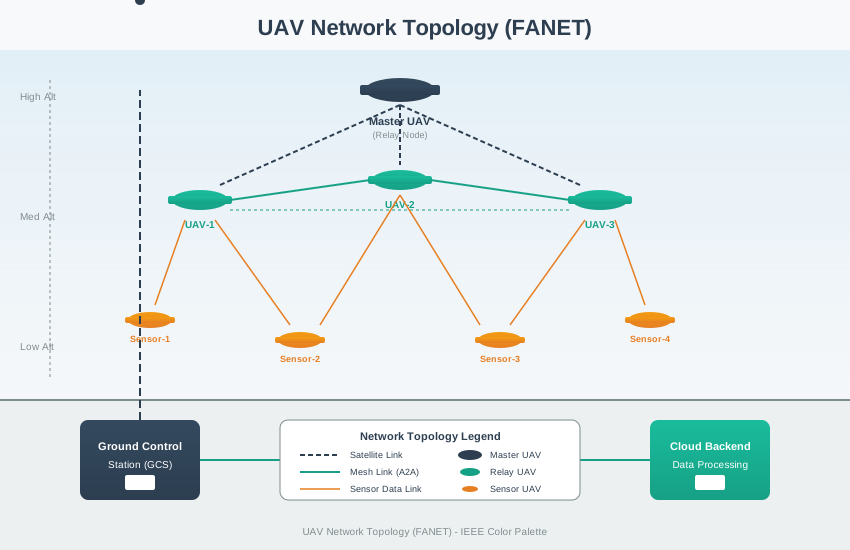
A gateway means the boundary system that joins the aerial devices to another network or service.
Blueprint Bina is your guide for this deck.

After studying this chapter
Learning objectives
You will be able to:
- Explain why a FANET uses selected gateway UAVs instead of asking every UAV to reach the ground directly.
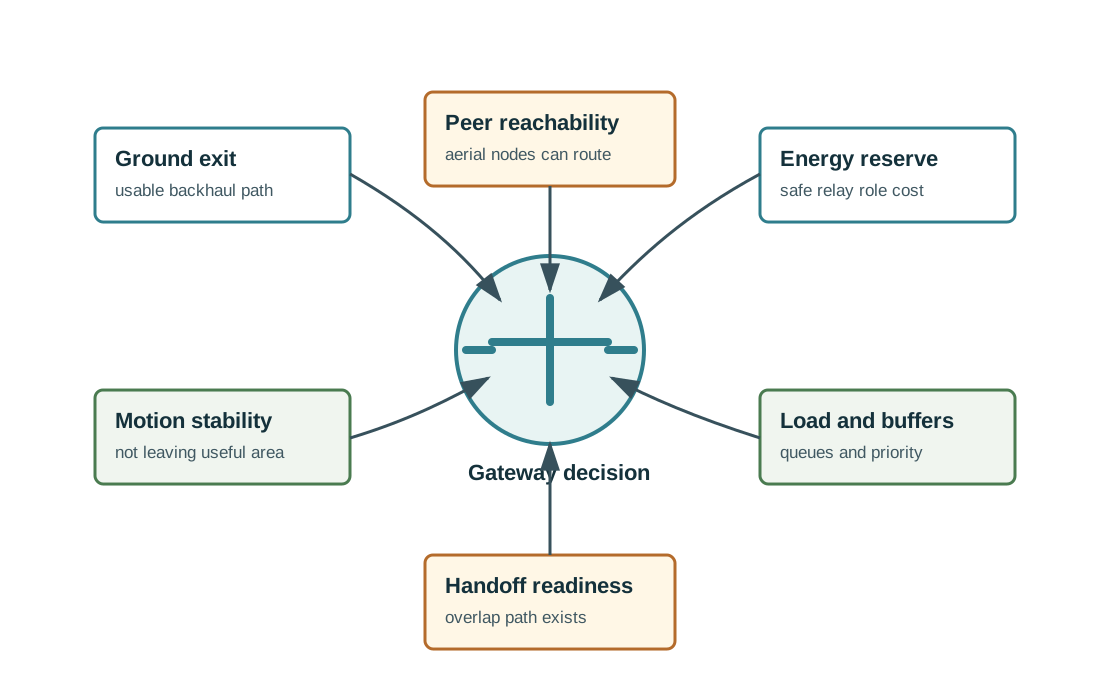
- Build a gateway candidate record using ground-link, peer-reachability, energy, motion, load, and handoff records.
- Compare single-gateway, multi-gateway, and layered gateway patterns without relying on brittle fixed ratios.
- Describe how hold-down rules and handoff preparation reduce route flapping.
Major section
What a FANET Gateway Does
When the gateway is no longer a good bridge, it should prepare another candidate before the old path becomes unusable.
- It remains part of the aerial network, and it maintains an exit path toward a non-aerial system.
- UAVs exchange telemetry, alerts, and neighbor records with other aerial nodes.
- These flows need priority and traceability.
Major section
What a FANET Gateway Does (continued)
That second job may use a ground station, a field gateway, a vehicle-side relay, satellite equipment, or another backhaul link depending on the mission.
- The gateway must not break this local path while serving the ground exit.
- The gateway may forward summaries, event messages, or buffered data from several peers.
- Its load can rise faster than a normal relay node.
- Some missions send commands, task updates, or safety-relevant acknowledgments through the gateway.
Major section
Candidate Records
Gateway selection is a record-quality problem.
- A candidate that has a strong ground link but cannot reach its peers is not a good gateway.
- A candidate in the center of the aerial group but with a weak ground exit is also risky.
- The selection record should explain the tradeoff.
- The gateway should not strand a sub-area.
Major section
Candidate Records (continued)
Gateway duty usually means extra relay work.
- The candidate needs enough reserve to serve the role and still leave the mission safely.
- The candidate should not be about to turn, descend, leave the area, or lose line of sight unless another gateway is already ready.
- A less central node may be better if the central node is overloaded.
Major section
Selection Patterns
The right pattern depends on mission shape, coverage area, ground receiver capacity, traffic priority, and how much redundancy is needed.
- Useful for small or short missions where one UAV can reach the ground and peers reliably.
- Useful when the aerial team covers a wider area, carries mixed traffic, or needs redundancy.
- Useful when altitude layers or mission roles differ.
Major section
Selection Patterns (continued)
Selection must avoid overlapping gateways that compete for the same ground path.
- A lower UAV may collect local data while a higher UAV provides the stronger exit path.
- Useful when a continuous path is unavailable.
- The gateway role may move with the UAV that can later deliver buffered data.
Major section
Selection Patterns (continued)
The partition boundaries are not fixed either: sub-area size is adjusted dynamically from UAV-interconnection and topology metrics, and those metrics are re-optimized over several iterations until the partition settles into a stable state.
- That 2-hop neighbor requirement is a concrete version of the peer-reachability record above: it is exactly the evidence a candidate needs before it can be trusted as a sub-area's gateway.
- For example, a mission with urgent alerts may weigh ground exit quality and peer reachability more heavily.
- A sparse sensing mission may accept slower delivery and prioritize energy reserve plus buffer capacity.
Major section
Handoff and Reselection
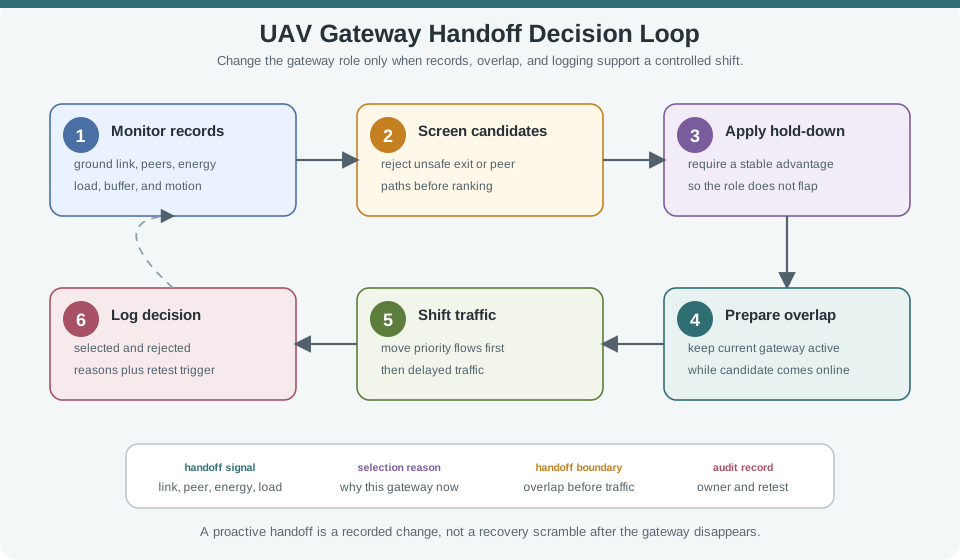
Gateway handoff should be proactive.
- Without a hold-down or hysteresis rule, two similar candidates can trade the role repeatedly.
- That route flapping burns control traffic and makes logs harder to interpret.
- The rule does not need to be a fixed percentage; it only needs to be explicit, tested, and appropriate for the mission.
Major section
Inspection Team Ground Exit
Scenario: A UAV team is inspecting a damaged utility corridor.
- Three UAVs are collecting local observations, one UAV is closer to the field gateway, and another UAV will soon pass through a better line-of-sight position.
- The current gateway has a usable ground exit but rising buffer load.
- Candidate B is selected for planned handoff.
Major section
Inspection Team Ground Exit (continued)
Candidate A has the best ground view but weak peer reachability.
- Candidate B has slightly lower ground-link quality, better peer reachability, enough energy reserve, and a predictable path through the next segment.
- Candidate A remains a backup only if peer routing improves or the mission path changes.
- Result: The design chooses the candidate that protects the whole path, not merely the candidate with the strongest ground-facing signal.
Major section
Concept Relationships
FANET gateway connects aerial forwarding to a ground or backhaul path.
- Candidate records combine ground link, peer reachability, energy reserve, motion, load, and handoff readiness.
- Selection pattern decides whether one, multiple, layered, or mobile gateways fit the mission.
- Handoff log makes gateway decisions traceable after the mission.
Deck summary
Key takeaways
When the gateway is no longer a good bridge, it should prepare another candidate before the old path becomes unusable.
- That second job may use a ground station, a field gateway, a vehicle-side relay, satellite equipment, or another backhaul link depending on the mission.
- Gateway selection is a record-quality problem.
- Gateway duty usually means extra relay work.
- The right pattern depends on mission shape, coverage area, ground receiver capacity, traffic priority, and how much redundancy is needed.
Retrieval practice
Recall check 1 of 5

Blueprint Bina says: answer from memory, then check your reasoning.
Q1Two gateway candidates trade the lead every few seconds. One has a slightly better ground signal; the other has better peer reachability and lower queue load. Which action best reduces brittle gateway behavior?
Show answer
Answer: A A stable gateway decision needs an explicit hold-down rule while comparing both ground exit and aerial peer records, plus overlap preparation and a log of selected and rejected reasons.
Retrieval practice
Recall check 2 of 5

Blueprint Bina says: answer from memory, then check your reasoning.
Q2One UAV has the strongest ground link but poor peer reachability; another has a slightly weaker ground link plus good peer reachability and energy reserve. Which is usually the better gateway?
Show answer
Answer: A A good FANET gateway needs both a usable ground exit and reachability to aerial peers, plus adequate energy reserve.
Retrieval practice
Recall check 3 of 5

Blueprint Bina says: answer from memory, then check your reasoning.
Q3A UAV has the strongest ground link but is near the edge of the aerial group and cannot reliably reach two peers. Another UAV has a slightly weaker ground link but better peer reachability and enough energy reserve. Which is usually the better gateway choice?
Show answer
Answer: A Gateway selection balances ground exit quality, peer reachability, energy reserve, motion, load, and handoff readiness.
Retrieval practice
Recall check 4 of 5

Blueprint Bina says: answer from memory, then check your reasoning.
Q4Which records should be kept after a gateway handoff?
Show answer
Answer: A Traceable gateway decisions need both the selected path and the reasons alternatives were not used.
Retrieval practice
Recall check 5 of 5

Blueprint Bina says: answer from memory, then check your reasoning.
Q5Place each uav fanet gateway selection concept where it lives so you can choose a gateway from fresh reachability, handoff, and load evidence.
Show answer
Answer: A The three regions separate observe candidates, choose a path, preserve decision so you can choose a gateway from fresh reachability, handoff, and load evidence.
Q6Complete the gateway candidate screen:
Show answer
Answer: A A gateway candidate must be useful to the exit path, reachable from peers, and ready for the extra role cost.
Print reference
Answers 1 of 2
Answer key.
- A · A stable gateway decision needs an explicit hold-down rule while comparing both ground exit and aerial peer records, plus overlap preparation and a log of selected and rejected reasons.
- A · A good FANET gateway needs both a usable ground exit and reachability to aerial peers, plus adequate energy reserve.
- A · Gateway selection balances ground exit quality, peer reachability, energy reserve, motion, load, and handoff readiness.
- A · Traceable gateway decisions need both the selected path and the reasons alternatives were not used.
Print reference
Answers 2 of 2
Answer key.
- A · The three regions separate observe candidates, choose a path, preserve decision so you can choose a gateway from fresh reachability, handoff, and load evidence.
- A · A gateway candidate must be useful to the exit path, reachable from peers, and ready for the extra role cost.