Emerging Paradigms · Study deck

Flying Ad-Hoc Networks (FANETs)

Picture three survey aircraft mapping smoke after a wildfire.

Blueprint Bina is your guide for this deck.

fanet
Blueprint Bina, the module guide, in a scene from this chapter.
iotclass.org

After studying this chapter

Learning objectives

You will be able to:

  • Explain what makes a FANET different from ground mobile ad hoc networks and road-constrained vehicular networks.
  • Identify the main aerial and ground-facing link types used in UAV team missions.
  • Describe the topology records a UAV needs before it can make a routing decision.
  • Choose among table-driven, on-demand, position-based, predictive, and store-carry-forward routing patterns based on mission conditions.
iotclass.org

Major section

Start Simple

A route drawn at take-off cannot prove that the next message has a usable path.

  • A gateway is the device or station that carries mission data into another network.
  • This short mission does not prove every flight plan or radio.
  • The deeper sections compare route styles, moving link evidence, energy cost, ground paths, partitions, and security limits for the full flying network.
iotclass.org

Major section

Minimum Viable Understanding

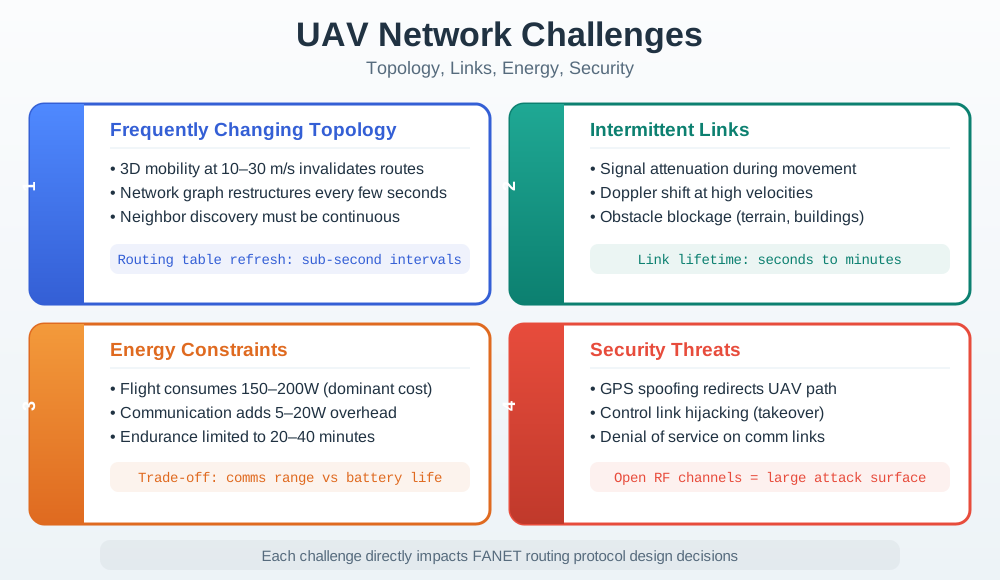
Links change because UAVs move horizontally, change altitude, turn, return to base, lose line of sight, or hand off to ground systems.

  • A FANET is an ad hoc network whose nodes are UAVs moving in 3D space.
  • Routing decisions need fresh local records: position, neighbor state, link quality, intended path, and whether buffering is acceptable.
  • Position-based and predictive routing are common FANET tools, but sparse missions also need store-carry-forward behavior.
iotclass.org

Major section

What Is a FANET?

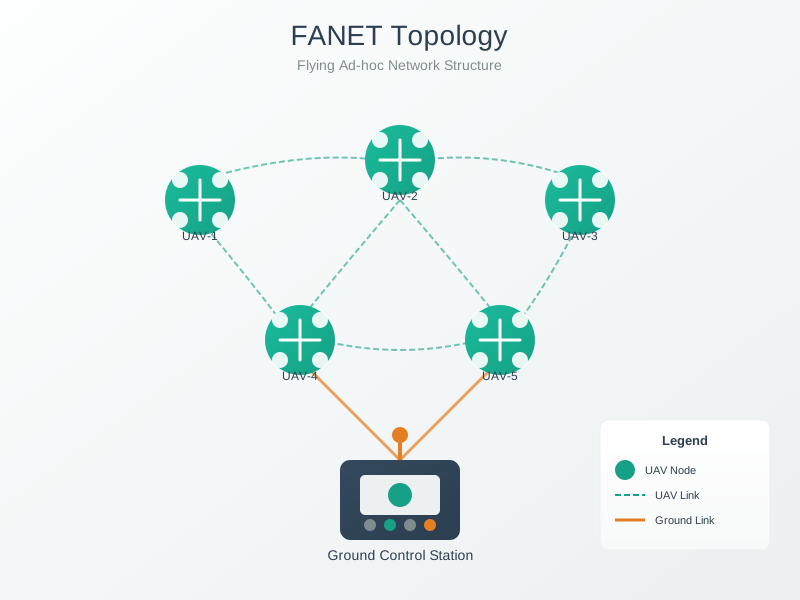
A Flying Ad Hoc Network (FANET) is a self-organizing network formed by UAVs without relying on one fixed communication path.

  • A FANET may include a ground station, gateways, or sensor systems, but the defining feature is that UAVs can forward traffic for each other while the aerial topology changes.
  • Gateway choice can change as the mission moves.
FANET topology: a flying ad-hoc network of UAVs and a ground station
iotclass.org

Major section

Topology Records

A FANET node should not forward based only on a static route table.

  • It needs a compact routing record that describes the local topology and the mission state.
  • The node records its own position, altitude, and the advertised positions of nearby UAVs.
  • Altitude changes can shorten or lengthen the true path.
  • Each neighbor entry needs a timestamp or freshness state.

Key terms

Stale neighbor data
Stale neighbor data is worse than no neighbor data because it can create false confidence.

Why it matters

Direction matters because a neighbor moving toward the destination is more useful than a neighbor that is about to leave the useful region.

iotclass.org

Major section

Topology Records (continued)

Stale neighbor data is worse than no neighbor data because it can create false confidence.

  • The node tracks whether a route is currently usable, whether a predictive path is planned, and whether packets may be buffered until contact returns.
  • For traffic that must leave the aerial network, the node tracks which gateway is reachable, overloaded, moving away, or reserved for higher priority traffic.
  • The overview depth layer introduces the compact topology record that keeps FANET routing tied to current mission state.
  • Direction matters because a neighbor moving toward the destination is more useful than a neighbor that is about to leave the useful region.
iotclass.org

Major section

Routing Choices

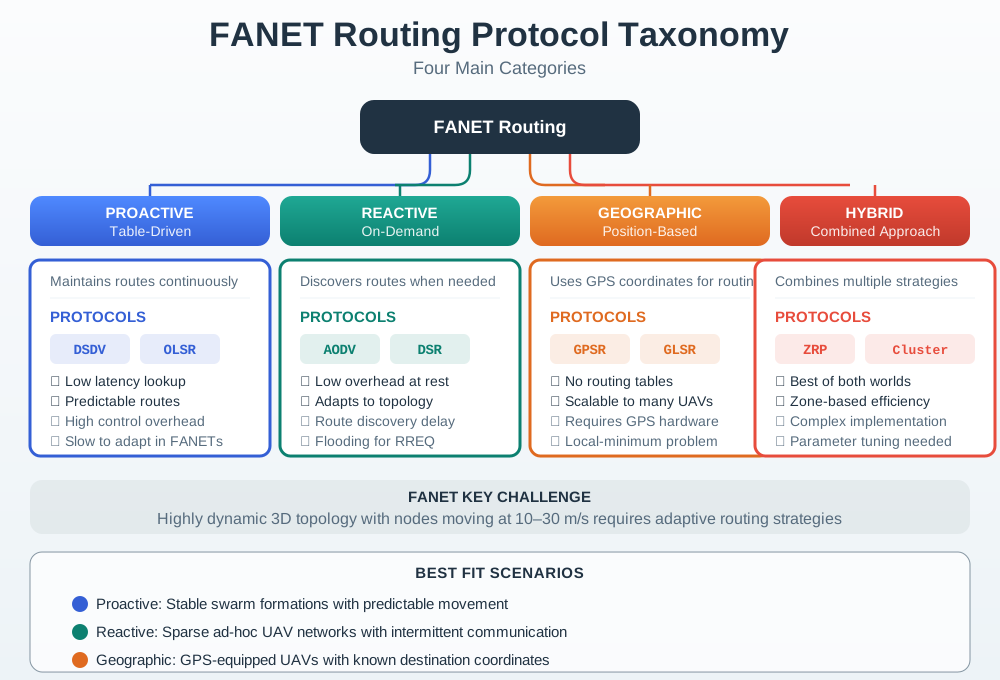
FANET routing is not one protocol choice for every mission.

  • Maintains routes proactively.
  • Discovers routes only when traffic needs them.
  • It reduces dependence on a complete route table and fits many mobile aerial paths.
  • Buffers traffic when no useful forwarder exists, then forwards after a later contact.

Why it matters

FANETs meet voids more often than ground networks because sparse aerial neighbors and altitude changes can open gaps that a flat map would not show.

FANET routing protocols fall into four families - proactive, reactive, geographic, and hybrid - each trading control overhead against adaptability.
iotclass.org

Major section

Routing Choices (continued)

No route discovery flood and no maintained table are needed, only current position records for the local neighborhood.

  • Greedy forwarding fails at a void: a location where every current neighbor is farther from the destination than the node itself, so no next hop makes progress.
  • That perimeter walk can itself get stuck circling a closed loop, so it switches to a different face of the boundary once it detects it has started moving backward instead of making progress.
  • FANETs meet voids more often than ground networks because sparse aerial neighbors and altitude changes can open gaps that a flat map would not show.
iotclass.org

Major section

Concept Relationships

3D topology records keep neighbor and link decisions tied to current mission state.

  • Position-based routing uses current location and neighbor records for local next-hop choices.
  • Predictive routing adds movement expectations or planned contact windows.
  • Gateway selection connects the aerial path to ground or vehicle systems.
iotclass.org

Deck summary

Key takeaways

A route drawn at take-off cannot prove that the next message has a usable path.

  • Links change because UAVs move horizontally, change altitude, turn, return to base, lose line of sight, or hand off to ground systems.
  • A Flying Ad Hoc Network (FANET) is a self-organizing network formed by UAVs without relying on one fixed communication path.
  • A FANET node should not forward based only on a static route table.
  • Stale neighbor data is worse than no neighbor data because it can create false confidence.
iotclass.org

Retrieval practice

Recall check 1 of 5

Blueprint Bina says: answer from memory, then check your reasoning.

Q1A UAV has a stale neighbor table, a low-priority image summary, and no current gateway path, but its flight plan predicts gateway contact in four minutes. What record best supports the routing decision?

AA store-carry-forward record with packet priority, buffer limit, and predicted gateway contact.
BA static route table recorded at launch, kept authoritative because the aircraft identifiers have not changed.
CA flooding record that rebroadcasts the image summary through every UAV until some path delivers it.
DA discard record that drops the image summary now because no gateway path exists at this moment.
Show answer

Answer: A Sparse FANET missions need explicit buffering and expiry evidence when immediate forwarding is not trustworthy; the full record also logs freshness checks and discard conditions.

iotclass.org

Retrieval practice

Recall check 2 of 5

Blueprint Bina says: answer from memory, then check your reasoning.

Q2A three-UAV inspection team loses direct gateway reachability while one aircraft still predicts contact in four minutes. Which first FANET routing record keeps the decision traceable?

AName the packet class, position and altitude age, neighbor freshness, link quality, chosen routing mode, buffer limit, predicted gateway contact, safety limit, owner, and retest trigger.
BKeep using the launch-time route table because the aircraft identifiers and mission area have not changed.
CFlood every packet through all UAVs until the gateway returns, regardless of traffic priority or energy reserve.
DTreat the missing gateway as a communications-only issue and leave return-to-base, collision avoidance, and command priority out of the routing record.
Show answer

Answer: A A traceable FANET routing decision connects packet class, fresh position and neighbor evidence, link state, route mode, buffering, gateway contact, safety limits, ownership, and retest triggers before the mission depends on the path.

iotclass.org

Retrieval practice

Recall check 3 of 5

Blueprint Bina says: answer from memory, then check your reasoning.

Q3A UAV has a fresh neighbor table, current position estimates, and several neighbors moving toward the destination area. Which routing pattern is usually the best first choice?

APosition-based forwarding using the current neighbor records
BContinuous flooding until every UAV receives every packet
CIgnore position and wait for a fixed route table to converge
DDrop all packets until a ground gateway is directly visible
Show answer

Answer: A Fresh position, neighbor, and movement records make position-based forwarding a strong fit for many FANET paths.

iotclass.org

Retrieval practice

Recall check 4 of 5

Blueprint Bina says: answer from memory, then check your reasoning.

Q4Which item is most important before trusting a neighbor entry for FANET routing?

AWhether the neighbor entry is fresh enough for the current mission phase
BWhether the neighbor has the shortest name
CWhether the route was drawn nicely in the planning diagram
DWhether the neighbor was the first UAV launched
Show answer

Answer: A Freshness is a core quality check because FANET topology information ages quickly.

Q5Place each FANET concept where it lives so you can keep mission data moving while aircraft and links change.

AAerial mesh
BStatic wired bus
CBattery charger
DImage codec
Show answer

Answer: A Separate aerial topology, next-hop routing, and delivery continuity so you can reason about motion, partitions, and the ground-network exit independently.

iotclass.org

Retrieval practice

Recall check 5 of 5

Blueprint Bina says: answer from memory, then check your reasoning.

Q6Complete the FANET forwarding-readiness check:

Atopology_ok = state['position_fresh'] and state['neighbor_table']
Btopology_ok = False
Ctopology_ok = state['node_name'] == 'leader'
Dtopology_ok = state['battery_color'] == 'green'
Show answer

Answer: A A FANET node should forward only when topology records, route mode, and link records are all present.

iotclass.org

Print reference

Answers 1 of 2

Answer key.

  1. A · Sparse FANET missions need explicit buffering and expiry evidence when immediate forwarding is not trustworthy; the full record also logs freshness checks and discard conditions.
  2. A · A traceable FANET routing decision connects packet class, fresh position and neighbor evidence, link state, route mode, buffering, gateway contact, safety limits, ownership, and retest triggers before the mission depends on the path.
  3. A · Fresh position, neighbor, and movement records make position-based forwarding a strong fit for many FANET paths.
iotclass.org

Print reference

Answers 2 of 2

Answer key.

  1. A · Freshness is a core quality check because FANET topology information ages quickly.
  2. A · Separate aerial topology, next-hop routing, and delivery continuity so you can reason about motion, partitions, and the ground-network exit independently.
  3. A · A FANET node should forward only when topology records, route mode, and link records are all present.
iotclass.org