Transport Protocols · Study deck
Transport Choices by Scenario
Picture a greenhouse that sends a room reading each minute and a frost warning only when danger appears.
Packet Pete is your guide for this deck.
After studying this chapter
Learning objectives
You will be able to:
- Explain: A transport decision record should name the sender, receiver, path segment, failure meaning, reliability owner, security boundary, evidence used, accepted tradeoff, owner, and retest trigger.
- Explain: Reliability can be owned by the transport stack, the application protocol, the gateway, the receiver, operations, or by no retry at all.
- Explain: One IoT product can have replaceable telemetry, confirmed commands, buffered uploads, file-like transfers, discovery messages, and alerts.
- Explain: Each flow can fail in a different way, so each flow needs its own transport decision.
Major section
Start With One Message Scenario
Losing the warning may ruin a crop.
- A transport rule controls how messages move between programs.
- The network designer should not choose one rule for the whole greenhouse.
- For a warning, it may be a visible active state with a time and owner.
Major section
Overview: Select Transport Per Message Flow
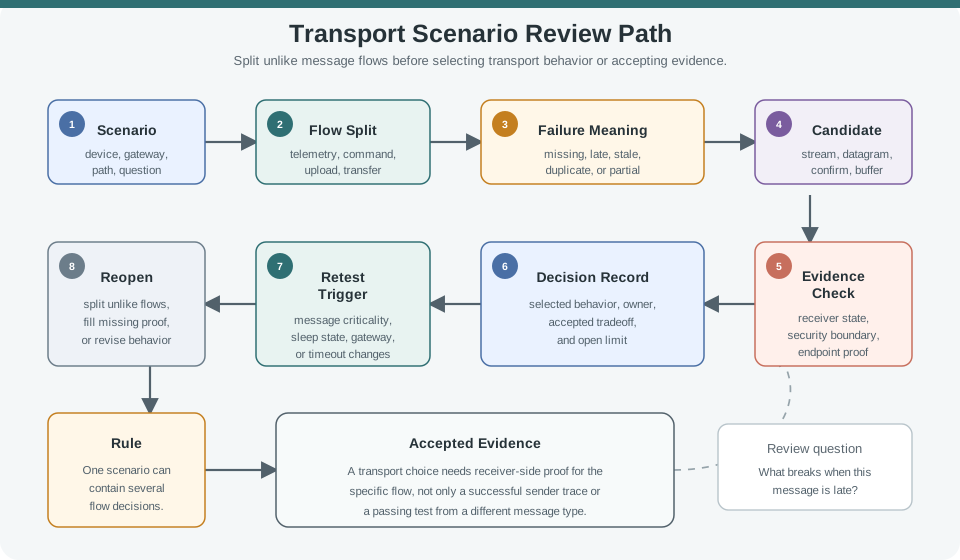
Transport selection starts with message purpose, not protocol names.
- Each flow can fail in a different way, so each flow needs its own transport decision.
- One IoT product can have replaceable telemetry, confirmed commands, buffered uploads, file-like transfers, discovery messages, and alerts.
Major section
Practitioner: Preserve the Decision Record
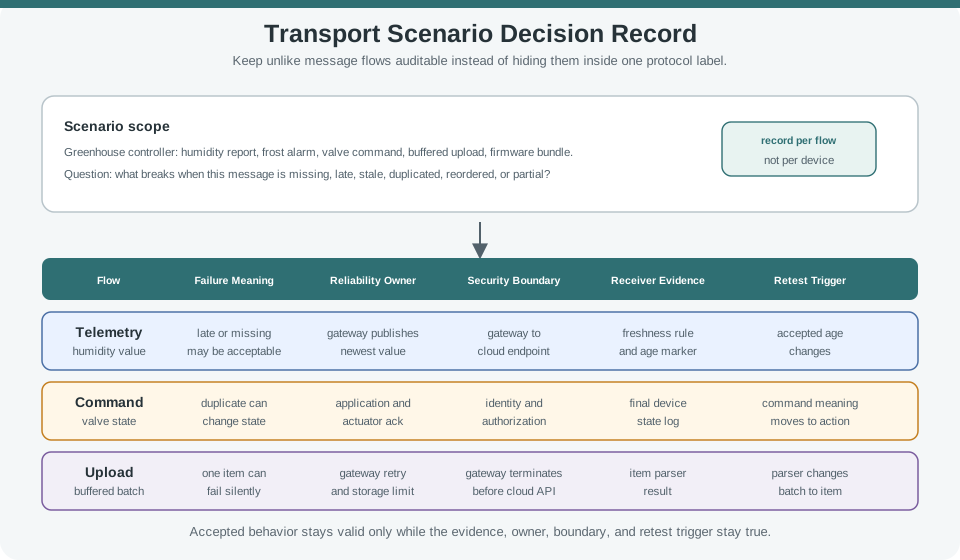
A transport decision record should name the sender, receiver, path segment, failure meaning, reliability owner, security boundary, evidence used, accepted tradeoff, owner, and retest trigger.
- The selected behavior can differ across flows.
- Replaceable telemetry may tolerate missing readings if the receiver enforces freshness.
Major section
Under the Hood: Ownership and Boundaries Change the Answer
Transport behavior is only one part of the decision.
- Reliability can be owned by the transport stack, the application protocol, the gateway, the receiver, operations, or by no retry at all.
- Security can terminate at a device, gateway, broker, cloud endpoint, or local controller.
- These ownership boundaries determine whether the selected transport preserves the message meaning.
Major section
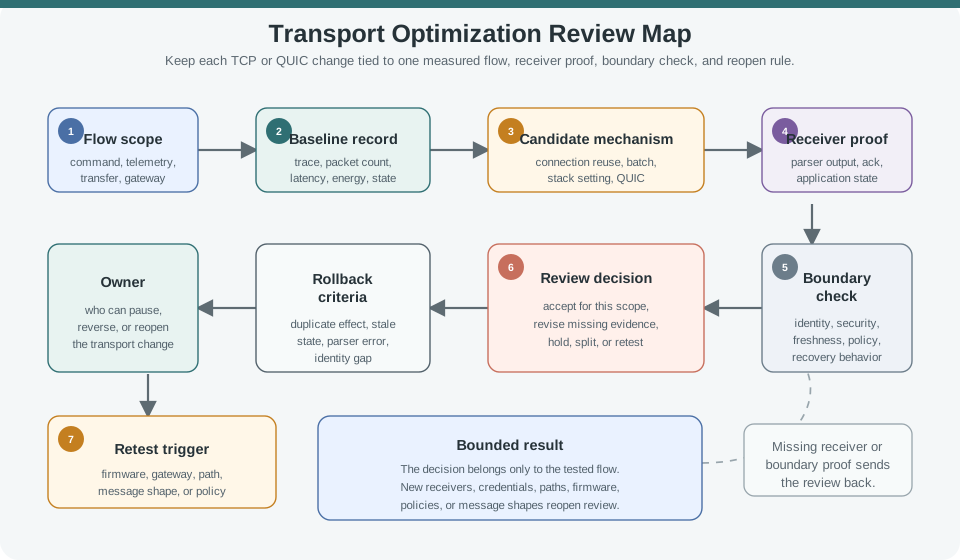
TCP Optimizations and QUIC for IoT
The team wants each command to arrive sooner.
- The device might keep a connection open.
- Yet the team has not measured the current path.
Deck summary
Key takeaways
Losing the warning may ruin a crop.
- Transport selection starts with message purpose, not protocol names.
- A transport decision record should name the sender, receiver, path segment, failure meaning, reliability owner, security boundary, evidence used, accepted tradeoff, owner, and retest trigger.
- Transport behavior is only one part of the decision.
- The team wants each command to arrive sooner.
Retrieval practice
Recall check 1 of 6

Packet Pete says: answer from memory, then check your reasoning.
Q1A device sends telemetry, firmware bundles, and actuator commands. What is the safest first transport-review move?
Show answer
Answer: B Transport scenario review begins by splitting unlike message flows and naming the failure meaning for each one.
Retrieval practice
Recall check 2 of 6

Packet Pete says: answer from memory, then check your reasoning.
Q2Which scenario record is strongest for a remote actuator command?
Show answer
Answer: C Confirmed command flows require explicit receiver and final-state evidence because transport success is not the same as application success.
Retrieval practice
Recall check 3 of 6

Packet Pete says: answer from memory, then check your reasoning.
Q3A gateway buffers readings, retries upload, and terminates security before forwarding records to a cloud API. Which retest trigger is most relevant?
Show answer
Answer: D Transport selections must be retested when ownership boundaries, endpoint constraints, or receiver rules change.
Retrieval practice
Recall check 4 of 6

Packet Pete says: answer from memory, then check your reasoning.
Q4A cold-room gateway opens a new TCP connection for every compressor command, while a pilot QUIC path carries bulk firmware chunks on the same backhaul. Which first record keeps the optimization decision bounded?
Show answer
Answer: B Transport optimization review should keep command reuse and bulk-transfer experiments separate, then compare each named flow against baseline behavior, receiver evidence, security boundaries, rollback criteria, ownership, and retest triggers.
Retrieval practice
Recall check 5 of 6

Packet Pete says: answer from memory, then check your reasoning.
Q5A gateway keeps a TCP connection open for repeated commands. The trace shows that the connection stayed open, but no receiver-side command state is included. What is the best review response?
Show answer
Answer: A A transport optimization record should connect the proposed mechanism to baseline evidence, receiver behavior, boundary checks, rollback criteria, and retest triggers.
Retrieval practice
Recall check 6 of 6

Packet Pete says: answer from memory, then check your reasoning.
Q6A QUIC proposal shows client-side stream separation, but the record lacks server state, identity checks after resumption, and an observability plan. What should the reviewer do?
Show answer
Answer: A QUIC review should preserve receiver evidence, security-boundary evidence, observability limits, rollback criteria, and retest triggers for the scoped flow.
Print reference
Answers 1 of 2
Answer key.
- B · Transport scenario review begins by splitting unlike message flows and naming the failure meaning for each one.
- C · Confirmed command flows require explicit receiver and final-state evidence because transport success is not the same as application success.
- D · Transport selections must be retested when ownership boundaries, endpoint constraints, or receiver rules change.
Print reference
Answers 2 of 2
Answer key.
- B · Transport optimization review should keep command reuse and bulk-transfer experiments separate, then compare each named flow against baseline behavior, receiver evidence, security boundaries, rollback criteria, ownership, and retest triggers.
- A · A transport optimization record should connect the proposed mechanism to baseline evidence, receiver behavior, boundary checks, rollback criteria, and retest triggers.
- A · QUIC review should preserve receiver evidence, security-boundary evidence, observability limits, rollback criteria, and retest triggers for the scoped flow.