Transport Protocols · Study deck

Matching Transport to Message Purpose

A cloud service sends a sampling-interval change to a gateway, which forwards it to a sleeping sensor.

Packet Pete is your guide for this deck.

transport-protocolsdtlsflow-evidence
Packet Pete, the module guide, in a scene from this chapter.
iotclass.org

After studying this chapter

Learning objectives

You will be able to:

  • Explain: Repeating a desired interval with the same command identity can be designed to leave one final setting, while repeating an action such as toggle may need stronger protection against duplicate execution.
  • Explain: One user-visible command can cross a managed stream, a datagram exchange and a local device interface, each with its own retry and timing rules.
  • Explain: That sequence keeps a protocol label from replacing application proof and carries the overview's flow-first reasoning into a durable review artifact.
  • Explain: Flow purpose, endpoint sleep behavior, gateway role, timeout policy, protection boundary, or receiver rule changes.
iotclass.org

Major section

Start With the Receiver Evidence

A protocol is a set of rules that two ends use for an exchange.

  • The key question is what the far side saw and what the app did next.
  • More checks and retries can aid delivery, but they spend time, power, and link space.
  • The records later in the chapter tie wire events to user-visible proof.
iotclass.org

Major section

Practitioner: Write the Transport Evidence Record
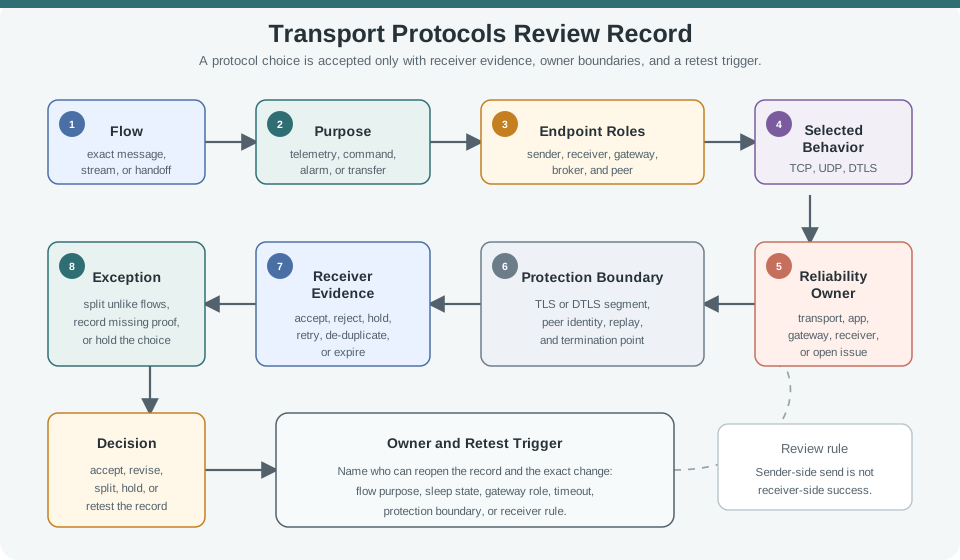
A useful transport record is compact enough to retest later.

  • The evidence map becomes operational when its decisions are preserved in a compact record.
  • That sequence keeps a protocol label from replacing application proof and carries the overview's flow-first reasoning into a durable review artifact.
  • Treating sender-side send as proof of application success.

Why it matters

Failure it prevents.

Transport protocols review record. Keep each protocol choice tied to the flow, purpose, endpoint roles, behavior, reliability owner, protection boundary, receiver evidence, exception, decision owner, and retest trigger that another reviewer can repeat.
iotclass.org

Major section

Practitioner: Write the Transport Evidence Record (continued)
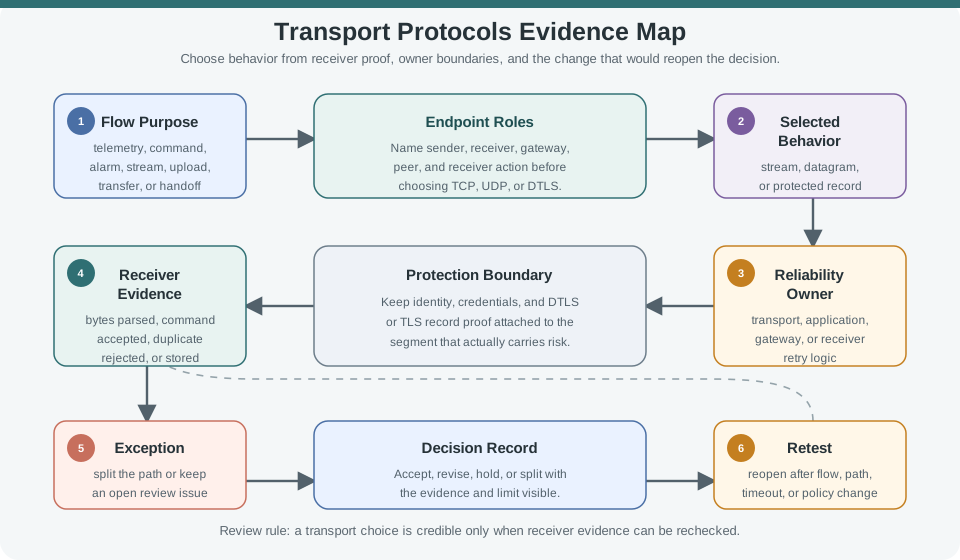
Flow purpose, endpoint sleep behavior, gateway role, timeout policy, protection boundary, or receiver rule changes.

  • Worked Record: Configuration Command A service sends a configuration command through a gateway to a device.
  • The record should not stop at the cloud-to-gateway transport segment.
  • If the gateway changes transport behavior, split the review into segment records.
iotclass.org

Major section

Trace the Command across Two Different Transport Segments

The transport sender cannot infer the physical result from silence.

  • The first transport segment takes 30 ms; the onward delay is 400 ms.
  • If the device confirms the applied setting at 470 ms, the complete observed response time is 470 ms.
  • The message contract, not the transport name alone, determines the safe recovery.

Numbers to remember

30 msThe first transport segment takes 30 ms
400 msthe onward delay is 400 ms.
470 msthe complete observed response time is 470 ms.
iotclass.org

Major section

Trace the Command across Two Different Transport Segments (continued)

A gateway receipt at 30 ms is not an acknowledgement that the message changed the sensor.

  • The gateway should preserve that identity when changing transport representation, along with the target device and requested interval.
  • It may acknowledge durable local queueing, but the reply must name that state instead of implying device completion.
  • Forwarding it later would violate its purpose even if transport delivery then succeeds.
iotclass.org

Major section

Trace the Command across Two Different Transport Segments (continued)

Repeating a desired interval with the same command identity can be designed to leave one final setting, while repeating an action such as toggle may need stronger protection against duplicate execution.

  • These application states sit above transport packet or stream observations.
  • One user-visible command can cross a managed stream, a datagram exchange and a local device interface, each with its own retry and timing rules.
  • Preserve the intended outcome through those changes rather than merging several successful segment records into an unsupported end-to-end success.
iotclass.org

Major section

Summary

The summary points below preserve that chain and the message, gateway, retry, parser, or policy change that would make its conclusion stale.

  • A replaceable reading, alarm, command, and firmware chunk can demand different acknowledgement, ordering, freshness, duplicate, and recovery behavior.
  • Separate records make those differences visible and let later changes reopen only the affected transport decision.
  • Transport protocol review starts with the application flow, endpoint roles, and receiver action.

Why it matters

Receiver evidence prevents sender-side transmission from being mistaken for application success.

iotclass.org

Deck summary

Key takeaways

A protocol is a set of rules that two ends use for an exchange.

  • A useful transport record is compact enough to retest later.
  • Flow purpose, endpoint sleep behavior, gateway role, timeout policy, protection boundary, or receiver rule changes.
  • The transport sender cannot infer the physical result from silence.
  • A gateway receipt at 30 ms is not an acknowledgement that the message changed the sensor.
iotclass.org

Retrieval practice

Recall check 1 of 3

Packet Pete says: answer from memory, then check your reasoning.

Q1A gateway forwards telemetry and commands through the same network path. What should a transport review avoid?

AWriting separate records for TCP evidence, UDP datagrams, and receiver actions.
BUsing one generic protocol conclusion across flows with different evidence needs.
CNaming endpoint roles and message purpose before choosing transport behavior.
DRecording where DTLS or another protection boundary changes the review.
Show answer

Answer: B Transport review should be flow-specific because different IoT messages have different reliability and security consequences.

iotclass.org

Retrieval practice

Recall check 2 of 3

Packet Pete says: answer from memory, then check your reasoning.

Q2A review record says a gateway command uses TCP from the service to the gateway, so the device command is reliable. What is the strongest review response?

AAccept the record because TCP on the first segment proves the downstream command.
BReject TCP for all gateway paths and require UDP for device commands.
CRequire downstream evidence for gateway handoff, device acceptance, duplicates, and protection.
DIgnore receiver behavior because transport review ends at network endpoints.
Show answer

Answer: C Gateway boundaries split transport review into segment behavior, reliability ownership, protection, and receiver-state evidence.

iotclass.org

Retrieval practice

Recall check 3 of 3

Packet Pete says: answer from memory, then check your reasoning.

Q3A UDP telemetry path now carries safety alarms, and the receiver must act on every current alarm. What should happen to the old transport record?

ARetest it, because message consequence, reliability ownership, receiver acceptance, and protection evidence have changed.
BKeep it unchanged because the IP path is the same.
CDelete receiver evidence because UDP never needs application review.
DAccept the protected packet without checking receiver action, replay handling, alarm identity, or final alarm state.
Show answer

Answer: A Transport decisions become stale when message meaning, reliability ownership, receiver behavior, or security boundaries change.

iotclass.org

Print reference

Answers

Answer key.

  1. B · Transport review should be flow-specific because different IoT messages have different reliability and security consequences.
  2. C · Gateway boundaries split transport review into segment behavior, reliability ownership, protection, and receiver-state evidence.
  3. A · Transport decisions become stale when message meaning, reliability ownership, receiver behavior, or security boundaries change.
iotclass.org