Transport Protocols · Study deck

Transport Protocols by Analogy

Packet loss means that a sent message does not arrive.

Packet Pete is your guide for this deck.

tcp-udp-analogiestransport-evidencereview-language
Packet Pete, the module guide, in a scene from this chapter.
iotclass.org

After studying this chapter

Learning objectives

You will be able to:

  • Explain: The concepts in this chapter form a loop: an analogy introduces a transport idea, evidence tests the translation, the application boundary limits the claim, and the decision record says whether the phrase may remain in use.
  • Explain: A finding is resolved only when the analogy's limit and retest condition are explicit, so a conversation, receipt, note, or queue cannot quietly expand into an unsupported delivery or acceptance claim.
  • Explain: It starts with the flow being explained, names the analogy, maps that analogy to transport evidence, then records the application behavior still outside the analogy.
iotclass.org

Major section

Start With the Analogy Boundary

A friendly story can hide retries, security, message limits, or work that the application must still do.

  • Packet loss means that a sent message does not arrive.
  • A protocol is a shared set of message rules.
  • TCP is a transport that keeps an ordered connection.
  • UDP means User Datagram Protocol.
iotclass.org

Major section

Start With the Analogy Boundary (continued)

It sends separate messages without that built-in ordered connection.

  • The call helps explain shared state and order.
  • These two stories cannot prove that one transport is always safer or faster.
  • They do not choose time limits, retry rules, or failure action.
  • Real traffic and product risk must set those choices.
iotclass.org

Major section

In 60 Seconds · Minimum Viable Understanding

Analogies are useful when they help reviewers ask better questions.

  • TCP can be compared to a conversation with ordered turns, while UDP can be compared to individual notes sent without a conversation.
  • Those comparisons are only starting points.
  • If an analogy hides what the application still must prove, it is too loose for review.

Key terms

TCP
TCP is a byte-stream transport with connection state, ordering, acknowledgement, retransmission, and close behavior.
Plain-English explanations
Plain-English explanations are acceptable only when they preserve that boundary.
iotclass.org

Major section

Why Use Analogies Carefully · Useful Analogy Patterns

An individual-note analogy fits UDP when it explains datagrams.

  • Saying that TCP is like a signed conversation can help explain acknowledgement and ordering, but it must not imply that the application command was safe, authorized, or applied to the right state.
  • Saying that UDP is like sending individual notes can help explain datagrams, but it must not imply that UDP is always careless.
  • A transport acknowledgement may confirm bytes or packets at one layer.
iotclass.org

Major section

Worked Review: Measurement Note · Worked Review: Command Conversation

A team describes a periodic measurement flow as "just a quick note." That analogy may fit if the next measurement replaces the previous one, but the review still needs evidence.

  • The analogy is accepted only if it leads to those records.
  • It should not become a shortcut for ignoring stale or duplicate measurements.
  • The analogy is useful when it reminds reviewers to check turns in the exchange.
iotclass.org

Major section

Common Findings

A finding is resolved only when the analogy's limit and retest condition are explicit, so a conversation, receipt, note, or queue cannot quietly expand into an unsupported delivery or acceptance claim.

  • TCP is described as proof that a command succeeded.
  • UDP is described as disposable without checking freshness or duplicate rules.
  • A receipt analogy fails to say what layer is being acknowledged.
  • The same analogy is reused after flow, timeout, retry, or state rules change.
iotclass.org

Major section

Ordering Quiz · Overview: Analogy Is A Bridge Back To Evidence
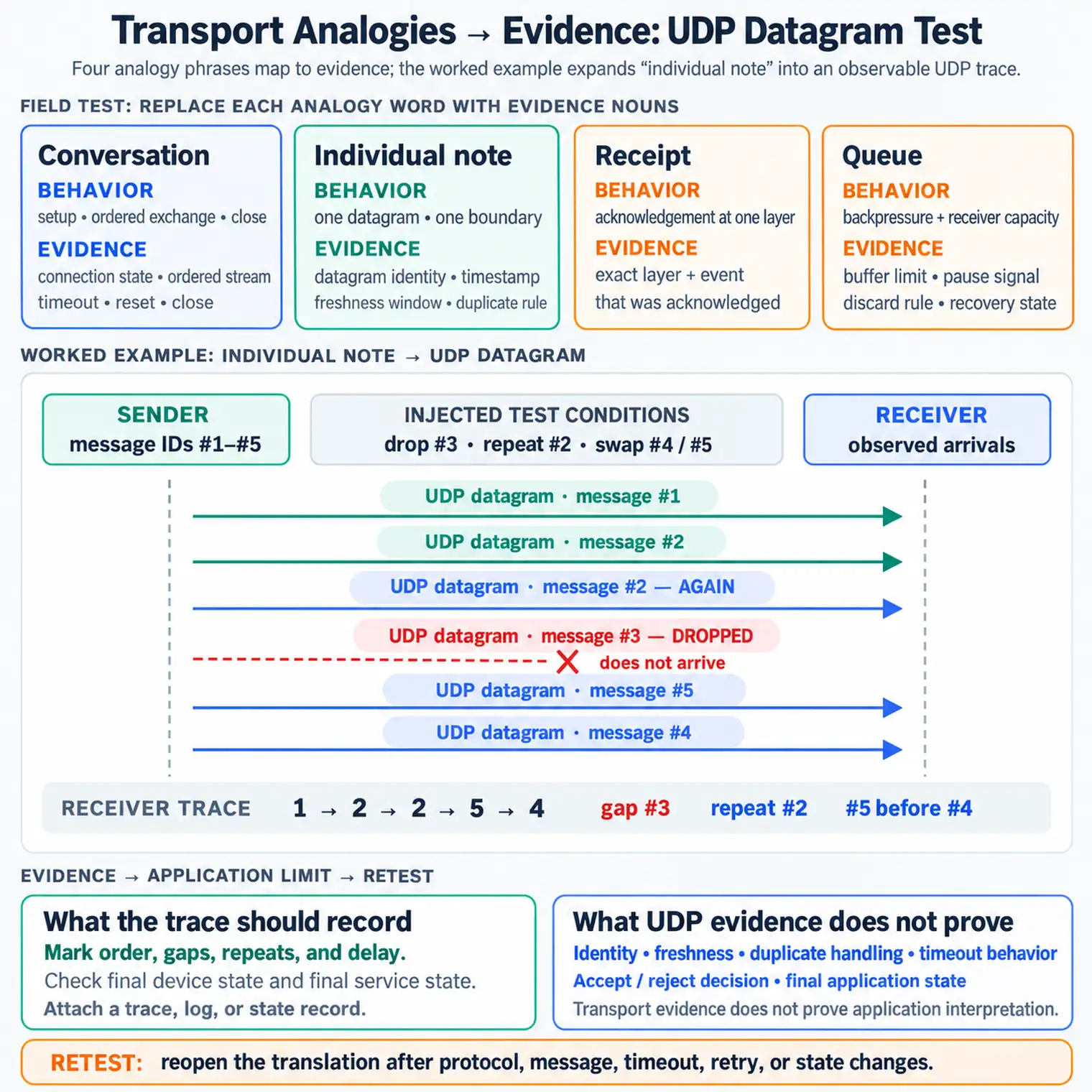
Each phrase is useful only when the review maps it back to observable evidence.

  • A TCP connection can carry bytes without proving the command was authorized or applied.
  • A UDP datagram can arrive without proving that the receiver accepted a fresh measurement.
  • That translation step is what keeps analogies useful for review.

Key terms

If a late value
If a late value is harmless because the next sample replaces it, the note analogy may be enough after the freshness rule is attached.

Why it matters

The boundary matters because transport behavior and application behavior are different claims.

Transport analogy translation map. Each everyday phrase must translate into protocol behavior, observable evidence, and an explicit limit before it supports a review decision.
iotclass.org

Major section

Practitioner: Write The Analogy Boundary Record · Under the Hood: Transport Metaphors Break At Layer Boundaries
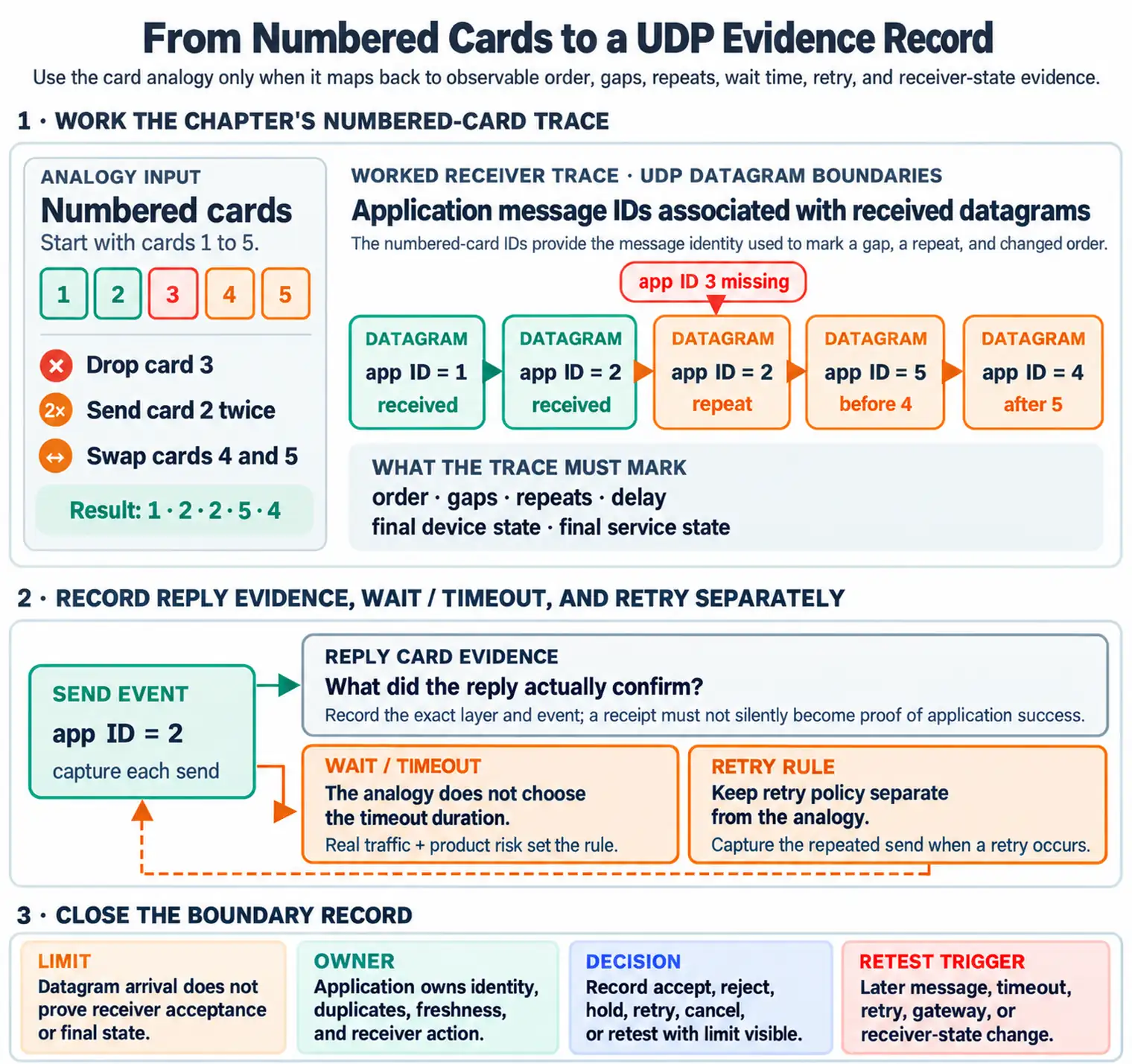
The boundary record keeps plain-language explanation useful without letting it overclaim.

  • It starts with the flow being explained, names the analogy, maps that analogy to transport evidence, then records the application behavior still outside the analogy.
  • Finish with the comparison limit, decision, owner, and retest trigger.

Key terms

After the translation
After the translation is agreed, the team needs a record that keeps the metaphor tied to one actual flow.
Layer boundaries
Layer boundaries are also where analogies become misleading during debugging.

Why it matters

Failure It Prevents.

Transport analogy evidence record. The phrase is useful only when it maps to transport evidence, application responsibility, the comparison limit, and the retest trigger.
iotclass.org

Major section

Summary · Key Takeaway

Transport analogies are useful when they improve review evidence.

  • Conversation, note, receipt, and queue comparisons can explain TCP, UDP, acknowledgements, and flow control, but each comparison has limits.
  • The safest habit is to translate every analogy back into observable records: flow, protocol behavior, evidence, application responsibility, limit, decision, and retest trigger.
  • Analogies are useful only when they lead back to real transport properties: ordering, reliability, connection state, congestion, and security.
iotclass.org

Major section

Concept Relationships

The concepts in this chapter form a loop: an analogy introduces a transport idea, evidence tests the translation, the application boundary limits the claim, and the decision record says whether the phrase may remain in use.

  • A later message, timeout, retry, gateway, or receiver-state change returns the team to the start.
  • Keeping that relationship visible is what makes simple language useful without allowing it to replace protocol proof.
  • Transport Practical Apps shows how practical flows become transport review records.
iotclass.org

Deck summary

Key takeaways

A friendly story can hide retries, security, message limits, or work that the application must still do.

  • It sends separate messages without that built-in ordered connection.
  • Analogies are useful when they help reviewers ask better questions.
  • An individual-note analogy fits UDP when it explains datagrams.
  • A team describes a periodic measurement flow as "just a quick note." That analogy may fit if the next measurement replaces the previous one, but the review still needs evidence.
iotclass.org

Retrieval practice

Recall check 1 of 3

Packet Pete says: answer from memory, then check your reasoning.

Q1A learner says TCP is like a phone call, so the receiver must understand every application message. What should the reviewer clarify?

AThe analogy proves every byte was turned into the intended application command
BConnection state can fit, but parsing and authorization still need evidence
CThe analogy removes the need to discuss UDP datagrams
DThe analogy is stronger than a trace, log, or bounded review record
Show answer

Answer: B Plain-English analogies help only when learners can map them back to transport evidence and limits.

iotclass.org

Retrieval practice

Recall check 2 of 3

Packet Pete says: answer from memory, then check your reasoning.

Q2A cold-room cloud service opens a TCP connection to the gateway and sends a compressor-setpoint command, then claims the compressor accepted the new state. What is the best review response?

AAccept the record because TCP connection success proves the compressor accepted and applied the command.
BReject every transport analogy even when it names the layer, evidence, and limit.
CAsk for command identity, receiver acknowledgement, final state, and retry or rollback evidence.
DReplace TCP with UDP because UDP avoids conversation setup and therefore proves commands faster.
Show answer

Answer: C A transport analogy must translate into evidence.

iotclass.org

Retrieval practice

Recall check 3 of 3

Packet Pete says: answer from memory, then check your reasoning.

Q3A review says a gateway command path is like a phone call because the cloud opened a TCP connection to the gateway. The claim is that the sleeping device acted on the command later. What evidence is still needed?

AOnly the TCP connection log, because a connection proves the final device state.
BOnly a shorter analogy, because shorter explanations are stronger evidence.
CNo additional evidence, because gateways cannot change transport behavior.
DGateway-to-device delivery, receiver action, final state, and timeout evidence.
Show answer

Answer: D Transport analogies must split gateway and receiver boundaries so connection evidence is not promoted to application-state proof.

iotclass.org

Print reference

Answers

Answer key.

  1. B · Plain-English analogies help only when learners can map them back to transport evidence and limits.
  2. C · A transport analogy must translate into evidence.
  3. D · Transport analogies must split gateway and receiver boundaries so connection evidence is not promoted to application-state proof.
iotclass.org