Transport Protocols · Study deck
User Datagram Protocol (UDP)
Picture a greenhouse node sending soil status every thirty seconds.
Broker Bex is your guide for this deck.

After studying this chapter
Learning objectives
You will be able to:
- Explain: Protected UDP paths need a separate security review, often at the application or DTLS layer, and commands with side effects need acknowledgement, identifiers, idempotent handling, or a clear failure policy above UDP.
- Explain: If packet 181 is missing but packet 182 arrives within the dashboard freshness window, the receiver can show the newer value and mark the older sample as skipped.
- Explain: It adds source port, destination port, length, and checksum information to application data, then sends each message as an independent datagram without first creating a transport session.
- explain UDP datagrams, ports, length, and checksum behavior
Major section
Start With One Datagram
Most readings can be replaced by the next one, but a valve command cannot.
- The product owner must decide which messages may be lost, late, repeated, or out of order before choosing the light send-and-forget path.
- Reachability alone does not prove trust.
- This opening does not choose the right transport for every message.
Major section
Start With One Datagram (continued)
A distant store may collect trends, but it must not be the only place that knows whether a valve may open.
- Practitioner writes and tests the receiver contract.
- Under the Hood examines checksums, ports, message size, loss, ordering, repair, and the security work that sits above the small datagram boundary.
- UDP makes that send cheap, but it also leaves delivery, ordering, retry, and acceptance decisions outside the transport itself.
Major section
Overview: UDP Is a Datagram Boundary
UDP is a connectionless transport protocol.
- It adds source port, destination port, length, and checksum information to application data, then sends each message as an independent datagram without first creating a transport session.
- That small transport boundary can be a good fit for IoT traffic when each message has bounded meaning.
Major section
Overview: UDP Is a Datagram Boundary (continued)
A routine reading can often be replaced by the next reading.
- A discovery request may need to reach more than one local endpoint.
- An application protocol such as CoAP can add acknowledgement behavior only where it is needed.
- UDP therefore works best when the review names the message consequence.
Major section
Overview: UDP Is a Datagram Boundary (continued)
For example, a greenhouse node might send soil-moisture status every 30 seconds with a sample time and sequence number.
- If packet 181 is missing but packet 182 arrives within the dashboard freshness window, the receiver can show the newer value and mark the older sample as skipped.
- Replaceable telemetry, local discovery, and one-shot diagnostic events often have tolerances that can be written down.
- The review question is not whether UDP is simple.
Major section
Overview: UDP Is a Datagram Boundary (continued)
Commands, alarms, billing records, and audit events usually need acknowledgement, identifiers, replay controls, or a different transport pattern.
- The review question is whether the application record explains what happens when a datagram is missing, duplicated, delayed, stale, or untrusted.
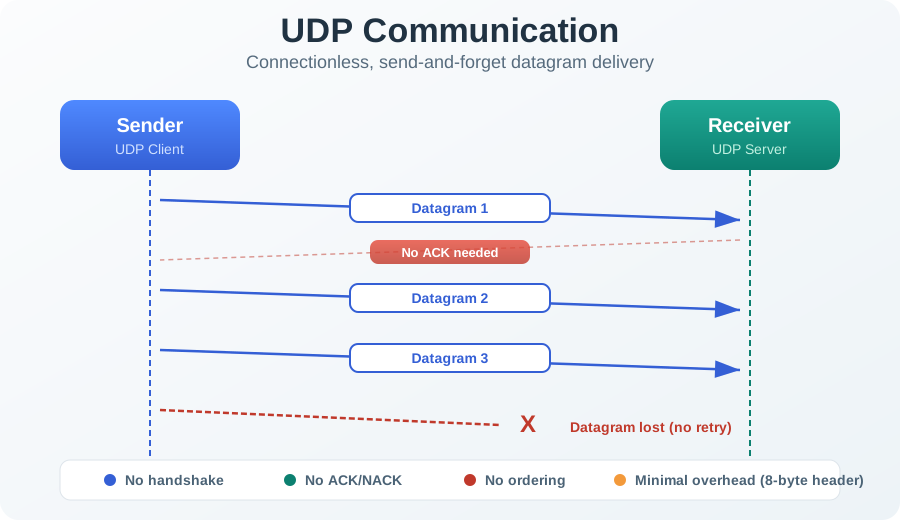
- UDP's appeal and its limit are easiest to see in one exchange.
- The small header and independent message boundary reduce transport work, but loss, ordering, duplication, backoff, and application confirmation remain outside that promise.
Major section
Practitioner: Write the Receiver Contract
The contract also needs an owner.
- The same device can use UDP for routine status while using a different acknowledgement path for commands, configuration, or firmware transfer.
- A practical contract should be testable from both sides of the path.
- If the operator accepts loss for a dashboard-only flow, the monitoring system owns the stale-data alarm.
Major section
Practitioner: Write the Receiver Contract (continued)
For a parking-space sensor, the sender record might show datagram ID, sample time, payload schema, destination service, and retry timer.
- Freshness rule, duplicate handling, sequence or identifier use, acknowledgement rule, and idempotent action.
- Assuming the receiver will infer intent from arrival alone.
- Security layer, peer identity, replay handling, retry limits, and change triggers.
Major section
Under the Hood: What UDP Does Not Promise
UDP provides port multiplexing, a datagram boundary, length information, and checksum-based corruption detection.
- The checksum is not a security boundary.
- Protected UDP paths need a separate security review, often at the application or DTLS layer, and commands with side effects need acknowledgement, identifiers, idempotent handling, or a clear failure policy above UDP.

Major section
Under the Hood: What UDP Does Not Promise (continued)
Arrival: a high-rate datagram stream reaches open and closed UDP ports.
- A receiver may parse the datagram and still reject it as stale, unauthenticated, duplicated, outside a safety window, or inconsistent with the current device state.
- Under-the-hood review should therefore ask which field carries identity or freshness, which check rejects repeats, and where rejected datagrams are logged.
- The Boundary rule blocks a DTLS claim from being reused as reliability evidence.
Major section
Under the Hood: What UDP Does Not Promise (continued)
Backoff ownerName what prevents retries, discovery responses, or bursty telemetry from creating congestion or receiver overload.
- A burst of retries, discovery responses, or telemetry reports can overload a gateway even though each datagram is individually small.
- The design evidence should name rate limits, retry backoff, multicast response spreading, queue policy, or alarm behavior.
- If nobody owns those controls, the UDP decision is incomplete even when every single datagram format is valid.
Major section
Under the Hood: What UDP Does Not Promise (continued)
In the classic closed-port pattern, an attacker sends datagrams across many destination ports, often with a forged source address.
- The host must inspect each datagram; for a closed port, the IP layer may generate an ICMP Port Unreachable response toward the forged address.
- Closed-port response: policy may emit ICMP Destination Unreachable, Port Unreachable; ICMP rate limiting can bound but not erase the inbound cost.
- Likewise, DTLS can reject unauthenticated application data, but the receiver still spends network and cryptographic work reaching that decision.
Major section
Summary
UDP is a deliberately small transport protocol.
- It gives applications ports, datagram boundaries, length, and checksum behavior without creating a reliable ordered stream.
- That makes UDP useful for bounded IoT messages, discovery traffic, and application protocols that own their own acknowledgement or retry behavior.
- For review, the important evidence is the receiver contract: message meaning, freshness, duplicate handling, retry ownership, protection boundary, operational visibility, and retest triggers.
Deck summary
Key takeaways
Most readings can be replaced by the next one, but a valve command cannot.
- A distant store may collect trends, but it must not be the only place that knows whether a valve may open.
- UDP is a connectionless transport protocol.
- A routine reading can often be replaced by the next reading.
- For example, a greenhouse node might send soil-moisture status every 30 seconds with a sample time and sequence number.
Retrieval practice
Recall check 1 of 3

Packet Pete says: answer from memory, then check your reasoning.
Q1Which claim is strong enough to justify UDP for an IoT status-reading path?
Show answer
Answer: A A useful UDP decision names the message meaning, acceptable failure behavior, receiver responsibility, and review trigger.
Retrieval practice
Recall check 2 of 3
Packet Pete says: answer from memory, then check your reasoning.
Q2A gateway sometimes receives duplicated UDP readings because the application retries above UDP. What should the design record show?
Show answer
Answer: C When retry behavior sits above UDP, receiver-side duplicate handling and freshness rules become part of the design evidence.
Retrieval practice
Recall check 3 of 3
Packet Pete says: answer from memory, then check your reasoning.
Q3A UDP command must not create duplicate side effects if a retry occurs. Which design evidence is most important?
Show answer
Answer: D Side-effecting UDP commands need application-level evidence for acknowledgement, identifiers, idempotency, duplicate handling, and failure behavior.
Print reference
Answers
Answer key.
- A · A useful UDP decision names the message meaning, acceptable failure behavior, receiver responsibility, and review trigger.
- C · When retry behavior sits above UDP, receiver-side duplicate handling and freshness rules become part of the design evidence.
- D · Side-effecting UDP commands need application-level evidence for acknowledgement, identifiers, idempotency, duplicate handling, and failure behavior.