Testing & Validation · Study deck
Traffic Capture Tools
Traffic tools feel technical, but their first question is ordinary: where should the recorder stand?
Test Tessa is your guide for this deck.

After studying this chapter
Learning objectives
You will be able to:
- place a capture tool where it can actually see the traffic in question
- match a tool to its role (capture, decode, record) instead of treating it as an oracle
- preserve capture evidence and read it honestly
- Explain: A traffic-analysis tool does one thing: it records the packets that reach its observation point, in whatever mode it is running.
Major section
Tools Are Evidence Collectors, Not Oracles
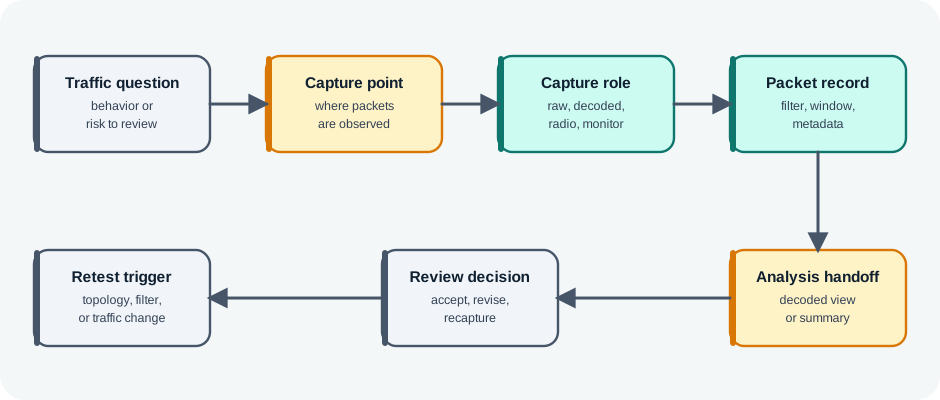
A traffic-analysis tool does one thing: it records the packets that reach its observation point, in whatever mode it is running.
- That makes it an evidence collector, and like any evidence collector its output is only as good as where it was placed, what it was allowed to see, and how the record was preserved.
Major section
Tools Are Evidence Collectors, Not Oracles (continued)
The mistake that wastes traffic reviews is treating a tool's output as a complete explanation.
- Strong tool use pairs the capture with its context — observation point, mode, filter, clock — and compares it against device logs and service records before drawing a conclusion.
- The tool collects evidence; you still have to bound the conclusion to what that vantage point could see.
- The One-Minute ViewMatch role to question Graphical analyzer, CLI capture, scriptable decode, or radio capture — pick the role the question needs.
- Beginner ExamplesRead these examples as a progression from the simplest observation to the boundary that still needs evidence.
Major section
Tool Roles and Getting Traffic to Them
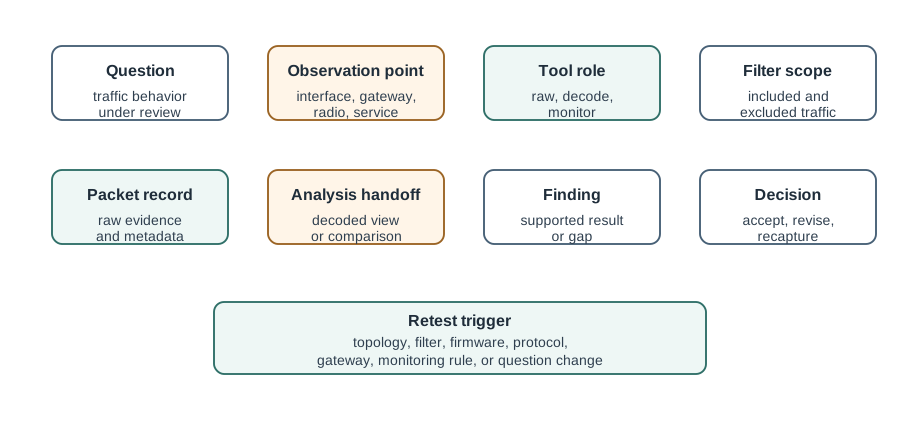
Choosing a tool is really choosing a role for the observation point and the question.
- Heavy to run on constrained or remote devices.
- A summary can hide context unless the raw file is kept.
- Application and monitoring records at the far end.
Major section
Tool Roles and Getting Traffic to Them (continued)
The route connects correct capture placement to an auditable conclusion and exposes packets that were merely out of view.
- Getting the Traffic to the ToolOn a switched network, a host in promiscuous mode sees only the frames the switch forwards to its port — its own, broadcast, and multicast — not other devices' conversations.
- Wi-Fi frame capture needs monitor mode on the right channel; BLE and Zigbee need protocol-specific radio sniffers.
- If you can match the role to the question and get the traffic to the tool, you can stop here.
Major section
Preserving Evidence and Reading the Capture Honestly
The pcapng format carries useful metadata alongside the packets — interface details, timestamps, and comments — and keeping the raw file lets a later reviewer decode it differently or check a field the first summary omitted.
- A decoded note without its raw record is a review note, not durable packet evidence; if the raw file is gone, say so and limit the conclusion accordingly.
- Trust Timestamps, but Know Their SourceTiming analysis — latency, jitter, inter-packet gaps — depends on the capture's clock.
- Real Loss Versus Capture DropsA gap in a capture has two very different causes.
Major section
Preserving Evidence and Reading the Capture Honestly (continued)
Timestamps come from the capture point, so a single point gives consistent relative timing, but comparing captures from two points means reconciling two clocks that may drift.
- The same caution applies to a filter: a capture filter discards excluded packets permanently, so a "missing" message may simply have been filtered out, which is why the filter scope belongs in every record.
- Common Review FindingsReview these failure modes in the order they can weaken or invalidate the result.
- Finish with Over-generalized: A clean trace at one point becomes a conclusion about every path and time window.
Deck summary
Key takeaways
A traffic-analysis tool does one thing: it records the packets that reach its observation point, in whatever mode it is running.
- The mistake that wastes traffic reviews is treating a tool's output as a complete explanation.
- Choosing a tool is really choosing a role for the observation point and the question.
- The route connects correct capture placement to an auditable conclusion and exposes packets that were merely out of view.
- The pcapng format carries useful metadata alongside the packets — interface details, timestamps, and comments — and keeping the raw file lets a later reviewer decode it differently or check a field the first summary omitted.
Retrieval practice
Recall check 1 of 3

Test Tessa says: answer from memory, then check your reasoning.
Q1What is the most reliable way to use a traffic-capture tool's output as review evidence?
Show answer
Answer: D The tool is only as good as its placement and the preserved record; context (point, mode, filter, clock) is what makes the finding reproducible and bounded.
Retrieval practice
Recall check 2 of 3
Test Tessa says: answer from memory, then check your reasoning.
Q2You need to capture the traffic between two other IoT devices on a managed switch, but your capture host in promiscuous mode sees none of it. What enables the capture?
Show answer
Answer: D conversation to your port by default.
Retrieval practice
Recall check 3 of 3
Test Tessa says: answer from memory, then check your reasoning.
Q3Under heavy load, a capture shows gaps in a device's packet stream. Before concluding the network is dropping packets, what should you check first?
Show answer
Answer: C Capture drops and network loss look similar in the file but differ in cause; the tool's drop counters distinguish them before you blame the network.
Print reference
Answers
Answer key.
- D · The tool is only as good as its placement and the preserved record; context (point, mode, filter, clock) is what makes the finding reproducible and bounded.
- D · conversation to your port by default.
- C · Capture drops and network loss look similar in the file but differ in cause; the tool's drop counters distinguish them before you blame the network.