Testing & Validation · Study deck
Testing with Traffic Analysis
Traffic-analysis testing uses captured network evidence to check how an IoT system communicates under controlled conditions, and monitoring applies the same discipline continuously after release.
Test Tessa is your guide for this deck.

After studying this chapter
Learning objectives
You will be able to:
- start from a question before capturing traffic, not the other way around
- run a capture review loop against a baseline
- separate a real anomaly from a false alarm using correlation
- Explain: A long packet recording shows thousands of lines, but nobody wrote whether five retries were expected or which device should stop them.
Major section
Start Simple: Ask Before You Capture
A long packet recording shows thousands of lines, but nobody wrote whether five retries were expected or which device should stop them.
- The file is large and the evidence is weak.
- Collect only traffic you are authorized to inspect.
- Encrypted content may also hide detail.
- Monitoring uses the same habit after release.
Major section
Start Simple: Ask Before You Capture (continued)
An unusual burst is a clue; it is not proof of its cause until the other evidence agrees.
- The deeper sections show how questions, baselines, scope, and repeat tests turn packet records into reviewable decisions without overstating what was observed.
- A heartbeat that disappears is meaningful only if the expected heartbeat was named first.
- A retry burst is a signal, not a cause, until the capture scope, baseline, device logs, and change history agree.
Major section
From a Question to a Capture, Not a Pile of Files
The mistake that wastes traffic work is capturing first and asking questions later, which leaves a pile of packet files no one can interpret.
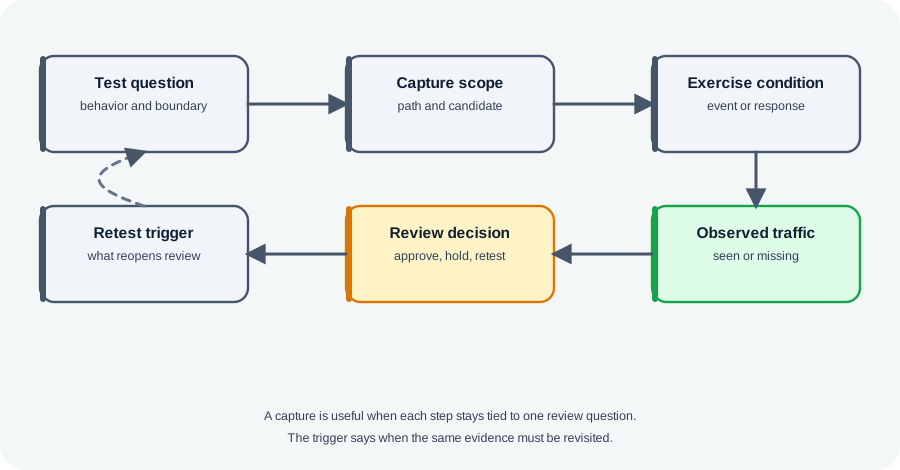
- Traffic-analysis testing inverts that: you state the communication behavior under review, define what you expect, exercise the path that should produce it, capture, observe, and decide.
- Monitoring runs the same loop forever against a baseline.
- Missing traffic is evidence only when the scope and expectation make its absence meaningful.
Major section
From a Question to a Capture, Not a Pile of Files (continued)
Monitoring is the same loop running continuously after release — it compares live traffic against an expected baseline and surfaces the differences worth a look.
- If you only need the intuition, this layer is enough: phrase a communication question, state the expected behavior, exercise the boundary, capture, and decide — on systems you are authorized to operate.
- The experiment states a hypothesis and records exactly the conditions that test it, so the result means something.
- This loop connects packet collection to a falsifiable claim, keeping the chapter focused on tests rather than accumulating unexplained files.
Major section
From a Question to a Capture, Not a Pile of Files (continued)
A traffic capture is the same: a small capture tied to a clear question is strong evidence, while a huge capture with no question is a weak record.
- Scope fixes the vantage point, interfaces, filters, and time window; the condition identifies the action or fault that should produce traffic; and the observation records what crossed that boundary.
- The One-Minute ViewQuestion before capture Name the communication behavior and the boundary first; the question is what makes the capture mean something.
- If you can put the question before the capture, you have the core idea.
Major section
The Review Loop, Baselines, and Monitoring Records
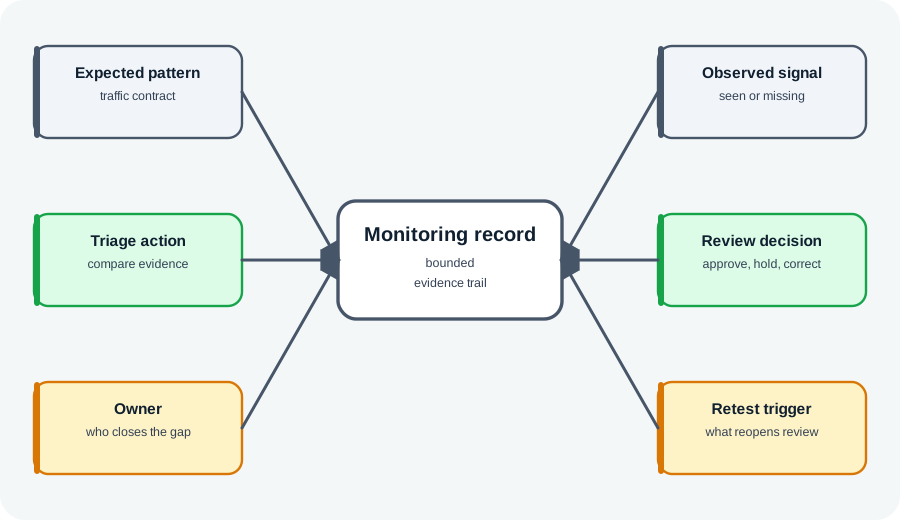
A traffic-analysis test is reviewable when each capture carries the same fields, and monitoring is reviewable when each signal does.
- The loop below keeps a test from becoming a pile of files; the baseline below keeps monitoring from becoming guesswork.
- "Does the device stop retrying after a rejected command?".
- Bounded retries, then a stop or state change.
- The event or state that should produce the traffic.
Major section
The Review Loop, Baselines, and Monitoring Records (continued)
The test question is whether the device retries as specified and then stops or changes state.
- "Is the network healthy?".
- But a deviation is a signal, not a cause, and it must stay bounded.
- If you can run the loop and keep a monitoring signal bounded, you can stop here.
Major section
Baselines, False Alarms, and Correlation
The deeper layer is about why a monitoring signal can mislead.
- Three mechanisms matter: how a baseline is built and why it drifts, how detection thresholds trade false alarms against missed events, and why an anomaly is correlation rather than cause.
- IoT traffic's regularity is what makes this tractable.
- A benign change reads as an anomaly.
Major section
Baselines, False Alarms, and Correlation (continued)
A baseline that is never maintained slowly turns into a source of false alarms.
- Baselines Are Built From Flows and They DriftFlow analysis groups packets into conversations — broadly, who talked to whom, over which ports and protocol — and summarizes their volume and timing.
- A real change passes as a false negative.
- Signal read as cause.
Major section
Baselines, False Alarms, and Correlation (continued)
Assigning a cause from the signal alone is the most common and most expensive mistake.
- A baseline is the expected shape of those flows: a sensor that reports on a regular interval, a gateway that syncs periodically.
- A Signal Is Correlation, Not CauseA deviation tells you something changed, not why.
- A bounded root-cause investigation.
Major section
Baselines, False Alarms, and Correlation (continued)
Thresholds Trade False Positives Against False NegativesTurning "different from baseline" into an alert needs a threshold, and the threshold is a trade-off.
- Neither error is free, and the right balance depends on how costly a missed event is versus a wasted investigation.
- An anomaly is treated as the root cause.
- Common PitfallsReview these failure modes in the order they can weaken or invalidate the result.
Major section
Summary
Traffic-analysis testing turns a communication question into a controlled capture, and monitoring runs the same loop continuously against an expected baseline after release.
- A capture is evidence only when tied to a question, scope, expected behavior, exercise condition, observation, and decision; "did the network stay quiet?" is not a useful question.
- Missing traffic can be a finding, but only when the scope and expected behavior make its absence meaningful.
- Monitoring uses flow analysis to baseline normal behavior.
Deck summary
Key takeaways
A long packet recording shows thousands of lines, but nobody wrote whether five retries were expected or which device should stop them.
- An unusual burst is a clue; it is not proof of its cause until the other evidence agrees.
- The mistake that wastes traffic work is capturing first and asking questions later, which leaves a pile of packet files no one can interpret.
- Monitoring is the same loop running continuously after release — it compares live traffic against an expected baseline and surfaces the differences worth a look.
- The test question is whether the device retries as specified and then stops or changes state.
Retrieval practice
Recall check 1 of 3

Test Tessa says: answer from memory, then check your reasoning.
Q1Why is a large packet capture with no stated question a weak piece of traffic-analysis evidence?
Show answer
Answer: A The question and expected behavior are what let a reviewer interpret the capture, including when missing traffic is itself a finding.
Retrieval practice
Recall check 2 of 3
Test Tessa says: answer from memory, then check your reasoning.
Q2A capture shows repeated retries after a rejected command, but the record never states the expected retry behavior or the response that triggered it. What is the strongest review feedback?
Show answer
Answer: B Retries are only interpretable against an expected behavior and a known trigger; without those the capture is not yet evidence.
Retrieval practice
Recall check 3 of 3
Test Tessa says: answer from memory, then check your reasoning.
Q3After a firmware update, monitoring flags a device group as anomalous because its reporting pattern changed, and an operator wants to declare an incident. What is the strongest response?
Show answer
Answer: C The deviation is a signal, and a known configuration change is a likely benign cause; confirm against intended behavior and update the baseline rather than assuming an incident.
Print reference
Answers
Answer key.
- A · The question and expected behavior are what let a reviewer interpret the capture, including when missing traffic is itself a finding.
- B · Retries are only interpretable against an expected behavior and a known trigger; without those the capture is not yet evidence.
- C · The deviation is a signal, and a known configuration change is a likely benign cause; confirm against intended behavior and update the baseline rather than assuming an incident.