Testing & Validation · Study deck
Traffic Analysis Fundamentals
Picture a temperature reading that appears in the device log but never changes the dashboard.
Test Tessa is your guide for this deck.

After studying this chapter
Learning objectives
You will be able to:
- treat a packet capture as evidence, not the whole story
- choose capture points and filters that bound what can be measured
- read protocol state from a capture to support a narrow, defensible claim
- Explain: A focused trace can show which boundary first loses the message.
Major section
Start Simple: Follow One Missing Message
A focused trace can show which boundary first loses the message.
- A gateway means the boundary system that connects local devices to another network or service.
- A protocol means shared rules for exchanging messages.
- This runway does not prove the whole cause from one capture.
- The first move is not to capture everything.
Major section
Start Simple: Follow One Missing Message (continued)
The deeper sections explain review questions, observation points, filters, timing, protocol state, privacy, correlation, and evidence limits.
- That question gives traffic analysis its shape.
- You choose the place to watch, keep the packet record, and compare what the wire showed with the device log and service record.
- If the message is absent at the device, the story is different from a message that leaves the device but never reaches the service.
Major section
Packets Are Evidence, Not the Whole Story
Traffic analysis lets you compare what a device claims it did with what the network actually carried.
- In IoT systems that comparison explains the failures that logs alone cannot: missing messages, unexpected reconnects, wrong protocol state, endless retries, or a quiet disagreement between a device log and a service record.
- The discipline that keeps it honest is simple.
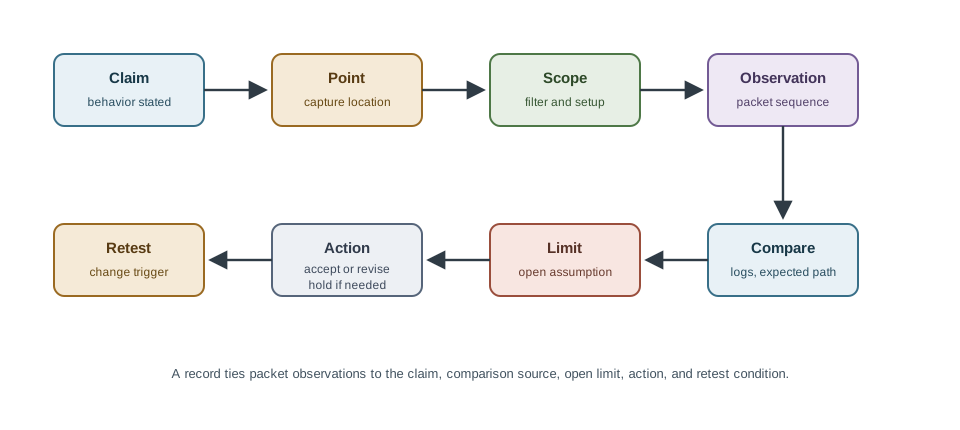
- This sequence connects raw packets to the chapter's evidence-first analysis discipline.
Major section
Packets Are Evidence, Not the Whole Story (continued)
The question identifies the behavior in dispute; the point and scope determine which packets can be seen; and the evidence limit names what an encrypted payload or unseen segment cannot prove.
- The One-Minute ViewQuestion first Start from the behavior that needs packet evidence, not from the capture tool.
- Point has blind spotsA capture only shows what is visible from where it was taken.
- Beginner ExamplesRead these examples as a progression from the simplest observation to the boundary that still needs evidence.
Major section
Capture Points, Filters, and What You Can Measure
Whether the device attempted to send traffic.
- Reconciling device logs with service records.
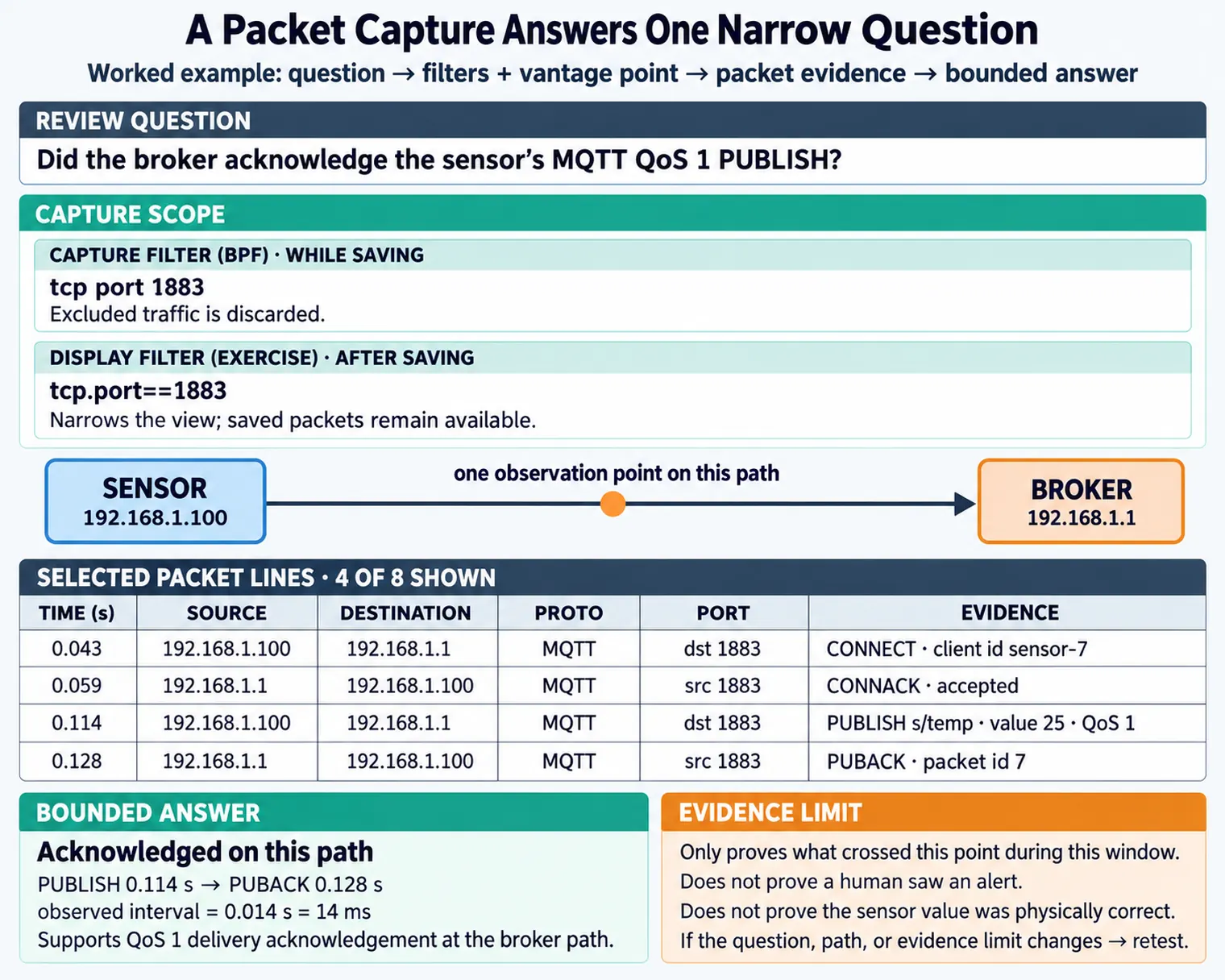
- A display filter is applied after packets are saved; it narrows what you look at while preserving the full capture for later questions, which is safer when the investigation might change direction.
Major section
Capture Points, Filters, and What You Can Measure (continued)
Either way, the filter belongs in the record so another reviewer can repeat the analysis.
- Wireless review usually needs monitor mode or a dedicated radio capture path, and the record must name the channel, mode, and adapter, because a wireless capture on the wrong channel is silently incomplete.
- The decision and reopen rule connect what crossed one observation point to the next investigation without inventing a root cause.
- If you can pick the right capture point, distinguish the two kinds of filter, and read latency, jitter, and loss, you can stop here.
Major section
Protocol State and Bounding the Claim
A trace that shows a protocol state does not prove the firmware chose the right state.
- The deeper skill is reading the conversation, not just counting packets, and then refusing to conclude more than the trace can support.
- Encryption Hides Contents, Not MetadataEncryption protects the payload, not the envelope.
- An application-layer root cause.
Major section
Protocol State and Bounding the Claim (continued)
A TCP connection shows its handshake, retransmissions, and resets; an MQTT session shows CONNECT, SUBSCRIBE, and PUBLISH exchanges; a CoAP exchange shows requests, responses, and retransmissions over UDP.
- A secured session shows its handshake too — a TLS handshake over TCP, or a DTLS handshake for CoAP over UDP — so you can confirm whether an encrypted session even started before application data was attempted.
- Traffic was visible at that vantage point.
- A secure session was negotiated.
Major section
Protocol State and Bounding the Claim (continued)
Bound Every ConclusionA trace that shows a message moved does not prove the sensor reading was correct.
- Even when you cannot read application data, the capture still exposes the endpoints, the timing, the packet sizes, the retransmissions, and the connection resets.
- A service record showing received traffic does not show what happened earlier on the local network.
- That the firmware logic was correct to do so.
Major section
Protocol State and Bounding the Claim (continued)
That metadata is often enough to localize a problem to the transport or the path — but it is not enough to prove an application-layer cause, and that boundary is exactly where over-conclusion happens.
- Common FindingsReview these failure modes in the order they can weaken or invalidate the result.
- Finish with Conclusion too broad: A network observation is stretched into a claim about the sensor or the firmware.
- This sequence connects each warning to the evidence a reviewer should demand before accepting the claim.
Deck summary
Key takeaways
A focused trace can show which boundary first loses the message.
- The deeper sections explain review questions, observation points, filters, timing, protocol state, privacy, correlation, and evidence limits.
- Traffic analysis lets you compare what a device claims it did with what the network actually carried.
- The question identifies the behavior in dispute; the point and scope determine which packets can be seen; and the evidence limit names what an encrypted payload or unseen segment cannot prove.
- Whether the device attempted to send traffic.
Retrieval practice
Recall check 1 of 3

Test Tessa says: answer from memory, then check your reasoning.
Q1A packet capture has been collected for an IoT device. What is the most reliable way to use it as review evidence?
Show answer
Answer: B Traffic analysis is strongest when each capture is tied to a question, a vantage point, a recorded scope, and an explicit statement of its blind spots.
Retrieval practice
Recall check 2 of 3
Test Tessa says: answer from memory, then check your reasoning.
Q2A device log says a message was sent, but a capture taken only at the service boundary does not show the message. What is the strongest traffic-analysis review action?
Show answer
Answer: A The service-side view is useful, but it cannot show the whole path by itself.
Retrieval practice
Recall check 3 of 3
Test Tessa says: answer from memory, then check your reasoning.
Q3A gateway-side capture of an encrypted IoT session shows repeated TCP retransmissions followed by a connection reset, but the payloads are unreadable. What information remains observable despite encryption?
Show answer
Answer: B The envelope is still visible, so a transport or path problem is well supported, but an application root cause is not.
Print reference
Answers
Answer key.
- B · Traffic analysis is strongest when each capture is tied to a question, a vantage point, a recorded scope, and an explicit statement of its blind spots.
- A · The service-side view is useful, but it cannot show the whole path by itself.
- B · The envelope is still visible, so a transport or path problem is well supported, but an application root cause is not.