Network Topologies · Study deck
Managing Live Topology Changes
A warehouse moves a wireless gateway to clear a loading bay, and twenty sensor routes change with it.
Packet Pete is your guide for this deck.

After studying this chapter
Learning objectives
You will be able to:
- name the five topology-management decision types used in this module (active set, role assignment, route adjustment, data-value decision, mode change)
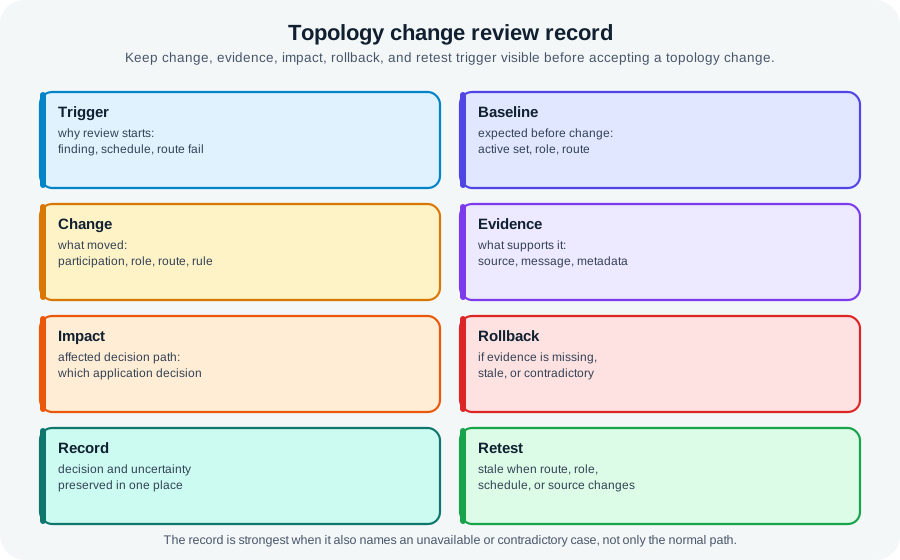
- state the evidence a topology-change review record must preserve (trigger, baseline, change, evidence, impact, rollback, retest)
- review a relay-role reassignment and identify the receive, forward, metadata, and quality-state evidence it needs before acceptance
- distinguish a bounded topology decision from an unsupported "universal improvement" claim
Major section
Manage a Gateway Move Without Losing the Map
A planned move can have a window and baseline; an unplanned topology route loss needs containment before optimization.
- Figure: Topology management review record fields for trigger lists the evidence that closes the change.
- A final managed topology picture without the previous state cannot show which dependencies moved.
- Topology discovery must be bounded.
Major section
Manage a Gateway Move Without Losing the Map (continued)
After the move, require 20 identities and no persistent loop or flap.
- After the topology change, 14 are direct, five use one relay, and sensor S19 has no path.
- The total number still shown in inventory is 20, but reachable service has fallen to 19.
- A file existing is not restoration evidence.
Major section
Manage a Gateway Move Without Losing the Map (continued)
A stable but overloaded relay can also be a failed outcome even if every device appears connected.
- If S19 remains absent or a relay exceeds its limit, restore the old position or apply the pre-approved alternate.
- The review change record should explain every changed topology route, not merely contain a green status.
- A node disappearing from the live map must remain visible as missing, not vanish from both the picture and denominator.
Major section
Manage a Gateway Move Without Losing the Map (continued)
Repeated movement between two parents can drain batteries and reorder traffic even when both links pass simple reachability.
- Retired devices need a dated state so they are not mistaken for faults.
- It must not suppress an unrelated loss outside the window.
- Close the change only when the evidence set reconciles.
Major section
Manage a Gateway Move Without Losing the Map (continued)
A routing system may choose a new parent without a human ticket, but thresholds, hysteresis, timers, and allowed neighbours are still managed policy.
- If nineteen sensors work but the remaining routes now depend on one battery relay, the change may have introduced a failure concentration that the count hides.
- A missing stream during the approved move should be labelled maintenance, but the label must have a start, end, owner, and affected devices.
- Some faults appear only when doors close, machines start, traffic bursts, or batteries reach a low state.
Major section
Manage a Gateway Move Without Losing the Map (continued)
The final change record should state which conditions were observed and which remain assumptions requiring later review.
- A tool can flag added nodes, missing links, changed parents, and threshold breaches, but a named owner should decide whether the observed topology fits the maintenance intent.
- Returning hardware to its old position does not prove routes, credentials, alerts, and stored data all returned to their former state.
- Approving the change because “most nodes rejoined” would leave one physical shelf unmonitored.
Major section
Start With the Story
A nearby device takes over and the warning path works again.
- The quick repair looks successful, but no one has checked whether replies return, batteries will last, or the new path crosses an unapproved boundary.
- A gateway is a device that joins one network to another.
- One set of trials cannot prove every future network shape.
Major section
Start With the Story (continued)
Movement and load can create new risks.
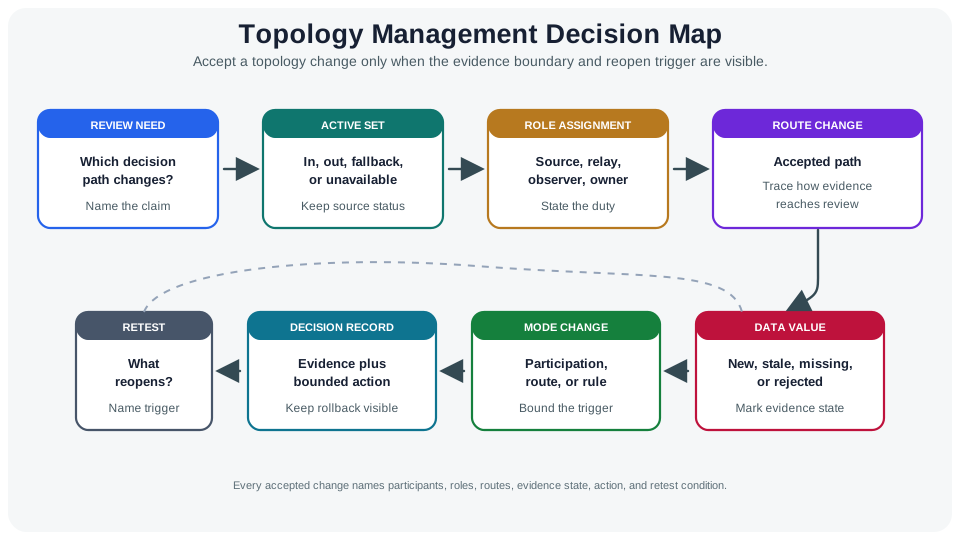
- The deeper sections show how active sets, role changes, route updates, data value, and context rules turn live adaptation into a controlled topology record.
- After deployment, the topology is still alive.
- A node can become a relay, a route can be retired, a gateway can move to fallback, or a noisy sensor can be removed from the active set.
Deck summary
Key takeaways
A planned move can have a window and baseline; an unplanned topology route loss needs containment before optimization.
- After the move, require 20 identities and no persistent loop or flap.
- A stable but overloaded relay can also be a failed outcome even if every device appears connected.
- Repeated movement between two parents can drain batteries and reorder traffic even when both links pass simple reachability.
- A routing system may choose a new parent without a human ticket, but thresholds, hysteresis, timers, and allowed neighbours are still managed policy.
Retrieval practice
Recall check 1 of 3

Packet Pete says: answer from memory, then check your reasoning.
Q1A gateway is about to promote one sensor to relay and drop two stale sensors from the active set. What must the topology-management record name before acceptance?
Show answer
Answer: D For a topology-management change, connect the affected decision to participating nodes, role changes, route behavior, accepted-data rules, rollback, and the condition that forces another check.
Retrieval practice
Recall check 2 of 3
Packet Pete says: answer from memory, then check your reasoning.
Q2A node that normally reports only its own reading is assigned as a relay after the previous relay becomes unavailable. What should the reviewer require first?
Show answer
Answer: B Role changes are bounded topology-management decisions.
Retrieval practice
Recall check 3 of 3
Packet Pete says: answer from memory, then check your reasoning.
Q3Which under-the-hood rule best prevents topology-management drift?
Show answer
Answer: C Topology-management drift is controlled by preserving the state of evidence that was accepted, unavailable, stale, suppressed, rejected, or contradictory.
Print reference
Answers
Answer key.
- D · For a topology-management change, connect the affected decision to participating nodes, role changes, route behavior, accepted-data rules, rollback, and the condition that forces another check.
- B · Role changes are bounded topology-management decisions.
- C · Topology-management drift is controlled by preserving the state of evidence that was accepted, unavailable, stale, suppressed, rejected, or contradictory.