Network Topologies · Study deck

Topology Selection Records

A farm needs links for soil probes spread across fields, while a factory needs bounded paths around metal machines.

Packet Pete is your guide for this deck.

selection
Packet Pete, the module guide, in a scene from this chapter.
iotclass.org

After studying this chapter

Learning objectives

You will be able to:

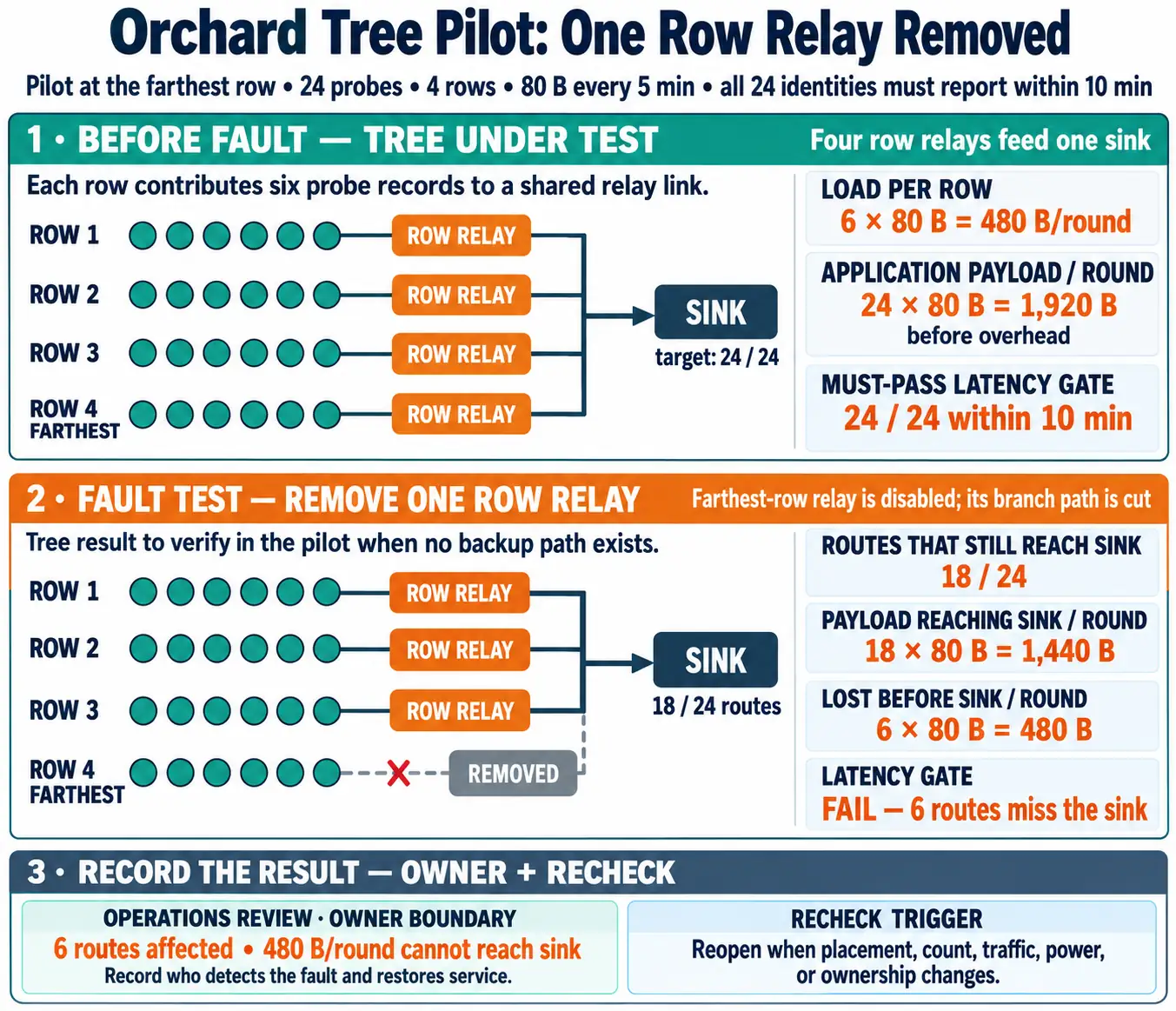
  • Explain: If each probe sends 80 bytes every five minutes, the application payload is (24\times80=1{,}920) bytes per reporting round before overhead; shared relay links must carry several probes' records.
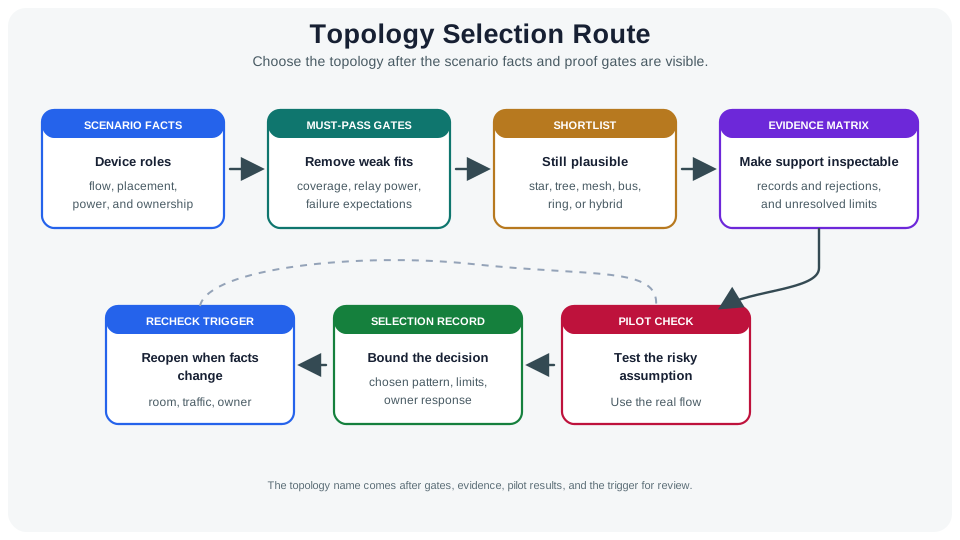
  • Explain: The pilot should attack the assumption most likely to overturn the record rather than rehearse an easy success. Figure: A topology pilot traces the primary flow shows the resulting test chain.
  • Explain: These questions turn the greenhouse choice into a traceable record: two room-level stars may fit powered gateways and battery sensors where a full mesh fails the relay-energy gate.
iotclass.org

Major section

Select the Route Shape From Scenario Evidence
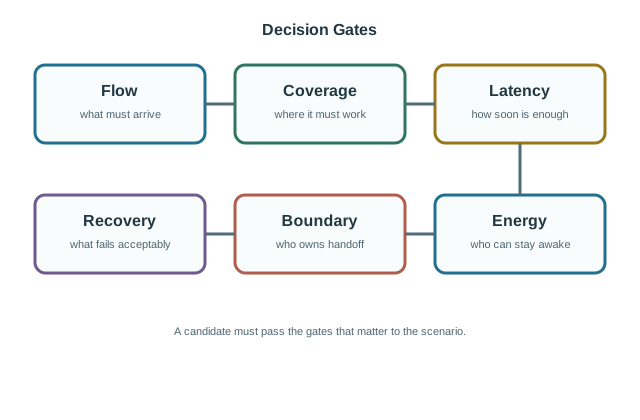
A candidate that misses a hard constraint leaves the path even if it scores well elsewhere.

  • The record is what can be reviewed when the site changes.
  • A desk simulation can narrow candidates, but the pilot exposes walls, terrain, interference, installation limits, and battery behavior.

Numbers to remember

80 bytesIf each probe sends 80 bytes every five minutes

Why it matters

This prevents a familiar topology from winning before the physical problem is described.

Six topology selection gates test flow, coverage, latency, energy, ownership, and recovery
iotclass.org

Major section

Select the Route Shape From Scenario Evidence (continued)
A direct star may require every probe to reach one mast.

  • A tree can place one relay per row, but failure of a row relay removes six probes.
  • A mesh may route around one relay, yet forwarding increases energy use at selected nodes.
  • The mesh should produce named alternate parents and measured forwarding cost.
iotclass.org

Major section

Select the Route Shape From Scenario Evidence (continued)

Revisit the selected record when device count, traffic, site layout, or failure limit changes.

  • If each probe sends 80 bytes every five minutes, the application payload is (24\times80=1{,}920) bytes per reporting round before overhead; shared relay links must carry several probes' records.
  • The star should fail visibly if the farthest probe cannot reach the mast.
  • A topology choice is valid for its stated scenario, not for every future expansion.
iotclass.org

Major section

Start With the Story

A gateway is a device or service that joins different system parts.

  • Telemetry is a time-linked record from a device.
  • A chosen shape fits only the facts that were tested.
  • The deeper sections compare candidates and evidence records so new rooms, traffic, owners, or power limits reopen the decision instead of inheriting it blindly.
iotclass.org

Major section

Practitioner: Build the Selection Record

The selection record needs rejection criteria that are specific enough to defend.

  • These questions turn the greenhouse choice into a traceable record: two room-level stars may fit powered gateways and battery sensors where a full mesh fails the relay-energy gate.

Key terms

Latency defines how soon
Latency defines how soon is enough, while Energy exposes who can stay awake or relay.
Six topology selection gates test flow, coverage, latency, energy, ownership, and recovery
iotclass.org

Major section

Under the Hood: Boundaries, Pilots, and Recheck Logic
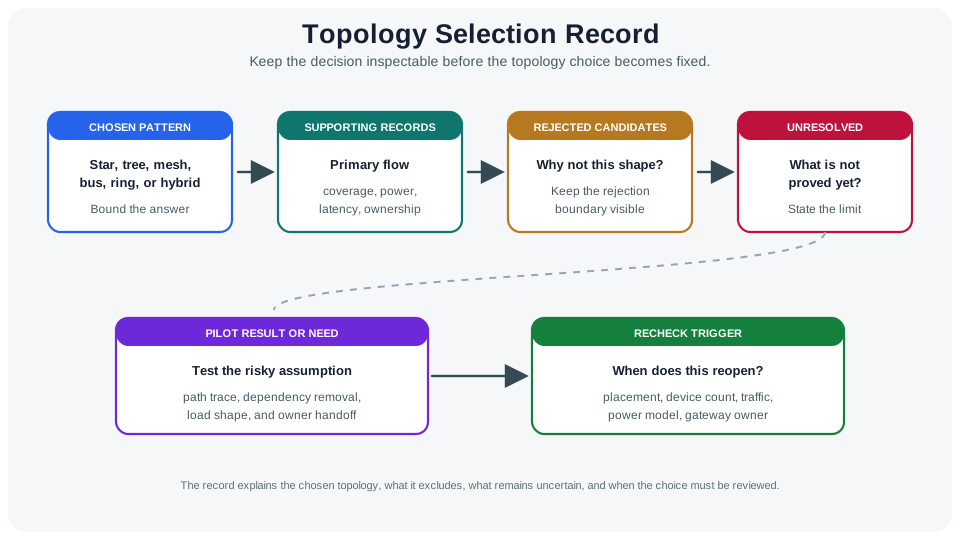
Passing the gates still leaves assumptions and rejected alternatives that a future reviewer must see.

  • The pilot should attack the assumption most likely to overturn the record rather than rehearse an easy success. Figure: A topology pilot traces the primary flow shows the resulting test chain.
The topology selection record keeps the chosen pattern, support, rejections, assumptions, pilot, and trigger together
iotclass.org

Major section

Summary

The final record names the chosen pattern, rejected candidates, unresolved assumptions, limits, and recheck trigger because a topology name alone cannot prove resilience, latency, route repair, or operational fit.

  • Topology selection starts with scenario facts, not a preferred shape.
  • Decision gates remove candidates that cannot satisfy primary flow, coverage, energy, ownership, or recovery requirements, leaving a shortlist supported by the scenario record.
  • A pilot tests the riskiest assumption before commitment.
iotclass.org

Deck summary

Key takeaways

A candidate that misses a hard constraint leaves the path even if it scores well elsewhere.

  • A direct star may require every probe to reach one mast.
  • Revisit the selected record when device count, traffic, site layout, or failure limit changes.
  • A gateway is a device or service that joins different system parts.
  • The selection record needs rejection criteria that are specific enough to defend.
iotclass.org

Retrieval practice

Recall check 1 of 3

Packet Pete says: answer from memory, then check your reasoning.

Q1A team asks for a topology recommendation before documenting device roles, traffic direction, placement, power, or ownership. What should happen first?

AExtract scenario facts into selection gates before naming a topology.
BChoose mesh because it sounds resilient in most IoT systems.
CChoose star because it is usually the simplest diagram.
DReuse the last topology record without checking the current scenario.
Show answer

Answer: A The first selection step is to extract scenario facts and convert them into gates that bound the candidate set.

iotclass.org

Retrieval practice

Recall check 2 of 3

Packet Pete says: answer from memory, then check your reasoning.

Q2A selection record recommends a tree because a site has floors, rooms, and local aggregators. What should be added before the team accepts that topology for deployment?

AA pilot check for aggregator loss, with a limit and recheck trigger.
BA claim that tree topologies are always more reliable than star topologies.
CRemoval of all rejected candidates from the record.
DA switch to full mesh without checking relay budget or path diversity.
Show answer

Answer: A A tree recommendation is strongest when it tests parent or aggregator loss, states coverage and relay limits, and names the change that reopens selection.

iotclass.org

Retrieval practice

Recall check 3 of 3

Packet Pete says: answer from memory, then check your reasoning.

Q3A team chooses mesh for resilience, but all traffic still depends on one gateway and battery nodes would need to relay. What is the strongest design response?

AAccept mesh immediately because any mesh removes all single points of failure.
BTest dependency, relay budget, and path diversity before accepting mesh.
CIgnore battery behavior because topology selection only checks diagrams.
DDelete the recheck trigger once a topology name has been selected.
Show answer

Answer: B Topology families do not guarantee behavior.

iotclass.org

Print reference

Answers

Answer key.

  1. A · The first selection step is to extract scenario facts and convert them into gates that bound the candidate set.
  2. A · A tree recommendation is strongest when it tests parent or aggregator loss, states coverage and relay limits, and names the change that reopens selection.
  3. B · Topology families do not guarantee behavior.
iotclass.org