Network Topologies · Study deck

Topology Failure and Recovery

A cold-room gateway fails while its sensors still reach a local relay.

Packet Pete is your guide for this deck.

failures
Packet Pete, the module guide, in a scene from this chapter.
iotclass.org

After studying this chapter

Learning objectives

You will be able to:

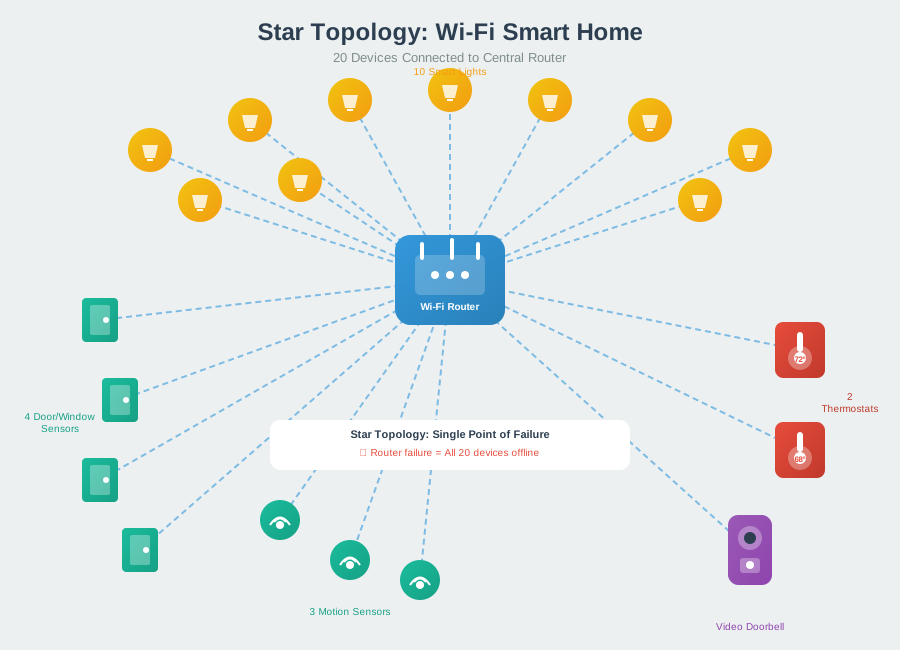
  • Explain: The route becomes concrete in Figure: A smart-home star topology exposes the central Wi-Fi, where one smart-home star exposes a shared centre without implying that every device loses power or local behaviour.
  • Explain: Mesh recovery counts only when route, retry, and service evidence show that the important flow still works; star and tree can be resilient when shared dependencies are monitored, bounded, and backed by tested alternatives.
  • Explain: The monitor detects it at 8 s, a standby path is ready at 13 s, and the operator receives the test alarm at 17 s.
iotclass.org

Major section

Start With the Story
A healthy-looking link does not prove the service is healthy.

  • A gateway means the boundary system that joins local devices to another network or service.
  • A gateway drops, a parent router is overloaded, a mesh route goes stale, or a shared channel collapses under retries.
  • The lesson of topology failure is to trace the dependency that changed, prove which flows are affected, and record the recovery path before calling the design resilient.
iotclass.org

Major section

Overview: Failures Reveal the Real Topology
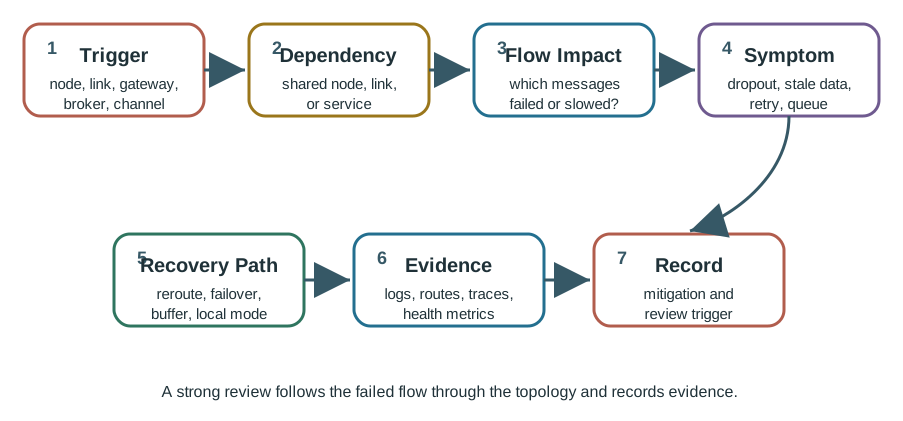
This route preserves causality as the chapter asks what the network actually did after its diagram stopped being true.

  • The route becomes concrete in Figure: A smart-home star topology exposes the central Wi-Fi, where one smart-home star exposes a shared centre without implying that every device loses power or local behaviour.
Failure review moves from trigger and dependency through flow impact, recovery, evidence, and record
iotclass.org

Major section

Practitioner: Build the Failure Record
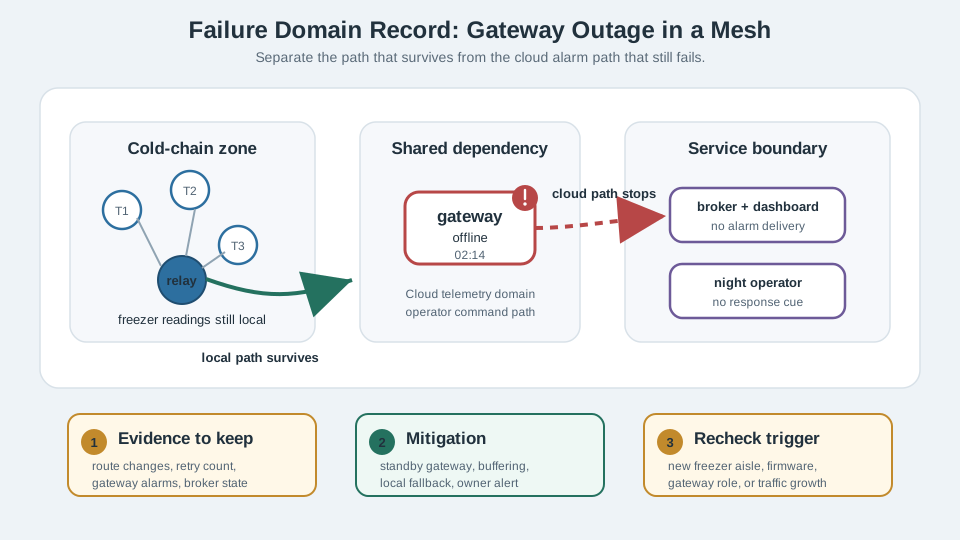
The practitioner record must distinguish partial survival from service recovery.

  • The red gateway offline boundary stops the broker + dashboard, leaving the night operator with no alarm delivery and no response cue.
  • Surviving measurements do not equal a recovered alert service.

Key terms

Success therefore
Success therefore means the service goal was re-observed with evidence, not merely that a component reported healthy.
A cold-chain failure record separates a surviving local relay path from a failed cloud alarm path
iotclass.org

Major section

Under the Hood: Resilience Needs Current Evidence
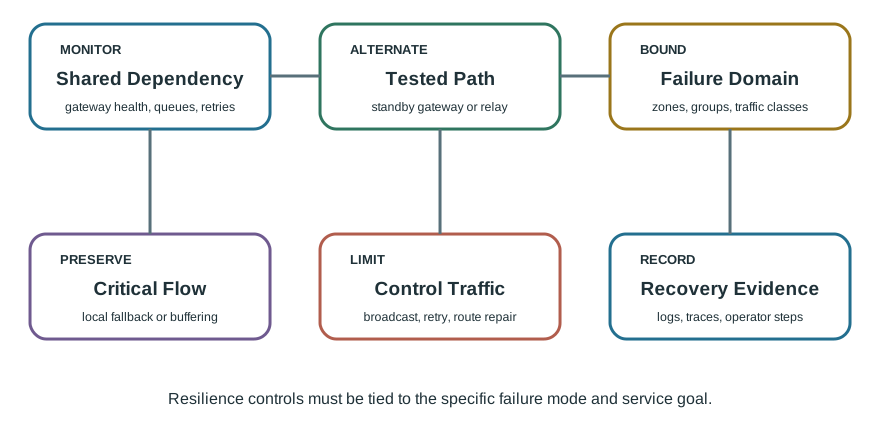
Resilience claims age as routes, loads, and maintenance practice change.

  • Each control is credible only while its named path is tested and its evidence remains current.
  • The summary should leave readers with repairable claims rather than topology slogans.

Key terms

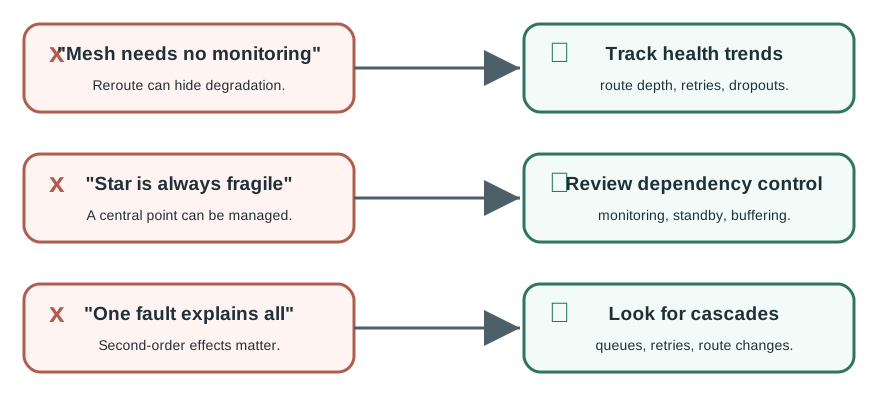
“Star is always fragile”
“Star is always fragile” is replaced by Review dependency control: a central point can be managed with monitoring, standby, and buffering.
“Mesh needs no monitoring”
“Mesh needs no monitoring” is repaired by Track health trends, because reroute can hide degradation in queues, retries, and route changes.
Resilience controls connect a failure domain and critical flow to monitoring, alternate paths, bounds, preservation, and records
iotclass.org

Major section

Time the Night Operator's Alarm, Not Just the Reroute

The monitor detects it at 8 s, a standby path is ready at 13 s, and the operator receives the test alarm at 17 s.

  • The end-to-end interruption for this test is 17 s, not the 5 s reroute time.
  • It only establishes the health condition the icon measures.
A cold-chain failure record separates a surviving local relay path from a failed cloud alarm path
iotclass.org

Major section

Time the Night Operator's Alarm, Not Just the Reroute (continued)
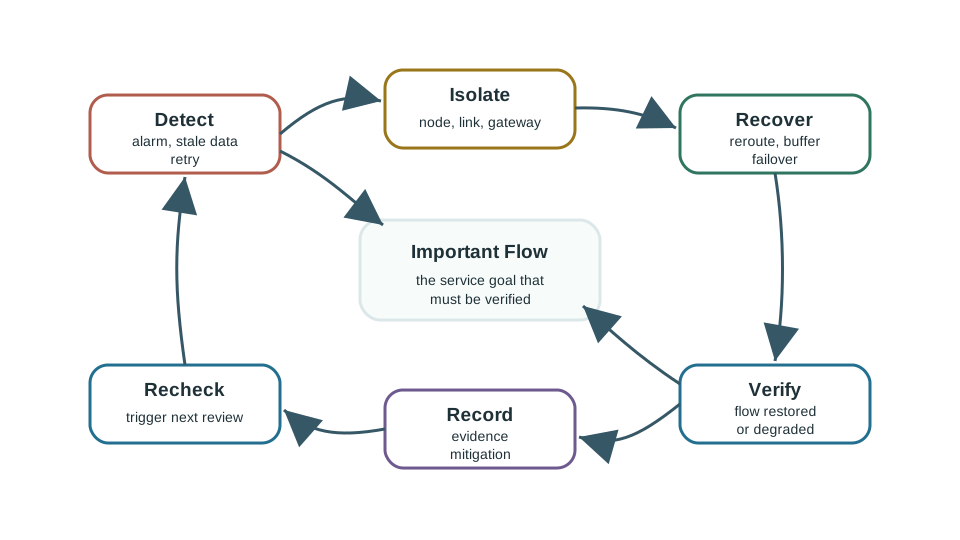
The recovery loop at Figure: Recovery evidence loops through detection advances from Detect and Isolate to Recover, but Verify must observe the important flow before the incident is closed.

  • If both gateways use the same power supply or outside router, removing one gateway tests only a limited failure domain.
  • The standby may work in that drill yet fail during the power or backhaul fault that matters in the building.
  • Recovery may now restore connectivity while alarm delivery waits behind the backlog.
  • The critical-flow test must include that load if it is credible in service.
iotclass.org

Major section

Summary

Topology failure review starts with the service goal and affected flow, not with the topology name alone.

  • Failure domains can include nodes, links, gateways, brokers, shared channels, power groups, firmware, and operations boundaries.
  • Mesh recovery counts only when route, retry, and service evidence show that the important flow still works; star and tree can be resilient when shared dependencies are monitored, bounded, and backed by tested alternatives.
  • The durable record states impact, evidence, mitigation, and the trigger for the next review.
iotclass.org

Deck summary

Key takeaways

A healthy-looking link does not prove the service is healthy.

  • This route preserves causality as the chapter asks what the network actually did after its diagram stopped being true.
  • The practitioner record must distinguish partial survival from service recovery.
  • Resilience claims age as routes, loads, and maintenance practice change.
  • The monitor detects it at 8 s, a standby path is ready at 13 s, and the operator receives the test alarm at 17 s.
iotclass.org

Retrieval practice

Recall check 1 of 3

Packet Pete says: answer from memory, then check your reasoning.

Q1A tree network loses one parent router and a whole branch stops reporting while the root still works. What should the failure review record?

ATreat the entire network as healthy because the root router still works.
BRecord affected branch, devices, mitigation, and retest trigger.
CCall it a full mesh because some other branches still report normally.
DIgnore the failure because the parent router usually has good uptime.
Show answer

Answer: B Topology failure review names the dependency, affected flow, recovery evidence, mitigation, and next trigger.

iotclass.org

Retrieval practice

Recall check 2 of 3

Packet Pete says: answer from memory, then check your reasoning.

Q2A mesh keeps forwarding local sensor readings after one relay fails, but all cloud dashboards stop because the only gateway is down. What is the best failure analysis?

AThe mesh topology prevented every failure, so the deployment is healthy.
BThe topology is a total failure because one gateway stopped.
CLocal relay recovery worked, but the gateway remains a cloud failure domain.
DThe failure is only an application problem and does not belong in topology review.
Show answer

Answer: C Failure analysis separates affected flows and records the dependency that controls each flow.

iotclass.org

Retrieval practice

Recall check 3 of 3

Packet Pete says: answer from memory, then check your reasoning.

Q3A mesh deployment still delivers readings after two relay nodes fail, but route depth and retries increase each week. What should the reviewer conclude?

ANo action is needed because the mesh is still online.
BThe deployment should always be replaced with a ring topology.
CRoute depth and retries are application details and should be ignored in topology review.
DThe mesh is degrading; review monitoring, relay placement, or maintenance.
Show answer

Answer: D Self-healing can preserve service while the topology becomes less resilient.

iotclass.org

Print reference

Answers

Answer key.

  1. B · Topology failure review names the dependency, affected flow, recovery evidence, mitigation, and next trigger.
  2. C · Failure analysis separates affected flows and records the dependency that controls each flow.
  3. D · Self-healing can preserve service while the topology becomes less resilient.
iotclass.org