Network Topologies · Study deck
Core Topology Shapes and Trade-offs
Six temperature sensors can share one gateway, relay through neighbours, or connect along a common bus.
Packet Pete is your guide for this deck.

After studying this chapter
Learning objectives
Topology names describe dependencies that must be tested against the service need.
- A connection drawing must identify senders, relays, and the system exit.Six cold-room sensors can send directly to a gateway or forward along a line, creating different dependencies for the same readings.
- Shared hubs, cables, and branches determine which devices lose service together.A star gateway failure removes all six sensor routes, while a failed sensor leaves the other five direct streams connected.
- Alternate routes help only when the deployed protocol can use them.A ring needs usable break-handling, and a mesh needs real powered relays before a spare-looking line supports a recovery claim.
- Traffic, power, and measured coverage determine whether the shape remains practical.The line link nearest G forwards six payloads per minute, so its capacity and energy burden differ from the far-end link.
Major section
Walk the Failure Paths in Each Shape (1/2)
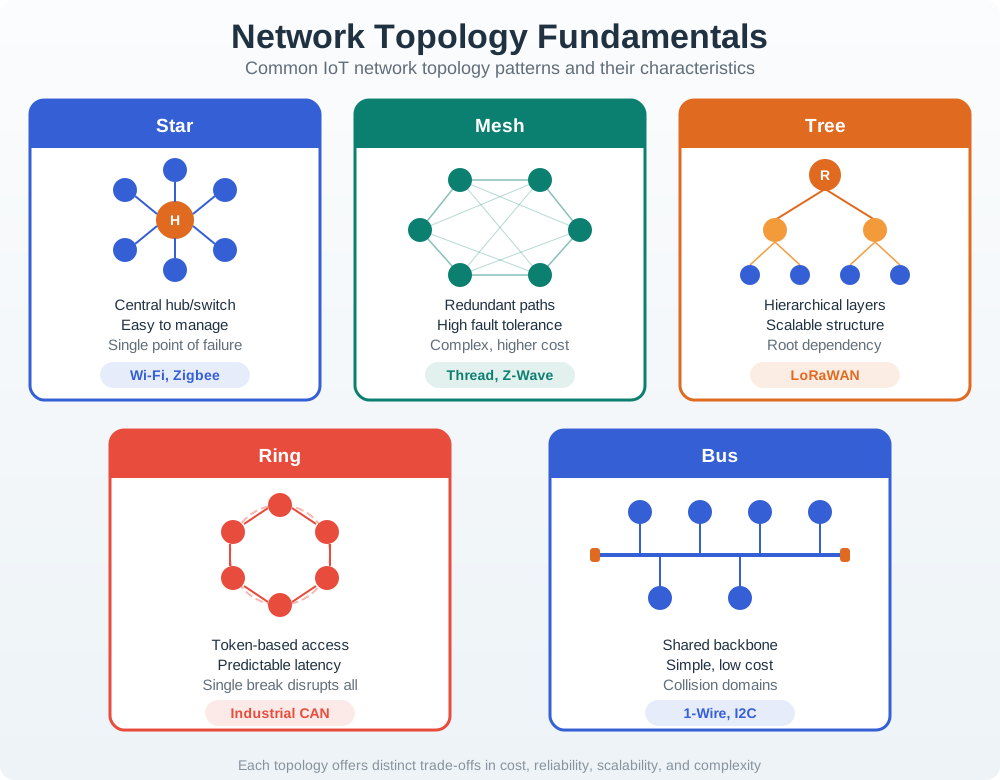
This reference compares network shapes by their paths and shared failure points.
- The star sends each device’s traffic through a shared centre.The direct links make endpoint faults easy to isolate, but every device still depends on the centre for its route.
- Bus and line paths share failures according to the break location.A backbone short can affect the shared segment, while an open link can divide devices by position.
Major section
Walk the Failure Paths in Each Shape (2/2)
- The ring needs usable break-handling before another direction provides recovery.The tour uses token permission, and a broken link stops it; recovery still needs equipment and protocol support rather than a loop drawing.
- Tree branches concentrate dependencies, while mesh paths need working relays.Mesh alternatives need powered relays and routing evidence; hybrid patterns combine the displayed families for groups with different needs.
Major section
The star’s sensor and gateway failures (1/2)
A star isolates an endpoint failure but concentrates dependence at its center.
- The six-sensor star needs six direct links to the gateway.Each cold-room sensor sends independently to the shared centre, so one endpoint does not relay the other sensors’ normal reports.
- Failure of S3 removes only its own sensor stream.The other five sensors remain connected through their direct gateway links, giving the fault test an explicit expected set of identities.
Major section
The star’s sensor and gateway failures (2/2)
- Gateway failure removes the route for all six sensors.The centre is a shared dependency even though the endpoints have separate links, so its failure has a different impact from losing S3.
- Power and upstream dependencies need their own resilience evidence.The chapter’s star can have redundant power and two upstream links, but those provisions do not remove the central traffic dependency.
Major section
The S4–S5 cut in a sensor line (1/2)
A line's failure impact depends on exactly where its shared path breaks.
- The line has S1 through S6 in sequence before gateway G.Reports from the far end must pass along intermediate links, making the location of a break part of the service claim.
- A break between S4 and S5 can isolate S1 through S4.Those four sensors are on the far side of the specified cut and lose their path toward the gateway in this line.
Major section
The S4–S5 cut in a sensor line (2/2)
- S5 and S6 remain connected on the gateway side.Their links to G do not cross the S4–S5 cut, so the test should still receive reports bearing those sensor identities.
- The named cut and affected identities make the claim testable.Five received records are not proof of five distinct sensors; a duplicate from S2 must not conceal a missing S6 report.
Activity 1 · Draw it
✎ Mark the exact break

I want you to trace the missing reports back to the link that carries them.
Draw S1–S2–S3–S4–S5–S6–G on paper. Cross out the link between S4 and S5. Circle the sensors that can still reach G. Beside it, sketch six sensors in a star and mark what changes when S3 fails.
4 minutes · Pen and paper · Answer: Activity 1
Major section
Traffic concentration near the gateway (1/2)
Relaying concentrates traffic near the destination even when sensors send equal payloads.
- Each sensor sends one 100-byte payload per minute.The six cold-room sensors contribute equal payload sizes, but their position in the line determines how much forwarding each link performs.
- The final line link near G carries all six sensors’ payloads.Upstream reports accumulate as they travel toward the gateway, concentrating traffic at the link that must carry every sensor’s records.
Major section
Traffic concentration near the gateway (2/2)
- The final link carries 600 bytes per minute before overhead.Six 100-byte payloads share that link, so the payload total is a starting point rather than the complete protocol traffic measurement.
- The far-end link carries only S1 and has less forwarding work.Its payload burden differs from the gateway-side link, making per-link traffic and energy measurements necessary even when all sensors report equally.
Major section
Radio links in the real cold room (1/2)
A wireless drawing needs field measurements before its links can be trusted.
- Walls, metal shelves, and antenna orientation can weaken planned radio links.The cold-room drawing can show a connection that the actual building cannot support once obstacles and interference affect the radio path.
- A site survey compares the planned shape with installed measurements.Plan, measure, compare, adjust, and remeasure; the clinic’s pharmacy below −75 dBm flags a coverage gap alongside the cold-room door tests.
Major section
Radio links in the real cold room (2/2)
- Placement or channel changes need another measurement.Adjusting the drawing cannot close the field loop until the revised topology has been checked at the real site under its conditions.
- Door-open and door-closed tests can reveal hidden dependencies.The cold-room survey repeats both door conditions, testing whether the wireless shape still supports the sensor paths that the service requires.
Major section
Physical, power, and service dependencies
Physical diversity can still leave one shared service dependency.
- A mesh can have alternate neighbours but one shared gateway.Every usable radio route may still end at the same exit, leaving a service dependency that extra local links cannot remove.
- Redundant power can strengthen a star without removing its shared centre.The chapter’s star example can have two upstream links, yet traffic still passes through the central network node during normal reporting.
- Physical links, power zones, and services need separate failure checks.A route drawing alone cannot establish what survives a failed power source, gateway, or upstream service beyond the visible sensor links.
- A resilience claim must name the failure its measured alternatives survive.Removing a mesh relay needs observed convergence and battery evidence after the alternate path forms, rather than approval from the mesh label alone.
Major section
Sleepy leaves and powered relay roles
The network shape must fit the different roles of its devices.
- Sleepy sensors and powered routers have different forwarding roles.A lighting segment can use powered luminaires as relays, while low-power sensor leaves cannot be assumed to provide the same continuing service.
- Tree branches have concentrated traffic and shared failure impact.A building controller can aggregate room devices before reporting upstream, so loss of a parent affects the devices depending on that branch.
- A full mesh needs rapidly growing link and neighbour-management work.Every node connects to every other node; six sensors need 6 × 5 / 2 = 15 links, with rapidly growing neighbour-management work.
- A partial mesh limits management through selected useful relay paths.The topology record still needs the powered roles, measured links, and repair behaviour that make those selected alternatives usable in the installation.
Major section
The topology acceptance and retest record
Topology acceptance requires a record that can be reopened after change.
- The record must name traffic paths, device roles, and shared dependencies.Room sensors can use gateway-star reporting while a controller branch keeps local door behaviour independent of cloud reporting. Links do not grant operational permission. Record management, telemetry, and control reachability; after topology changes, test an allowed sensor report and denied peer command.
- A power loss or link cut tests the required remaining service.The six-sensor star predicts one missing stream after S3 fails and six after gateway loss, giving the drill clear expected outcomes.
- Router movement and traffic changes can invalidate earlier path evidence.Added devices, a new room layout, gateway movement, or altered relay roles can change the previously tested capacity and failure map.
- Named owners and retest triggers keep topology approval reviewable.The saved shape, test conditions, observed cut effects, and repair responsibilities let the team reopen the record after a deployment change.
Major section
Start With the Story
A useful first sketch reveals what fails together before selecting a topology name.
- Scattered devices can still send every message through one logical centre.Twelve room sensors across a building can form a logical star when their telemetry passes through one powered hub. Record logical paths and physical installation details. Legends explain roles, links, layout, and labels; tables hold addresses, while installation plans retain cable routes, outlets, obstacles, and coverage.
- Telemetry, urgent commands, and replies can have different dependencies.The first sketch needs each message path and shared exit so the team can identify what fails together for the required service.
- A spare-looking link cannot prove that recovery will work.A mesh needs usable relays and alternate paths, while a ring needs equipment and protocol behaviour that can handle the break.
- Several topology shapes can coexist within one deployed system.Sensors, cameras, and door controllers have different traffic, power, and local-control needs, so a hybrid record can separate their supported paths.
Major section
Practitioner: Build the Topology Selection Record
The plan also records antenna height, band, channel, and candidate access-point placement, so the prediction has stated inputs.
- The pharmacy area below −75 dBm is a warning that the planned shape has not met its coverage goal.

Deck summary
Key takeaways
Observed paths and failure tests give topology labels their practical meaning.
- Star, bus, ring, tree, and mesh describe connection patterns.Their names are vocabulary for message paths and dependencies, leaving the six-sensor cold room’s service need to determine an appropriate choice.
- The shared centre, backbone, branch, or relay determines the failure test.A failed S3 and a failed gateway can affect different numbers of star sensors, so the exact failed component belongs in the evidence.
- Power, coverage, and forwarding roles constrain usable drawn links.Walls and door conditions need site measurements, while sleepy sensors cannot automatically provide the reliable relaying that a mesh claim requires.
- Traffic measurements and operating owners complete the topology record.The gateway-side line link carries 600 payload bytes per minute before overhead, and later device or route changes can require a renewed review.
Retrieval practice
Recall check 1 of 3
Packet Pete says: answer from memory, then check your reasoning.
Q1A small classroom IoT network has one powered gateway, and every sensor sends readings directly to that gateway. What is the first topology trade-off to document?
Show answer
Answer: B Basic topology review starts from evidence about communication paths and dependencies.
Retrieval practice
Recall check 2 of 3
Packet Pete says: answer from memory, then check your reasoning.
Q2A site has low-power room sensors, several high-throughput cameras, and door controllers that must keep local behavior during short cloud outages. Which topology record is strongest?
Show answer
Answer: C A useful topology record separates device groups, traffic needs, failure domains, and retest triggers instead of forcing one label across all paths.
Retrieval practice
Recall check 3 of 3
Packet Pete says: answer from memory, then check your reasoning.
Q3Why is it risky to describe a wireless IoT deployment as a mesh just because devices are near each other?
Show answer
Answer: B Under-the-hood topology review separates physical placement from logical forwarding, failure domains, relay roles, and route evidence.
Print reference
Answers
Answer key.
- B · Basic topology review starts from evidence about communication paths and dependencies.
- C · A useful topology record separates device groups, traffic needs, failure domains, and retest triggers instead of forcing one label across all paths.
- B · Under-the-hood topology review separates physical placement from logical forwarding, failure domains, relay roles, and route evidence.
Print reference
Activity 1 answer
Model answer.
Draw it: In the line, S5 and S6 remain connected to G; S1 through S4 are isolated. In the star, each sensor connects directly to G, so losing S3 leaves the other five connected. Losing G would affect all six.