Network Topologies · Study deck
Measuring Topologies with Graph Metrics
A network diagram with twelve nodes may contain one fragile bridge or several alternate routes.
Packet Pete is your guide for this deck.

After studying this chapter
Learning objectives
You will be able to:
- Explain: This comparison sharpens graceful degradation: the record must say which flow persists, which slows or buffers, and which still fails beyond a surviving local graph.
- Explain: Under the Hood explains degree, paths, cuts, scale, route overhead, and why several neat-looking shapes can hide the same failure domain.
- Explain: The final: Gateway boundary: local is not enough points toward cloud service and asks for queues, uplink state, timing, and duplicates.
- Explain: The new edge adds installation and traffic cost, so the decision record should link that cost to the required resilience.
Major section
Start With the Story
If that relay fails, half the shelves disappear.
- The network owner needs to see that weak point before release.
- Under the Hood explains degree, paths, cuts, scale, route overhead, and why several neat-looking shapes can hide the same failure domain.
- Topology analysis is the habit of proving that difference before release.
Major section
Measure the Route Graph, Then Break It
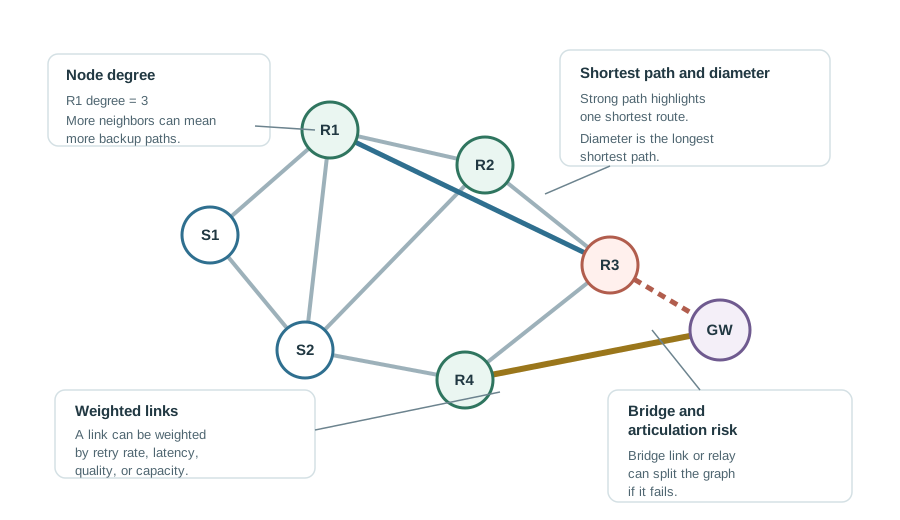
Centrality can highlight a node that sits on many paths.
- None of these values alone states whether the network meets its service target.
- A node can have several neighbours yet remain inside one power or gateway failure domain.
- Node B has degree 3, while A and E each have degree 1.
Major section
Measure the Route Graph, Then Break It (continued)
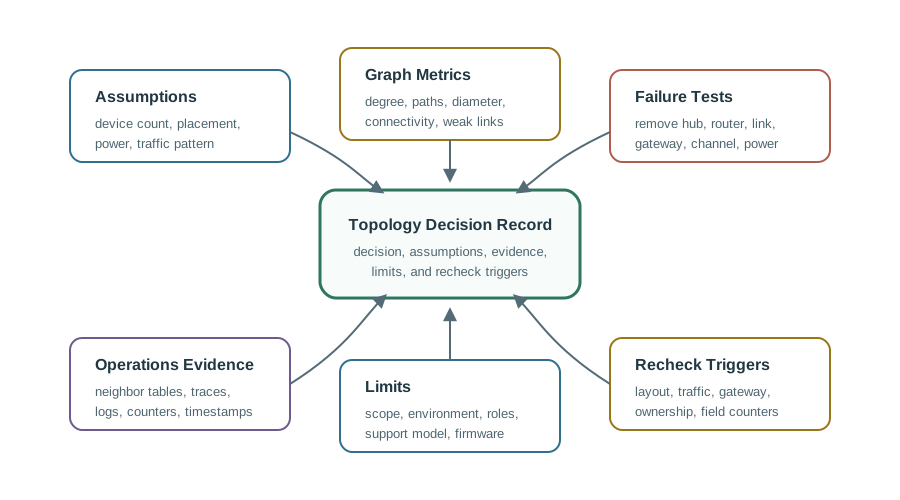
The shortest route from A to E is A-B-D-E, which has three edges.
- B is therefore a critical articulation for A in this graph.
- Adding edge A-C changes the failure result.
- After B is removed, A can still reach E by A-C-D-E.
Major section
Measure the Route Graph, Then Break It (continued)
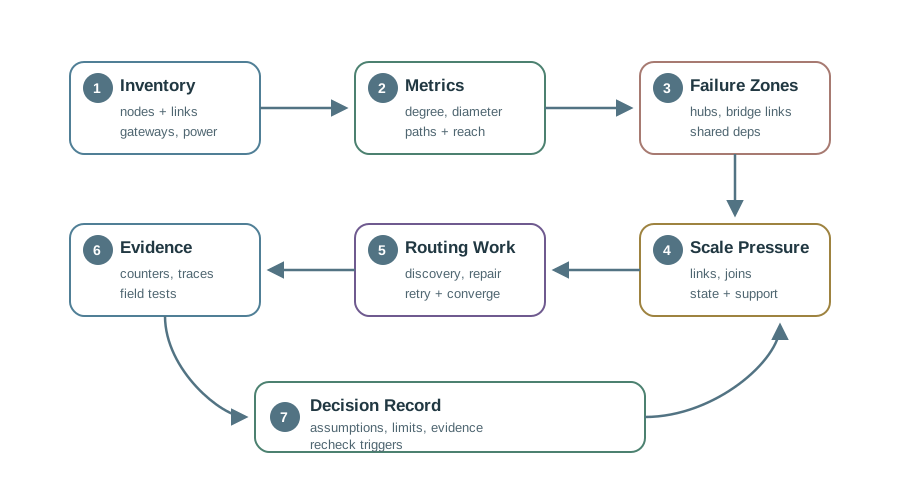
The new edge adds installation and traffic cost, so the decision record should link that cost to the required resilience.
- Calling the graph “more connected” is weaker than naming the protected route.
- Metrics from intended drawings and discovered networks may differ.
- A wireless link observed once should not automatically become a permanent symmetric edge.
Major section
Practitioner: Build the Topology Analysis Record
Counting links alone cannot reveal whether the remaining paths are useful.
- The callout for: Diameter identifies the longest shortest path, not simply the longest drawn edge.
- Those labels supply the record fields used below: connectivity explains possibility, while weights and failure probes explain operational fitness.
Major section
Under the Hood: Failure Domains Decide Whether Metrics Matter
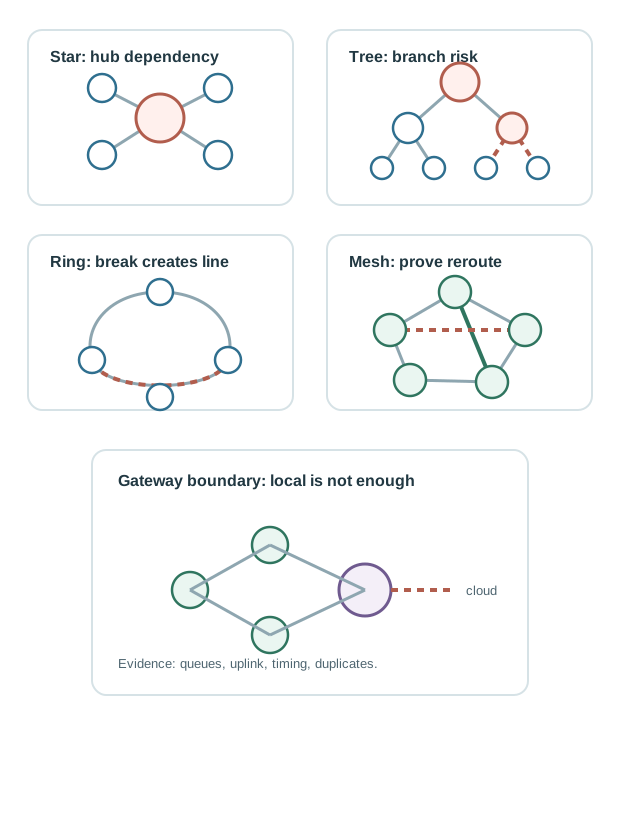
The final: Gateway boundary: local is not enough points toward cloud service and asks for queues, uplink state, timing, and duplicates.
- This comparison sharpens graceful degradation: the record must say which flow persists, which slows or buffers, and which still fails beyond a surviving local graph.
Deck summary
Key takeaways
If that relay fails, half the shelves disappear.
- Centrality can highlight a node that sits on many paths.
- The shortest route from A to E is A-B-D-E, which has three edges.
- The new edge adds installation and traffic cost, so the decision record should link that cost to the required resilience.
- Counting links alone cannot reveal whether the remaining paths are useful.
Retrieval practice
Recall check 1 of 3

Packet Pete says: answer from memory, then check your reasoning.
Q1A topology graph shows one gateway with degree 40 and every cloud path depends on it. What should the analysis flag first?
Show answer
Answer: D Topology analysis uses graph metrics and path dependency to find concentration, fragile failure domains, and the flows most likely to break under stress.
Retrieval practice
Recall check 2 of 3

Packet Pete says: answer from memory, then check your reasoning.
Q2A 40-node warehouse sensor design compares a full mesh with a partial mesh where each node has about four neighbors. Which analysis belongs in the record before selection?
Show answer
Answer: A A useful analysis record compares scaling burden with resilience evidence, then bounds the recommendation.
Retrieval practice
Recall check 3 of 3

Packet Pete says: answer from memory, then check your reasoning.
Q3A building mesh appears connected in the design tool, but one wing repeatedly misses readings in field logs. What is the strongest next analysis step?
Show answer
Answer: A Under the hood, topology health depends on weighted links, failure domains, route behavior, and operations evidence.
Print reference
Answers
Answer key.
- D · Topology analysis uses graph metrics and path dependency to find concentration, fragile failure domains, and the flows most likely to break under stress.
- A · A useful analysis record compares scaling burden with resilience evidence, then bounds the recommendation.
- A · Under the hood, topology health depends on weighted links, failure domains, route behavior, and operations evidence.