Security: Threats & Defense · Study deck
IoT Security Compliance
Picture a review where a policy says updates are checked, but nobody can show which device version passed.
Shield Shelly is your guide for this deck.

After studying this chapter
Learning objectives
You will be able to:
- treat compliance as evidence, not a checkbox
- run an audit-ready review loop with scope, evidence, and a boundary statement
- assign evidence ownership to the control, not the org chart
- recognize that evidence has a shelf life and compliance is not the same as security
Major section
Start With The First Audit Question
A control needs current evidence, an owner, and a stated limit.
- Firmware means the program stored on a device to control its hardware.
- The deeper sections show how requirements, controls, owners, evidence, exceptions, and refresh rules stay linked.
- In everyday device programs, the same packet can cover access control, firmware verification, data handling, monitoring, or recovery.
Major section
Overview: Compliance Is Evidence, Not a Checkbox
Compliance gets a bad reputation when it is treated as a list of boxes to tick.
- A better definition is this: compliance is the work of turning a requirement into reviewable evidence that someone else can inspect and trust.
- That packet must also stay scoped.
- Beginner ExamplesTaken together, these checks make the section reviewable.
Major section
Overview: Compliance Is Evidence, Not a Checkbox (continued)
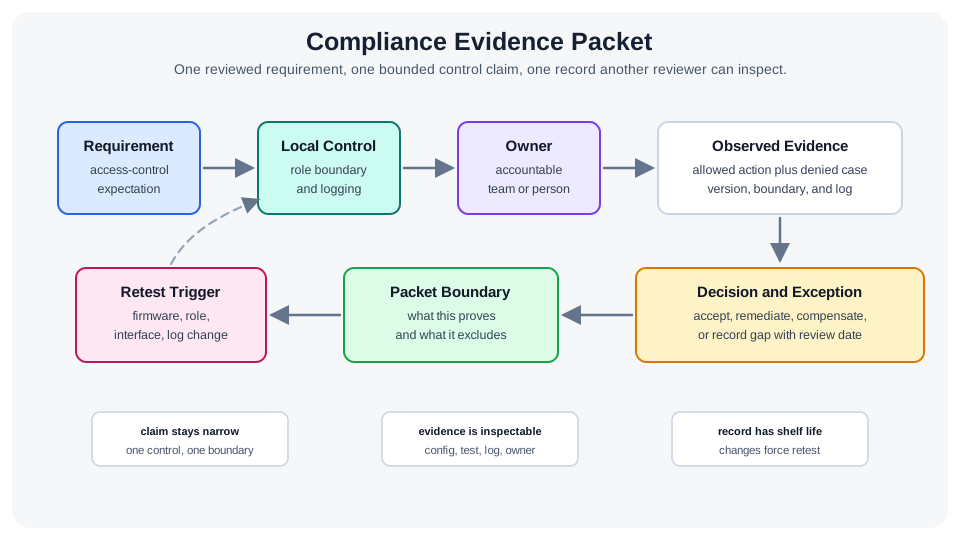
A gateway access-control packet can prove that one role could perform one allowed action and that another role was denied at the boundary.
- Scope prevents a useful compliance record from becoming an exaggerated security claim.
- If you only need the intuition, this layer is enough: a control without evidence is not audit-ready.
- Security compliance is the same discipline applied to controls instead of extinguishers.
Major section
Overview: Compliance Is Evidence, Not a Checkbox (continued)
Saying "we do encryption" is a claim; showing the configuration, the test, the owner, and the boundary it covers is evidence.
- The visual keeps the requirement, control, owner, observation, decision, boundary, and retest condition together.
- This sequence keeps the compliance claim traceable to what was actually checked.
- The One-Minute ViewEvidence over assertion A claim states intent; evidence shows what was observed, when, and within which boundary.
Major section
Overview: Compliance Is Evidence, Not a Checkbox (continued)
Ownership is part of itEvery control needs a named owner who keeps the evidence current and explains exceptions.
- Evidence expiresA design change can make a passing record stale, so each record carries a retest trigger.
- That order prevents a control name from being treated as proof and connects the visual to the chapter's evidence-led review sequence.
- If you can tell a claim from evidence, you have the core idea.
Major section
Practitioner: Run the Audit-Ready Review Loop
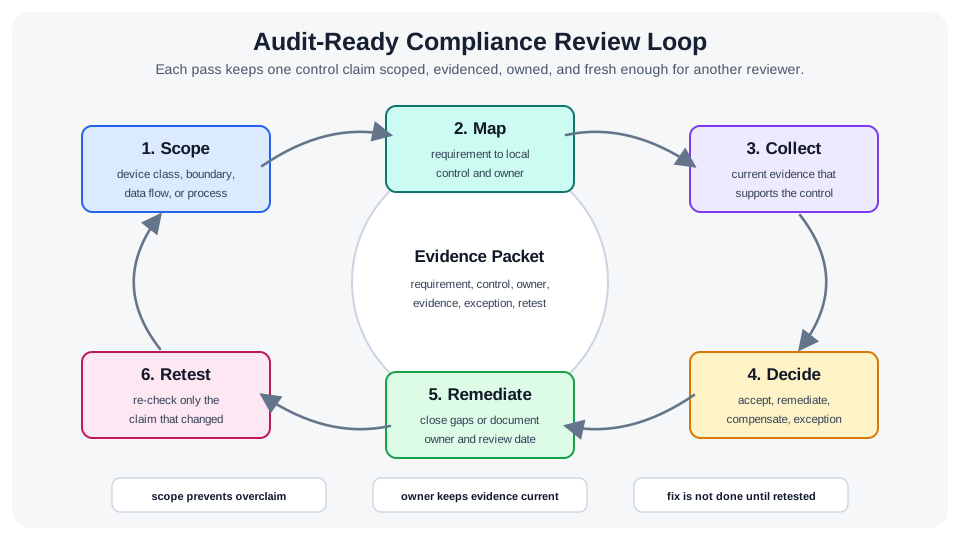
Compliance evidence is strongest when it moves through a repeatable loop.
- The loop is simple, but it catches the most common failures: unclear scope, unmapped controls, missing evidence, stale records, and unowned exceptions.
- Collect: Gather current evidence that directly supports the mapped control.
- No one is accountable for currency.
- Assertion that cannot be inspected.
Major section
Practitioner: Run the Audit-Ready Review Loop (continued)
Collection supplies current proof, while the decision records acceptance, remediation, compensation, or a dated exception.
- The closing rule is operational: a fix is not complete until its effect has been tested and the record made current.
- Config, logs, and allowed-and-denied tests with a boundary.
- Worked Review: Gateway Access EvidenceScope and evidence Maintenance access should be limited to named roles with reviewable logs.
Major section
Under the Hood: Traceability, Ownership, and the Limits of Compliance
The deeper layer explains why this method holds up under audit.
- Three ideas carry the weight: an unbroken traceability chain, ownership tied to controls, and an honest understanding of what compliance can and cannot prove.
- A reviewer should be able to follow that chain in either direction.
- Conclusions match the reviewed scope.
Major section
Under the Hood: Traceability, Ownership, and the Limits of Compliance (continued)
When frameworks are involved, the discipline is to map each requirement to a local control and its evidence rather than copying requirement text into a document.
- A pasted clause is not proof that the control exists in this deployment.
- Evidence is detached from the requirement.
- Records outlive the design they describe.
Major section
Under the Hood: Traceability, Ownership, and the Limits of Compliance (continued)
Ownership Follows the Control, Not the Org ChartCompliance fails quietly when controls have no real owner.
- Traceability Is the Core MechanismAn audit-ready packet is a chain with no broken links: requirement to control, control to evidence, evidence to a decision, and decision to a retest trigger.
- Evidence Has a Shelf LifeThe most overlooked property of evidence is that it expires.
- Named owner explains and refreshes the record.
Major section
Under the Hood: Traceability, Ownership, and the Limits of Compliance (continued)
For the gateway example, start at the denied configuration-change log, identify the non-maintenance role, and trace the record back to the maintenance-access requirement.
- The owner is not just a name; they are responsible for keeping evidence current, explaining exceptions, and triggering retest when the system changes.
- A passing record describes the system as it was at the time of observation.
- A reviewer can walk the chain both ways.
Major section
Under the Hood: Traceability, Ownership, and the Limits of Compliance (continued)
The two disciplines reinforce each other only when threat-driven controls and audit-ready evidence are kept together.
- Compliance and Security Are Not the SameThis is the subtlety practitioners must internalize.
- A gap is accepted with no review date.
- One sample is treated as the whole system.
Major section
Under the Hood: Traceability, Ownership, and the Limits of Compliance (continued)
Done this way, an audit becomes a reading of records that already tell the truth, not a scramble to assemble them.
- Passing a scoped review does not prove the whole system is secure, and a system can be technically compliant yet insecure if the requirements do not match the real threats.
- Compliance is best treated as a floor, a set of expectations that must be evidenced, rather than a ceiling that defines good security.
- Conversely, strong security that is undocumented can still fail an audit, because the evidence does not exist for someone else to inspect.
Deck summary
Key takeaways
A control needs current evidence, an owner, and a stated limit.
- Compliance gets a bad reputation when it is treated as a list of boxes to tick.
- A gateway access-control packet can prove that one role could perform one allowed action and that another role was denied at the boundary.
- Saying "we do encryption" is a claim; showing the configuration, the test, the owner, and the boundary it covers is evidence.
- Ownership is part of itEvery control needs a named owner who keeps the evidence current and explains exceptions.
Retrieval practice
Recall check 1 of 3
Shield Shelly says: answer from memory, then check your reasoning.
Q1A team states that their gateway meets an access-control requirement. Which observed boundary test best supports that claim?
Show answer
Answer: D Audit readiness needs observed behavior in a named boundary, accountability, and a condition that makes the evidence stale.
Retrieval practice
Recall check 2 of 3
Shield Shelly says: answer from memory, then check your reasoning.
Q2A packet claims a gateway meets an access-control requirement because a maintenance user could open the admin page. Why is this evidence incomplete?
Show answer
Answer: D A useful record needs the allowed action, the denied action or boundary, and the log evidence that the decision can be reviewed.
Retrieval practice
Recall check 3 of 3
Shield Shelly says: answer from memory, then check your reasoning.
Q3A deployment passes every item in a compliance checklist, yet a reviewer is uneasy about real-world security. What is the most accurate way to frame this?
Show answer
Answer: C Passing a scoped review evidences specific expectations.
Print reference
Answers
Answer key.
- D · Audit readiness needs observed behavior in a named boundary, accountability, and a condition that makes the evidence stale.
- D · A useful record needs the allowed action, the denied action or boundary, and the log evidence that the decision can be reviewed.
- C · Passing a scoped review evidences specific expectations.