Security: Threats & Defense · Study deck
Attack Scenarios: Defensive Method
This first route defines a defensive scenario review and builds the record structure used to test expected controls.
Shield Shelly is your guide for this deck.

After studying this chapter
Learning objectives
You will be able to:
- Explain: A scenario record asks a bounded question: what condition is being reviewed, what evidence would confirm or weaken the control claim, what mitigation fits the condition, and what residual risk remains.
- Explain: Evidence therefore has two layers—proof that malformed state is rejected or patched, and proof that post-compromise behavior such as new processes, changed firmware, or unusual outbound traffic is detected.
- Explain: The first device accepts a console or management action beyond the caller's authority; its stored credentials, neighbor reachability, or management role can then put peer devices at risk.
Major section
Start Simple: Test One Expected Block
It must not issue a door command or send a reading under another zone's name.
- An actuator is a device that changes the physical world.
- Telemetry is the device reading or status an attacker may try to change or intercept.
- A gateway is the device that carries local traffic into another service path.
Major section
Start Simple: Test One Expected Block (continued)
This scenario does not prove every defence or describe misuse steps.
- The deeper sections add assets, conditions, controls, residual risk, evidence limits, and retest triggers to the bounded review packet.
- A sensor identity should publish telemetry, but it should not change an actuator command route or publish outside its assigned topic.
- A defensive scenario asks whether that refusal is actually shown by policy, logs, and denied-case evidence.
Major section
A Scenario Is a Defensive Review Packet
The important shift is from narrative to evidence.
- A dramatic story about an attacker is not a review.
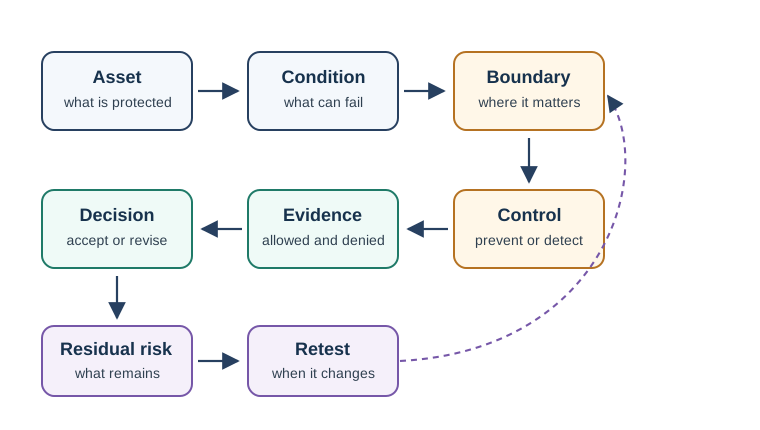
- A scenario record asks a bounded question: what condition is being reviewed, what evidence would confirm or weaken the control claim, what mitigation fits the condition, and what residual risk remains.
Major section
A Scenario Is a Defensive Review Packet (continued)
Retest is triggered by a topic change, schema change, gateway rule change, or dispatch-decision change.
- If you only need the intuition, this layer is enough: a scenario is a compact defensive packet.
- It states a plausible condition, marks the boundary, names the expected control, lists the evidence for the allowed and denied cases, and records residual risk and a retest trigger.
- Beginner ExamplesTaken together, these checks make the section reviewable.
Major section
A Scenario Is a Defensive Review Packet (continued)
The point is not to set a real fire; it is to test whether the alarm sounds, the exits open, and people respond, and to record what failed.
- The One-Minute ViewA condition, not a recipe State the reviewed condition defensively. "An identity can publish outside its assigned topic" is enough to drive review.
- If you can describe a scenario as a defensive evidence packet, you can stop here.
- That order prevents a control name from being treated as proof and connects the visual to the chapter's evidence-led review sequence.
Major section
Build a Scenario Record and Match Mitigations
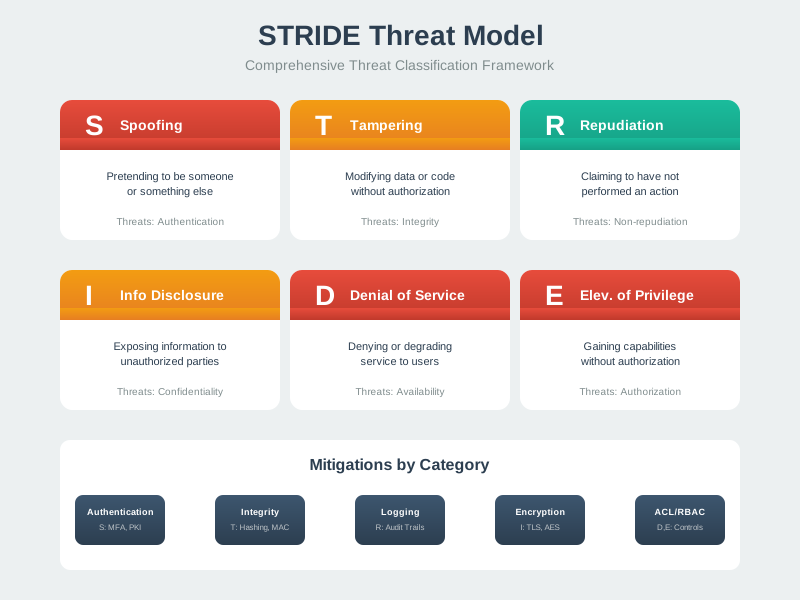
The families below are prompts for evidence-bound review, not a list of every possible threat.
- An identity is accepted for an action it should not perform.
- Data is accepted outside the expected source, format, range, or integrity.
- Source and schema validation, integrity records, rejected-message logs; reasonableness checks for high-impact decisions.

Major section
Build a Scenario Record and Match Mitigations (continued)
A path proves identity but not that the actor may invoke the specific command.
- Firmware, configuration, or policy can change behavior without enough acceptance evidence.
- Signed artifact or approval record, install or config state, denied-change and rollback records; protected configuration.
- Data is visible, retained, combined, or shared beyond the intended audience or purpose.
Major section
Build a Scenario Record and Match Mitigations (continued)
A shared path or service loses an important function under load, failure, or misuse.
- Allowed-flow and rate behavior, overload monitoring, isolation, degrade, and recovery records; quotas and graceful degradation.
- Availability scenarios include denial-of-service conditions where a service cannot answer legitimate devices or users.
- A stepping-stone host changes attribution.
Major section
Build a Scenario Record and Match Mitigations (continued)
The intermediary is already compromised and relays later traffic, so the visible source is not necessarily the origin.
- In a simple DoS review, one source or path overwhelms capacity or sends malformed traffic that the receiver cannot handle safely.
- Botnet DDoS separates victim and compromised fleet.
- Each boundary changes the available security evidence.
Major section
Build a Scenario Record and Match Mitigations (continued)
Vulnerable IoT devices are recruited first, often automatically, and only later receive a coordinated instruction that floods a different service.
- In a DDoS review, many compromised devices send the pressure at once; when those devices are centrally controlled they form a botnet.
- The review sequence is gateway outward.
- Denial of service blocks use.
Major section
Build a Scenario Record and Match Mitigations (continued)
Medium still requires treatment, but the immediate consequence is narrower or recovery is more practical.
- Evidence therefore has two layers—proof that malformed state is rejected or patched, and proof that post-compromise behavior such as new processes, changed firmware, or unusual outbound traffic is detected.
- The goal is to recover the path and contain the relay, not to trust the nearest source address.
- An IoT asset pass should cover more than the device.

Major section
Build a Scenario Record and Match Mitigations (continued)
The first device accepts a console or management action beyond the caller's authority; its stored credentials, neighbor reachability, or management role can then put peer devices at risk.
- This creates two protected assets: the device estate must not become attack infrastructure, and the external or internal target must remain available.
- Battery telemetry shows how a small data-integrity failure becomes a control failure.
- The last row illustrates why labels are not universal scores.
Major section
Build a Scenario Record and Match Mitigations (continued)
Unique credentials, closed management exposure, patching, egress policy, fleet-behavior analytics, rate limits, and target-side capacity controls address different halves of that scenario.
- A false-high state suppresses conservation while the real charge falls, so the node can deplete unexpectedly and shut down without completing its final report.
- A broad taxonomy may group threats as physical, resource, personnel, and technical conditions.
- High means serious confidentiality or trust damage with bounded operational scope.
Major section
Build a Scenario Record and Match Mitigations (continued)
Threat Impact Is a Consequence ClaimA useful impact scale separates consequence from likelihood and detectability.
- Encrypting only the last hop cannot repair a spoofed field message already accepted by the gateway, while link security alone cannot stop a stolen cloud-session token.
- Those labels are prompts for review evidence; they are not findings until they are tied to a concrete asset and boundary.
- A rise in privilege breaks the limit on allowed acts.

Major section
Build a Scenario Record and Match Mitigations (continued)
A threat pass can then look for nefarious activity or abuse, eavesdropping and hijacking, outages, IT-asset loss, failures or malfunctions, disasters, and physical attacks.
- The scenario record should state which affected assets are in scope and which are deliberately out of scope.
- Crucial means the scenario can compromise safety, essential operation, privileged control, or large amounts of sensitive information.
- Each pair still needs a real asset, boundary, harm, owner, and test.

Major section
Build a Scenario Record and Match Mitigations (continued)
The inherited baseline below is a coverage prompt; every project must rerank it against its own assets and operating context.
- The five CRUCIAL families — Malware: Exploit kits: Weak / default passwords: DDoS, and: Data leakage & modification — share one property: each can reach privileged control, essential operation, or bulk sensitive data.
- A checked category is not proof that every instance is affected; it is a prompt to trace the concrete path and either include that asset in the scenario or state why it is out of scope.
- MFA, PKI, hashes, MACs, logs, encryption, robust design, and access rules are only starting points.
Deck summary
Key takeaways
It must not issue a door command or send a reading under another zone's name.
- This scenario does not prove every defence or describe misuse steps.
- The important shift is from narrative to evidence.
- Retest is triggered by a topic change, schema change, gateway rule change, or dispatch-decision change.
- The point is not to set a real fire; it is to test whether the alarm sounds, the exits open, and people respond, and to record what failed.
Retrieval practice
Recall check
Shield Shelly says: answer from memory, then check your reasoning.
Q1What best describes a useful IoT attack-scenario record?
Show answer
Answer: A A scenario is a bounded review record that links the asset, condition, boundary, control, allowed and denied evidence, residual risk, and retest trigger.
Print reference
Answers
Answer key.
- A · A scenario is a bounded review record that links the asset, condition, boundary, control, allowed and denied evidence, residual risk, and retest trigger.