Zigbee, Thread & Matter · Study deck

Thread Security and Matter Boundary

Picture a lock that joins a Thread mesh and appears in a Matter app.

Radio Remi is your guide for this deck.

threadmattersecurity
Radio Remi, the module guide, in a scene from this chapter.
iotclass.org

After studying this chapter

Learning objectives

You will be able to:

  • Separate Thread network security evidence from Matter application and fabric evidence.
  • Review commissioning evidence without assuming that joining proves authorization.
  • Identify which security claims belong to the device, Border Router, controller, fabric, application, or operations process.
  • Evaluate replay, tampering, rogue-device, and over-permission claims through bounded evidence.
iotclass.org

Major section

In 60 Seconds

Thread protects the local mesh path.

  • Matter protects device identity, working sessions, fabric scope, commands, and rights at the app layer.
  • A badge or one working command cannot stand in for all five.
  • Thread and Matter work together, but they do not prove the same thing.
  • Those details may block a working demo.

Key terms

Mesh entry
Mesh entry is one check.
Mesh traffic
Mesh traffic is another.
Border routing
Border routing is another.
iotclass.org

Major section

Start With the Security Claim
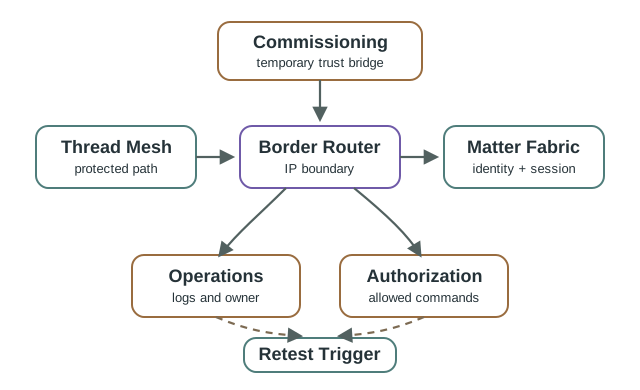
Security review starts with a precise claim.

  • Each claim needs its own evidence.
  • A Matter badge, a successful join, or a working command does not prove every layer.
Thread and Matter security boundary map showing commissioning, Thread mesh protection, Border Router boundary, Matter fabric identity, command authorization, operations evidence, and retest trigger.
iotclass.org

Major section

Layer Boundaries

Thread mesh evidence shows whether the device can communicate over the Thread network using the intended mesh path and protected link behavior.

  • Commissioning evidence shows whether the onboarding path proves the device and commissioner are allowed to exchange the credentials needed for the next step.
  • Border Router evidence shows what crosses between the Thread mesh and the rest of the IP network.
  • Matter fabric evidence shows the application identity and trust relationship used after commissioning.

Key terms

If these layers
If these layers are mixed together, reviews tend to over-approve.
iotclass.org

Major section

Layer Boundaries (continued)

Matter access-control evidence shows which node, user, automation, service, or controller may read, write, or invoke product behavior.

  • If these layers are mixed together, reviews tend to over-approve.
  • A local Thread packet test does not prove Matter command authorization.
  • A Matter command success does not prove that every mesh recovery path is acceptable.
iotclass.org

Major section

How Thread and Matter Security Actually Work

A fabric is identified by a Fabric ID and its Root CA, and each node carries a Node ID.

  • Thread mesh protection is IEEE 802.15.4 link security.: Every frame on a Thread mesh is encrypted and integrity-protected at the 802.15.4 MAC layer using AES-128 in CCM* mode.
  • The boundary you review is exactly what this device forwards between mesh and IP.
  • Reviewing over-permission is, concretely, reviewing ACL entries.
iotclass.org

Major section

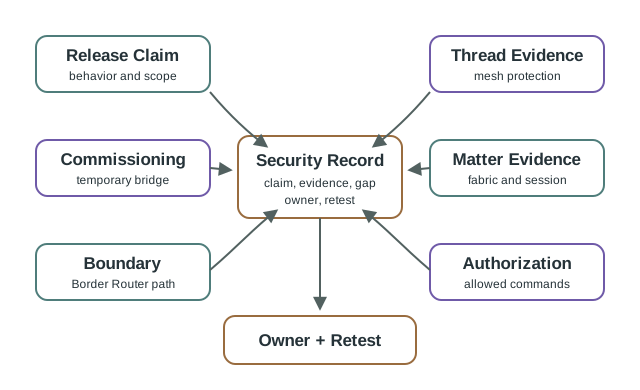
Build a Security Boundary Record

Retest trigger:: Name what reopens the record: device reset, ownership transfer, new controller, Border Router replacement, firmware update, credential change, or policy change.

  • Thread mesh protection, Matter session security, and command authorisation are related but distinct claims.
  • The: Boundary box then names the Border Router path, and: Authorization records the commands the subject may issue.
Thread and Matter security review record showing release claim, Thread evidence, commissioning evidence, Matter fabric evidence, Border Router boundary, access-control evidence, operations owner, and retest trigger.
iotclass.org

Major section

Threat Evidence Without Overclaiming

Security threat review is useful only when the evidence maps to the threat.

  • Replay evidence should show that old traffic is not accepted as fresh traffic.
  • The exact internal mechanism belongs to implementation evidence, but the release review needs a repeatable stale-message result or an equivalent protocol-conformance record.
  • The review does not need dramatic attack stories.
iotclass.org

Major section

Threat Evidence Without Overclaiming (continued)

Tampering evidence should show that changed protected traffic is rejected or fails validation.

  • It should not rely on the assumption that an attacker cannot observe radio traffic.
  • Rogue-device evidence should show that an unexpected device cannot complete the approved onboarding path without the required commissioning evidence.
  • It needs a clean mapping from threat to evidence.
iotclass.org

Major section

Summary

Thread and Matter security are strongest when their boundaries stay visible.

  • Thread protects the mesh path.
  • Matter provides the application fabric, identity, secure sessions, and command authorization above that path.
  • Commissioning connects the two for a short transition, and the Border Router connects the mesh to the wider IP network.
iotclass.org

Deck summary

Key takeaways

Thread protects the local mesh path.

  • Security review starts with a precise claim.
  • Thread mesh evidence shows whether the device can communicate over the Thread network using the intended mesh path and protected link behavior.
  • Matter access-control evidence shows which node, user, automation, service, or controller may read, write, or invoke product behavior.
  • A fabric is identified by a Fabric ID and its Root CA, and each node carries a Node ID.
iotclass.org

Retrieval practice

Recall check 1 of 3

Radio Remi says: answer from memory, then check your reasoning.

Q1How do Thread security and Matter security divide responsibility?

AThread protects the local mesh path; Matter protects the application fabric and permissions
BBoth protect only the border router's uplink to the internet
CThread protects the cloud API while Matter protects the radio hop
DThey are the same layer, so proving one automatically proves the other
Show answer

Answer: A Thread secures the local mesh path; Matter secures the application fabric identity, sessions, and permissions.

iotclass.org

Retrieval practice

Recall check 2 of 3

Radio Remi says: answer from memory, then check your reasoning.

Q2A device joins the intended Thread mesh and can send local protected traffic. The team wants to approve the Matter release claim that a controller may unlock the product. What is the strongest review response?

AApprove the release claim because protected Thread mesh traffic proves the application command is authorized.
BReject the Thread evidence because Matter security replaces Thread security.
CApprove only the Thread mesh claim, then require Matter fabric and access-control evidence before approving the unlock claim.
DSkip Matter access-control review if the device was commissioned by an expected controller.
Show answer

Answer: C The review separates network protection from application identity and command authorization.

iotclass.org

Retrieval practice

Recall check 3 of 3

Radio Remi says: answer from memory, then check your reasoning.

Q3After a Border Router replacement, local Thread status messages still work, but an external Matter controller cannot reach the device. Which review conclusion is strongest?

AApprove all of the security claims, because protected local Thread traffic proves the whole path, boundary included.
BInvalidate every Thread mesh result gathered so far, because one failed external controller path means the whole security record is tainted.
CSeparate the local mesh claim from the Border Router and Matter-controller claim, then retest the boundary-dependent behavior.
DAssume the external controller itself is faulty and remove the controller path from the review scope entirely.
Show answer

Answer: C The replacement reopens the boundary claim while preserving evidence that still supports local mesh behavior.

iotclass.org

Print reference

Answers

Answer key.

  1. A · Thread secures the local mesh path; Matter secures the application fabric identity, sessions, and permissions.
  2. C · The review separates network protection from application identity and command authorization.
  3. C · The replacement reopens the boundary claim while preserving evidence that still supports local mesh behavior.
iotclass.org