Zigbee, Thread & Matter · Study deck
Thread Protocol Comparison
A protocol means an agreed set of rules for passing data.
Radio Remi is your guide for this deck.

After studying this chapter
Learning objectives
You will be able to:
- Compare Thread with nearby IoT protocols without relying on brittle feature tables.
- Separate radio, network, application, ecosystem, power, and release evidence.
- Explain why Thread-versus-Zigbee comparisons must distinguish shared radio assumptions from different network and application layers.
- Identify when Wi-Fi, Bluetooth LE, Z-Wave, Zigbee, or Thread is the better evidence path for a bounded claim.
Major section
Begin With the Job, Not the Name · Thread Protocol Comparison Evidence · In 60 Seconds
Zigbee is a separate stack that can use the same low-power radio.
- A protocol means an agreed set of rules for passing data.
- Bandwidth means how much data a link can carry in a given time.
- IPv6 is a network address and packet plan.
Major section
Start With the Claim · What Each Comparison Really Tests
A protocol comparison should begin with the claim that the product, lab, or deployment needs to prove.
- A claim such as "Thread is better than Zigbee" is too broad to verify.
- A claim such as "this battery-operated Matter sensor can report through a Thread Border Router in the intended building zone and still has an owner for retest" can be reviewed.
- Matter Tests application interoperability.
Major section
Evidence Map and Network Model Fit
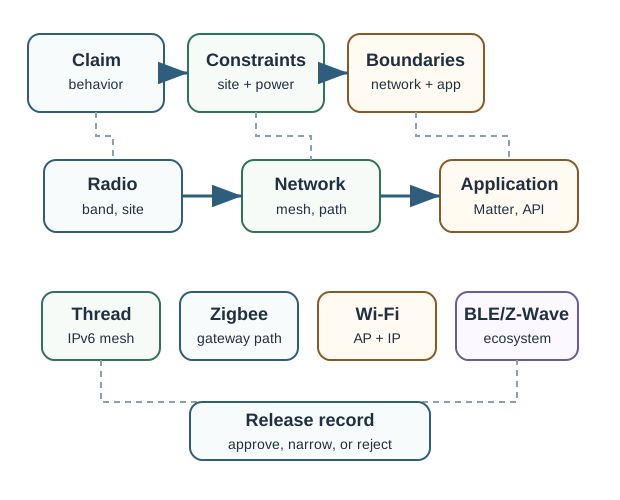
The comparison should move from requirement to evidence, not from protocol name to winner.
- Bluetooth LE Short-range, phone-friendly interaction path where proximity and pairing are part of the product behavior.
Major section
Thread Versus Zigbee · Low-Power IP Reachability Test
Thread and Zigbee are often compared because both may sit on the IEEE 802.15.4 radio family.
- That shared radio ancestry does not make them interchangeable.
- The strongest Thread argument is usually not that the radio is inherently better.
- The strongest Zigbee argument is usually not that old technology is automatically safer.
Major section
Thread Versus Wi-Fi · Thread Versus Bluetooth LE
Wi-Fi is often better when the product needs sustained bandwidth, direct access to existing IP networks, or a mains-powered device with mature enterprise network support.
- Thread is often better when a constrained device needs small messages, mesh reach, low-power states, and a bounded Border Router path.
- Good comparison records avoid universal power or latency numbers.
- Bluetooth LE is strongest when the phone or a nearby controller is part of the normal interaction.
- Thread is stronger when the product claim needs a persistent low-power mesh with an owned IP path beyond phone proximity.
Major section
Thread Versus Z-Wave · Matter Changes the Question · Why Matter Favors Thread for Low-Power Mesh
Neither protocol is automatically correct from the name alone.
- Z-Wave comparisons need more than a range slogan.
- A fair comparison records the local radio plan, device ecosystem, controller support, certification route, availability of installers, and operational expectations.
- Matter defines application behavior above the network.
Major section
Build a Comparison Record · Worked Review: Existing Zigbee Site
A comparison record should be short enough to maintain and specific enough to retest.
- Claim:: The device must report small state changes in a Matter environment after normal installation.
- BLE evidence:: Phone proximity, pairing, remote gateway need, and user interaction window.
- The record deliberately includes rejected candidates.
- Rejection reasons are useful evidence.
Major section
Worked Review: New Matter Sensor · Common Comparison Drift
Wi-Fi remains a candidate if the product has power and bandwidth reasons.
- A product team is designing a new small sensor for a smart-home ecosystem and has no existing Zigbee installed base to preserve.
- Better comparison:: Matter can run over more than one transport path.
- BLE may remain a commissioning or local-interaction path, but not the full remote runtime path unless a gateway is included.
Major section
Protocol Comparison Checklist · Match the Evidence
Claim scoped The comparison says what product behavior is being reviewed and what is outside scope.
- Candidate evidence listed Each candidate has the evidence it would need, not only a feature label.
- Boundary named Border Router, gateway, controller, bridge, phone, dashboard, and cloud responsibilities are explicit.
- Application separated Matter, Zigbee clusters, BLE profiles, web APIs, and product behavior are not confused with the network layer.
Major section
Key Takeaway · Concept Relationships
Thread and Matter are not the same layer.
- Thread Protocol Comparison Evidence should compare Thread against alternatives using IPv6 mesh behavior, power, roles, security, Matter fit, operations, and deployment evidence.
- Thread and Zigbee both need radio and deployment evidence, but Thread comparison emphasizes IPv6 mesh and Border Router boundaries while Zigbee comparison emphasizes controller, gateway, and application-profile boundaries.
- Matter product evidence must be kept separate from Thread network evidence.
Deck summary
Key takeaways
Zigbee is a separate stack that can use the same low-power radio.
- A protocol comparison should begin with the claim that the product, lab, or deployment needs to prove.
- The comparison should move from requirement to evidence, not from protocol name to winner.
- Thread and Zigbee are often compared because both may sit on the IEEE 802.15.4 radio family.
- Wi-Fi is often better when the product needs sustained bandwidth, direct access to existing IP networks, or a mains-powered device with mature enterprise network support.
Retrieval practice
Recall check 1 of 6

Radio Remi says: answer from memory, then check your reasoning.
Q1When is Bluetooth LE a better evidence path than Thread for a device?
Show answer
Answer: A Bluetooth LE fits when proximity, phone pairing, or short interaction windows dominate, whereas Thread fits persistent IP meshes.
Retrieval practice
Recall check 2 of 6

Radio Remi says: answer from memory, then check your reasoning.
Q2In a Thread-versus-Zigbee comparison, what is Thread's defining network-model advantage?
Show answer
Answer: A Thread's distinguishing comparison point is IPv6-native mesh reachability through a routing Border Router, not a different radio slogan.
Retrieval practice
Recall check 3 of 6

Radio Remi says: answer from memory, then check your reasoning.
Q3A device must be a low-power mesh node and directly reachable as an IP endpoint without a protocol-translating gateway. Which comparison answer is strongest?
Show answer
Answer: A Thread is the stronger candidate when low-power mesh plus IP-native reachability is the actual requirement, but the decision still needs bounded release evidence.
Retrieval practice
Recall check 4 of 6

Radio Remi says: answer from memory, then check your reasoning.
Q4Why is Thread a natural low-power mesh transport candidate for Matter devices?
Show answer
Answer: A Matter is IP-based, so Thread's IP-native low-power mesh path fits without requiring a protocol-translating gateway.
Retrieval practice
Recall check 5 of 6

Radio Remi says: answer from memory, then check your reasoning.
Q5A team is selecting connectivity for a new battery-operated door sensor. The claim is that the sensor should join a Matter smart-home system, report small state changes, and work beyond phone proximity through an owned home network path. Which review answer is strongest?
Show answer
Answer: A Thread fits the low-power mesh and Matter transport direction, but the decision is only strong when the network, Border Router, Matter, and product behavior evidence are all recorded.
Retrieval practice
Recall check 6 of 6

Radio Remi says: answer from memory, then check your reasoning.
Q6A building already has a stable Zigbee lighting network, trained support staff, and a tested gateway path. A new low-rate sensor is being added, but the release does not require Matter interoperability or IP-native device addressing. What is the best review conclusion?
Show answer
Answer: B Existing operations evidence matters.
Print reference
Answers 1 of 2
Answer key.
- A · Bluetooth LE fits when proximity, phone pairing, or short interaction windows dominate, whereas Thread fits persistent IP meshes.
- A · Thread's distinguishing comparison point is IPv6-native mesh reachability through a routing Border Router, not a different radio slogan.
- A · Thread is the stronger candidate when low-power mesh plus IP-native reachability is the actual requirement, but the decision still needs bounded release evidence.
Print reference
Answers 2 of 2
Answer key.
- A · Matter is IP-based, so Thread's IP-native low-power mesh path fits without requiring a protocol-translating gateway.
- A · Thread fits the low-power mesh and Matter transport direction, but the decision is only strong when the network, Border Router, Matter, and product behavior evidence are all recorded.
- B · Existing operations evidence matters.