Zigbee, Thread & Matter · Study deck
Thread Network Architecture
A school has mains-powered room units, small battery buttons, and two bridge units that connect the building network to other services.
Radio Remi is your guide for this deck.

After studying this chapter
Learning objectives
You will be able to:
- Separate Thread Border Router, Leader, Router, REED, FED, MED, and SED responsibilities.
- Explain why parent-child evidence is different from mesh-routing evidence.
- Identify what a Border Router proves and what it does not prove.
- Build a role evidence record for a small Thread deployment.
Major section
Thread Network Architecture Evidence
A school has mains-powered room units, small battery buttons, and two bridge units that connect the building network to other services.
- Some can pass traffic, some may take on more work, and some sleep and depend on a parent.
- This review does not prove that every device can route or that a bridge proves the remote service works.
- The deeper sections explain leaders, routers, eligible devices, sleepy children, partitions, bridge duties, and the retest triggers needed as the installed network changes.
Major section
In 60 Seconds · Start With the Architecture Claim
Thread uses an IPv6 mesh architecture for constrained IoT devices.
- Routers form the always-available mesh backbone and can host child devices.
- A Leader is an elected router role for network management inside a partition; it is not the same as an application controller.
- A useful Thread architecture claim names the behavior being reviewed.
Major section
What Each Role Proves
Thread role names are useful only when they are tied to evidence.
- The goal is not to memorize labels; the goal is to know what each label proves about the network.
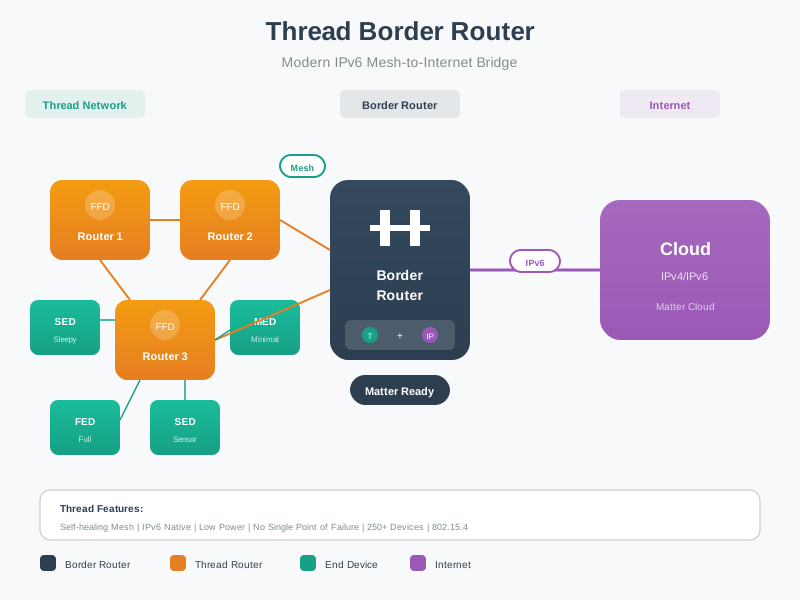
- Border Router Routes between the Thread mesh and another IP network.
- Evidence should show the specific boundary, service behavior, and owner of the off-mesh path.
Major section
What Each Role Proves (continued)
Evidence should show that leadership is a network role, not an application controller or single permanent device.
- Router Participates in mesh forwarding and may host child devices.
- Evidence should show that it is awake enough to support routing responsibilities.
- REED Is eligible to become a router when the network needs and permits that role.
Major section
What Each Role Proves (continued)
Evidence should avoid assuming that eligible means currently routing.
- FED Is an end device that remains ready to receive without acting as a mesh router.
- Evidence should separate low-latency reception from routing responsibility.
- MED or SED Communicates through a parent and may trade response timing for power.
Major section
Full and Minimal Device Boundary
The first architecture split is capability based.
- A Full Thread Device (FTD) keeps enough radio and protocol state active to route traffic and act as a parent.
- A Minimal Thread Device (MTD) is a leaf device: it attaches to a parent, communicates for itself, and does not forward traffic for neighbors.
Major section
Router Cap and REED Promotion
REEDs exist because capability and current role are different.
- That limit bounds routing state and control traffic so constrained devices do not have to maintain an unbounded mesh backbone.
- A network can contain many more than 32 devices, but only the active router set carries mesh-routing responsibility.
- A Router-Eligible End Device is an FTD acting as an end device until the network needs more routing capacity and promotion is permitted.
Major section
Border Router Boundary · Parent-Child Evidence
A Border Router is the most common place where architecture claims become too broad.
- A mesh-local test can show that devices inside the Thread network communicate.
- This keeps the Border Router from becoming a magic gateway in the documentation.
- End devices depend on parents.
- That relationship is architectural, not just operational.
Major section
RLOC16 and Mesh-Local Identity · Role Selection Evidence
Thread gives each device a Routing Locator (RLOC), a mesh-local IPv6 address whose lower bits contain a 16-bit RLOC16.
- Applications should not treat that locator as stable identity.
- The Mesh-Local EID (ML-EID) gives the device a stable mesh-local address that does not move with the topology.
Major section
Worked Architecture Records · Common Architecture Mistakes
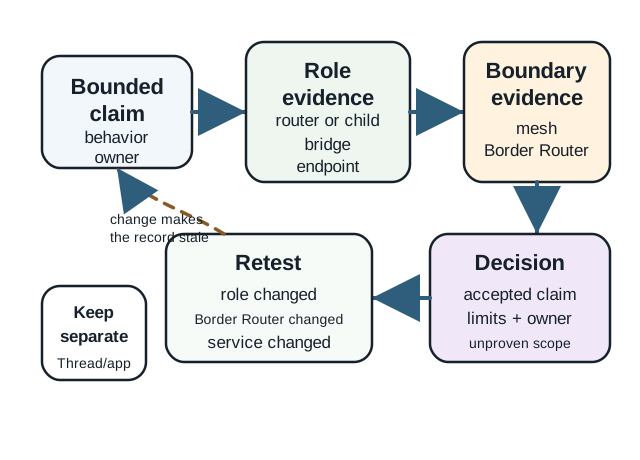
Each record should name the role, the boundary, the evidence, the limit, and the retest trigger.
- Retest: parent changes, latency requirement changes, battery profile changes, or firmware changes.
- Counting every device as mesh backbone End devices can be Thread members without forwarding traffic for others.
- Treating REED as current router Router eligible means capable of promotion, not proof that the device is currently routing.
Major section
Order a Thread Architecture Review · Summary
Thread network architecture is a role-and-boundary review.
- A strong chapter record does not simply say that Thread is a mesh.
- It explains which devices are carrying mesh responsibility, which devices depend on parents, which Border Router boundary is being claimed, and which evidence would need retest after a change.
- Architecture explains responsibilities and boundaries; operations verifies runtime behavior; Matter or another application layer verifies user-facing behavior.
Major section
Key Takeaway · Concept Relationships
Thread Network Architecture Evidence should validate Thread topology with leader, router, end-device, border-router, partition, route, power, and deployment evidence.
- Thread architecture Connects roles, parent-child relationships, mesh routing, Border Router boundaries, and evidence ownership.
- Router Provides mesh-forwarding responsibility and may host child devices.
- Architecture record Captures claim, evidence, limits, owner, and retest trigger.
Deck summary
Key takeaways
A school has mains-powered room units, small battery buttons, and two bridge units that connect the building network to other services.
- Thread uses an IPv6 mesh architecture for constrained IoT devices.
- Thread role names are useful only when they are tied to evidence.
- Evidence should show that leadership is a network role, not an application controller or single permanent device.
- Evidence should avoid assuming that eligible means currently routing.
Retrieval practice
Recall check 1 of 6

Radio Remi says: answer from memory, then check your reasoning.
Q1In Thread's architecture, what is the Leader?
Show answer
Answer: A The Thread Leader is an elected router role that manages the mesh within a partition, not an application controller.
Retrieval practice
Recall check 2 of 6
Radio Remi says: answer from memory, then check your reasoning.
Q2A sleepy sensor has a parent, while powered routers forward across the mesh. What proves each claim?
Show answer
Answer: D Attachment and mesh forwarding are different behaviors.
Retrieval practice
Recall check 3 of 6
Radio Remi says: answer from memory, then check your reasoning.
Q3Which Thread device type can route traffic and act as a parent for other devices?
Show answer
Answer: A A Full Thread Device can stay active enough to route and parent; Minimal Thread Devices are non-routing leaf devices.
Retrieval practice
Recall check 4 of 6
Radio Remi says: answer from memory, then check your reasoning.
Q4A Thread sensor can reach another Thread device on the same mesh. The team wants to say the deployment is ready for off-mesh service access through a Border Router. What is the strongest next review step?
Show answer
Answer: B The Border Router claim needs its own boundary and evidence record separate from mesh-local communication.
Retrieval practice
Recall check 5 of 6
Radio Remi says: answer from memory, then check your reasoning.
Q5What does a Thread RLOC16 encode, and why does Thread also provide an ML-EID?
Show answer
Answer: A RLOC16 encodes routing position and can change with topology; ML-EID is the stable mesh-local identity.
Retrieval practice
Recall check 6 of 6
Radio Remi says: answer from memory, then check your reasoning.
Q6A design review says a battery-powered sensor improves Thread mesh coverage because it is part of the network. What correction should the reviewer make?
Show answer
Answer: A Network membership and mesh-routing responsibility are different claims.
Print reference
Answers 1 of 2
Answer key.
- A · The Thread Leader is an elected router role that manages the mesh within a partition, not an application controller.
- D · Attachment and mesh forwarding are different behaviors.
- A · A Full Thread Device can stay active enough to route and parent; Minimal Thread Devices are non-routing leaf devices.
- B · The Border Router claim needs its own boundary and evidence record separate from mesh-local communication.
Print reference
Answers 2 of 2
Answer key.
- A · RLOC16 encodes routing position and can change with topology; ML-EID is the stable mesh-local identity.
- A · Network membership and mesh-routing responsibility are different claims.