Zigbee, Thread & Matter · Study deck
Thread IPv6 Mesh Foundations
Picture a battery sensor that can join a Thread network but stops reporting when one router loses power.
Radio Remi is your guide for this deck.

After studying this chapter
Learning objectives
You will be able to:
- Explain Thread as an IPv6 mesh layer for constrained IoT networks.
- Separate Thread's radio, adaptation, network, Border Router, and application boundaries.
- Describe how Thread relates to Matter without merging the two protocols.
- Identify the first evidence needed for role, addressing, mesh, and service-fit claims.
Major section
Start With the IPv6 Mesh Claim
Joining once does not prove that the device can recover or reach the right service.
- Internet Protocol means the shared addressing rules used to route data across networks.
- A protocol means the shared rules for a message exchange.
- 6LoWPAN means a method for carrying Internet Protocol version 6 traffic over small low-power radio frames.
Major section
Start With the IPv6 Mesh Claim (continued)
The simple review path is join, address, route, recover, and observe.
- Thread uses both ideas to form a routed mesh.
- This runway does not prove application behavior, security, coverage, or battery life.
- Once those steps are clear, Thread roles, security, implementation, and Matter relationships can be checked without treating the mesh as magic.
Major section
Thread IPv6 Mesh Foundations Evidence · In 60 Seconds
Thread is a low-power mesh networking protocol that carries IPv6 traffic over constrained radios.
- Thread is not the radio alone, not Matter alone, not a product ecosystem, and not a guarantee that any smart-home deployment is ready.
- A useful first review identifies what Thread provides, what it depends on, and what still needs separate evidence.
- Thread provides an IPv6 mesh network for constrained IoT devices.
Major section
Thread Claim Before Comparison · What Thread Provides
A claim such as "Thread is better" is too broad.
- Device behavior Telemetry, local control, event notification, commissioning support, bridge handoff, or low-power sensing.
- Network need IPv6 mesh routing, low-power wireless operation, local service reachability, or Border Router connectivity.
- IPv6 adaptation Header compression and adaptation make IPv6 practical over constrained frames.
Major section
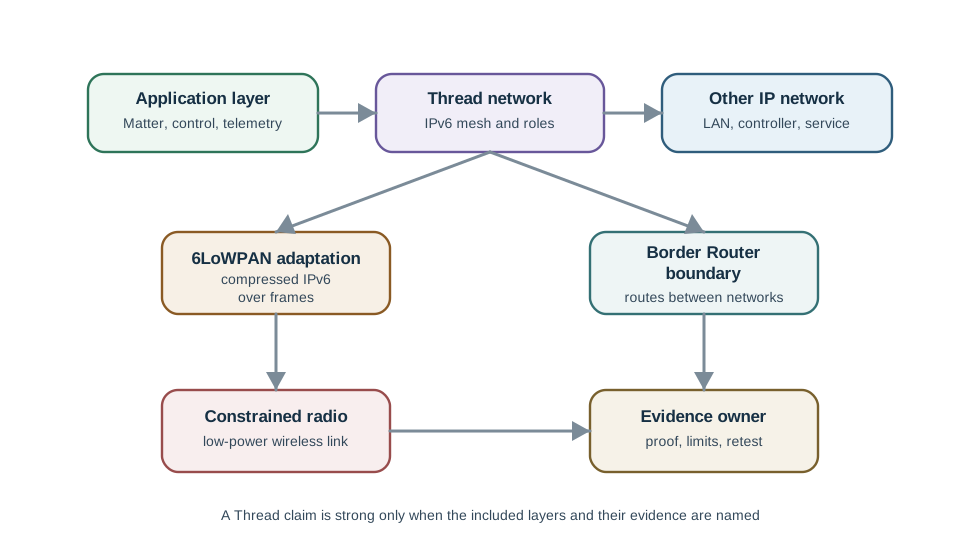
Stack and Boundary Map
For example, a successful Matter command may depend on Thread, but it does not by itself prove mesh recovery, role suitability, or Border Router service behavior.
- The boundary map separates constrained radio, 6LoWPAN adaptation, IPv6 mesh, Border Router routing, application behavior, and evidence ownership.
Major section
Native IPv6 Stack · Thread Layer Stack
Thread is built on the same IEEE 802.15.4 radio family as Zigbee, but it uses a different network stack.
- Thread layers 802.15.4 radio and MAC behavior, 6LoWPAN adaptation, IPv6 networking, and UDP transport so each Thread device is a real IP node with its own address.
- That IPv6-native design is the main architectural difference from non-IP mesh stacks.
- Connecting a Thread mesh to another IP network needs a Border Router that routes packets across the boundary, not a protocol-translating gateway that converts every device interaction into a different application model.
Major section
Device Roles at Introduction Level · Resilience and Leader Election
Learners should understand role intent before learning detailed role mechanics.
- Router-capable devices Can stay available enough to help carry mesh traffic when the network needs them.
- End devices Communicate through a parent and do not carry traffic for the wider mesh.
- The introduction does not need every role detail.
Major section
Thread and Matter Relationship · Border Router Boundary · Fit Evidence Map
Thread evidence: Devices attach to the mesh, keep appropriate roles, use network addresses correctly, route traffic, recover from local changes, and expose enough diagnostics to explain failures.
- Matter evidence: Devices expose an application model, endpoints, clusters, commands, events, fabrics, and commissioning behavior that match an application claim.

Major section
First Evidence Questions · Worked Introduction Records
Which role is implied?: Decide whether the device must route, stay reachable, sleep, bridge networks, or only communicate for itself.
- These questions keep the introduction practical without turning it into a setup guide.
- Low-power sensor claim Claim: a sensor should report events through a low-power mesh.
- Limit: immediate command reachability is not assumed.
Major section
Common Mistakes · Thread Introduction Checklist · Match Thread Foundations
Calling Thread a product ecosystem Thread is a network protocol.
- Product setup, app behavior, and ecosystem support are separate layers.
- Treating Matter and Thread as the same thing Matter can use Thread, but Matter application behavior and Thread network behavior prove different claims.
- Ignoring device roles A device that sleeps, a device that routes, and a device that bridges networks require different evidence.
Major section
Order the Thread Fit Review · Summary
Thread is best introduced as a low-power IPv6 mesh network for constrained IoT devices.
- It depends on a constrained radio and adaptation layer, provides mesh networking and IP addressing, and can connect through Border Routers to other IP networks.
- Thread is not the same as Matter, not the same as a product ecosystem, and not proof of every application path.
- A strong introductory review says what Thread proves, what it depends on, and what needs separate evidence.
Major section
Key Takeaway · Concept Relationships
Thread IPv6 Mesh Foundations Evidence should connect Thread IPv6 mesh roles, routing, commissioning, border routers, security, power behavior, and deployment evidence.
- Thread Connects constrained devices through an IPv6 mesh network.
- Constrained radio Provides the low-power wireless link that Thread uses.
- 6LoWPAN adaptation Connects IPv6 semantics to constrained link-layer frames.
Deck summary
Key takeaways
Joining once does not prove that the device can recover or reach the right service.
- The simple review path is join, address, route, recover, and observe.
- Thread is a low-power mesh networking protocol that carries IPv6 traffic over constrained radios.
- A claim such as "Thread is better" is too broad.
- For example, a successful Matter command may depend on Thread, but it does not by itself prove mesh recovery, role suitability, or Border Router service behavior.
Retrieval practice
Recall check 1 of 6
Radio Remi says: answer from memory, then check your reasoning.
Q1What does Thread provide at its core?
Show answer
Answer: A Thread is an IPv6 low-power mesh network for constrained devices, distinct from the application layer and the cloud.
Retrieval practice
Recall check 2 of 6
Radio Remi says: answer from memory, then check your reasoning.
Q2What networking model does Thread use?
Show answer
Answer: A Thread runs native IPv6 over IEEE 802.15.4 with 6LoWPAN adaptation.
Retrieval practice
Recall check 3 of 6
Radio Remi says: answer from memory, then check your reasoning.
Q3What is the key network-layer difference between Thread and Zigbee?
Show answer
Answer: A Thread routes native IPv6; Zigbee uses a non-IP network layer that normally needs gateway translation.
Retrieval practice
Recall check 4 of 6
Radio Remi says: answer from memory, then check your reasoning.
Q4What happens to a Thread network if the device currently acting as Leader fails?
Show answer
Answer: A Thread can elect a new Leader automatically; mesh routing does not depend on one permanent controller.
Retrieval practice
Recall check 5 of 6
Radio Remi says: answer from memory, then check your reasoning.
Q5A team says a device is Thread-ready because a Matter command worked once through a controller. How should reviewers assess the Thread-ready claim after one Matter command?
Show answer
Answer: B The command may be useful application evidence, but Thread network readiness still needs its own evidence.
Retrieval practice
Recall check 6 of 6
Radio Remi says: answer from memory, then check your reasoning.
Q6A Thread mesh-local test succeeds. The team wants to claim off-mesh service reachability through a Border Router. What evidence is still needed?
Show answer
Answer: B Off-mesh reachability depends on a boundary that should be reviewed separately from mesh-local behavior.
Print reference
Answers 1 of 2
Answer key.
- A · Thread is an IPv6 low-power mesh network for constrained devices, distinct from the application layer and the cloud.
- A · Thread runs native IPv6 over IEEE 802.15.4 with 6LoWPAN adaptation.
- A · Thread routes native IPv6; Zigbee uses a non-IP network layer that normally needs gateway translation.
- A · Thread can elect a new Leader automatically; mesh routing does not depend on one permanent controller.
Print reference
Answers 2 of 2
Answer key.
- B · The command may be useful application evidence, but Thread network readiness still needs its own evidence.
- B · Off-mesh reachability depends on a boundary that should be reviewed separately from mesh-local behavior.