Zigbee, Thread & Matter · Study deck
Thread Network Operations
Run one clear operations drill.
Radio Remi is your guide for this deck.

After studying this chapter
Learning objectives
You will be able to:
- Explain: Evidence: baseline parent and identity are recorded, parent change is observed, routing location changes are interpreted separately from stable application identity, and telemetry resumes through the expected application path.
- Explain: Thread Network Operations should help prove where IPv6 is native, where mesh behavior is managed, and where the border or application layer still sets limits.
- Explain: Under the Hood explains address scopes, role choice, path repair, and the limits that appear when low power and changing links meet.
- Explain: Thread network operations should be reviewed through evidence records, not through isolated commands or one successful join event.
Major section
Start With the IPv6 Mesh Claim
Under the Hood explains address scopes, role choice, path repair, and the limits that appear when low power and changing links meet.
- One join does not prove recovery.
- One local message does not prove the app.
- Most devices use little power.
- The system must keep working when a helper moves or fails.
Major section
Start With the IPv6 Mesh Claim (continued)
Thread is a low-power mesh system for this kind of local network.
- A mesh lets suitable devices pass messages for one another.
- Not every device does that job.
- A sleepy sensor may wake only to check in with its parent.
- A powered device may help form paths.
Major section
Start With the IPv6 Mesh Claim (continued)
Thread Network Operations should help prove where IPv6 is native, where mesh behavior is managed, and where the border or application layer still sets limits.
- It sends useful data.
- It must also recover when the chosen path disappears.
- Each step should leave evidence that an operator can read.
- A device role can change.
Major section
Start With the IPv6 Mesh Claim (continued)
Once those steps are clear, Thread roles, security, implementation, and Matter relationships can be checked without treating the mesh as magic.
- Its identity should remain clear.
- A working local path does not prove that an app service works.
- This first view shows one healthy mesh.
- Real systems can split, merge, and choose new leaders.
Major section
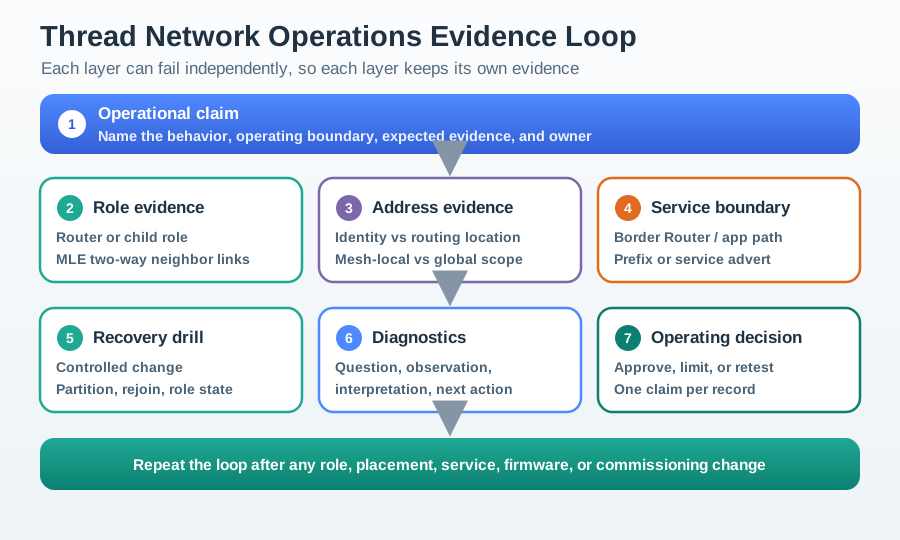
Operations Claim Before Tuning · Operations Evidence Loop
Network behavior Formation, attachment, routing, service reachability, commissioning support, low-power operation, or recovery after change.
- Evidence source Role state, address state, parent-child records, route observations, service advertisements, diagnostics, or recovery drill notes.
- Owner The team that accepts the evidence, responds to failures, and decides when a configuration change needs retest.
Major section
MLE and Mesh Maintenance · Formation and Role Evidence
Role selection The record explains which devices act as routers, router-eligible devices, full end devices, or sleepy end devices.
- A Thread mesh is maintained by MLE, or Mesh Link Establishment.
- Formation evidence explains how the network reached its current state and why each device role is acceptable.
- Role evidence should match deployment intent.
Major section
Addressing and Identity Evidence · Parent, Child, and Router Evidence · Bidirectional Link-Quality Evidence
Stable identity Endpoint identity should remain usable by the application even when topology changes.
- Routing location Routing-locator evidence can change when parent or router position changes.
- That change is normal when topology changes.
- Applications should not treat every address as the same kind of identifier.
Major section
Low-Power Operation Evidence · Border Router and External Service Evidence · Recovery and Partition Evidence
Mesh operation Attachment, routes, parent-child behavior, and mesh-local service behavior.
- Low-power operation is an agreement between application needs, role selection, polling behavior, parent custody, and diagnostics.
- It should not be approved from a theoretical battery calculation alone.
- The service boundary needs its own evidence.
Major section
Diagnostics Without Transcript Drift · Operations Record
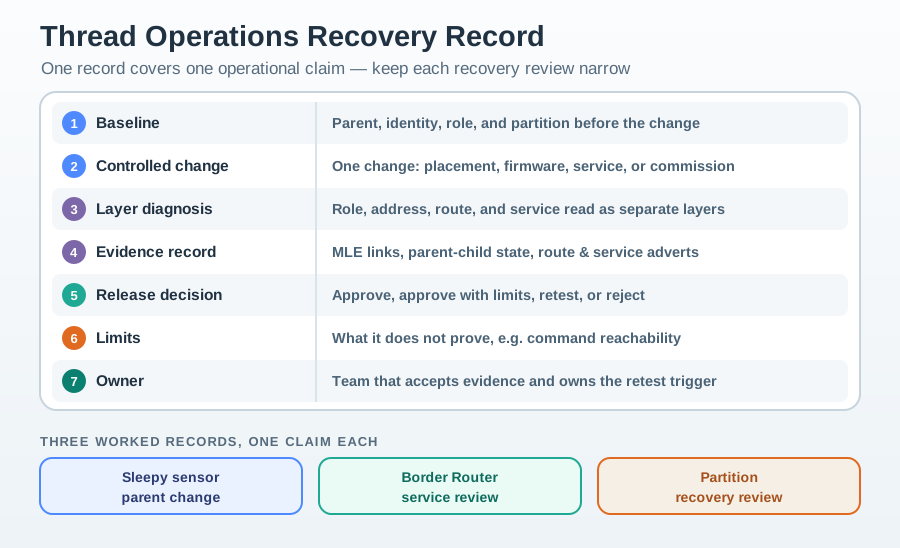
Raw diagnostic output is useful during troubleshooting, but a chapter review should not become a command manual.
- This format keeps diagnostics tied to operating decisions instead of leaving learners with long transcripts that are hard to review.
- The second figure shows how operational observations become a decision record.
- One record should cover one operational claim.
Major section
Worked Operations Records · Common Mistakes
Sleepy sensor parent change Claim: a sleepy sensor can keep reporting after parent change.
- Evidence: baseline parent and identity are recorded, parent change is observed, routing location changes are interpreted separately from stable application identity, and telemetry resumes through the expected application path.
- Limit: immediate command reachability is not included.
- Limit: alternate controller behavior requires separate review.
Major section
Order a Network Operations Review · Summary
Thread network operations should be reviewed through evidence records, not through isolated commands or one successful join event.
- The strongest record explains formation, role selection, parent-child behavior, addressing, low-power behavior, service boundaries, diagnostics, and recovery outcomes.
- A mesh can attach without proving off-mesh service behavior, and an application can succeed once without proving recovery behavior.
- Good operations evidence says what is proven, what is limited, and who owns retest.
Major section
Key Takeaway · Concept Relationships
Thread Network Operations Evidence should turn Thread planning into deployment evidence for commissioning, role changes, border routing, diagnostics, repair, and operational ownership.
- Operations claim Connects network behavior, operating boundary, evidence source, and owner.
- Formation evidence Connects join, restore, reattach, role choice, and dataset state.
- Role evidence Connects routing responsibility, parent-child state, low-power behavior, and repair control.
Deck summary
Key takeaways
Under the Hood explains address scopes, role choice, path repair, and the limits that appear when low power and changing links meet.
- Thread is a low-power mesh system for this kind of local network.
- Thread Network Operations should help prove where IPv6 is native, where mesh behavior is managed, and where the border or application layer still sets limits.
- Once those steps are clear, Thread roles, security, implementation, and Matter relationships can be checked without treating the mesh as magic.
- Network behavior Formation, attachment, routing, service reachability, commissioning support, low-power operation, or recovery after change.
Retrieval practice
Recall check 1 of 6

Radio Remi says: answer from memory, then check your reasoning.
Q1In Thread network operations, why keep a device's address identity separate from its routing location?
Show answer
Answer: A Thread operations separate stable address identity from mesh routing location, which can change as roles and parents change.
Retrieval practice
Recall check 2 of 6
Radio Remi says: answer from memory, then check your reasoning.
Q2What is the role of MLE (Mesh Link Establishment) in a Thread network?
Show answer
Answer: A MLE discovers neighbors, attaches devices to parents, and exchanges link quality, underpinning Thread routing.
Retrieval practice
Recall check 3 of 6
Radio Remi says: answer from memory, then check your reasoning.
Q3Why does Thread evaluate link quality bidirectionally rather than just whether a node can hear a neighbor?
Show answer
Answer: A Acknowledged delivery fails on asymmetric links, so Thread exchanges incoming link quality and routes over good bidirectional links.
Retrieval practice
Recall check 4 of 6
Radio Remi says: answer from memory, then check your reasoning.
Q4A Thread network splits into two disconnected halves, then the halves reconnect later. What happens?
Show answer
Answer: A A split Thread network forms partitions, each with a Leader, and merges into one when reconnected.
Retrieval practice
Recall check 5 of 6
Radio Remi says: answer from memory, then check your reasoning.
Q5A powered Thread device joins successfully and sends one message. The team wants to approve it as a router for nearby sleepy devices. How should reviewers decide whether this device may act as a router?
Show answer
Answer: B Router approval needs evidence that the device can operate as part of the mesh, not only evidence that it joined once.
Retrieval practice
Recall check 6 of 6
Radio Remi says: answer from memory, then check your reasoning.
Q6A child device changes parent after a controlled recovery drill. Which interpretation best separates Thread address evidence from application identity evidence?
Show answer
Answer: B Thread operations review should distinguish topology-dependent routing information from stable endpoint identity.
Print reference
Answers 1 of 2
Answer key.
- A · Thread operations separate stable address identity from mesh routing location, which can change as roles and parents change.
- A · MLE discovers neighbors, attaches devices to parents, and exchanges link quality, underpinning Thread routing.
- A · Acknowledged delivery fails on asymmetric links, so Thread exchanges incoming link quality and routes over good bidirectional links.
- A · A split Thread network forms partitions, each with a Leader, and merges into one when reconnected.
Print reference
Answers 2 of 2
Answer key.
- B · Router approval needs evidence that the device can operate as part of the mesh, not only evidence that it joined once.
- B · Thread operations review should distinguish topology-dependent routing information from stable endpoint identity.