Zigbee, Thread & Matter · Study deck
Thread Network Deployment
Picture a school adding thirty window sensors across two floors.
Radio Remi is your guide for this deck.

After studying this chapter
Learning objectives
You will be able to:
- Build a Thread implementation deployment record that separates claims from assumptions.
- Review Border Router services without confusing them with Thread Leader, controller, bridge, or cloud responsibilities.
- Check network dataset and commissioning custody before a deployment is handed to operations.
- Use diagnostics evidence to decide whether failures are mesh, service, commissioning, coexistence, or application issues.
Major section
Start With the IPv6 Mesh Claim
A bench unit joined once, but the installer must prove that every room can join the intended network, reach the building service, recover after loss, and leave evidence that support staff can read.
- This opening does not tune every radio setting or certify the whole site.
- Practitioner builds the staged install and support record.
- The simple review path is join, address, route, recover, and observe.
Major section
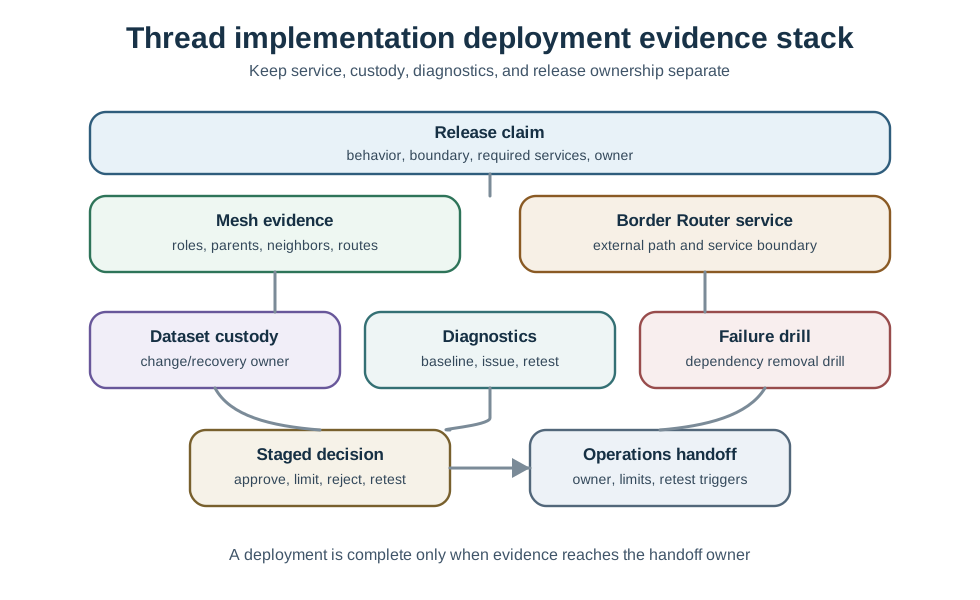
Implementation Deployment Evidence Stack
The implementation deployment evidence stack separates the release claim from the proof that supports it: mesh evidence, Border Router service, dataset custody, diagnostics, failure drill, staged decision, and operations handoff.
- Each layer needs evidence that matches its responsibility.
Major section
Site Planning and Optimization Gate
Optimization control Treat router count, placement, poll intervals, retries, and firmware tuning as change-controlled decisions with rollback and retest triggers.
- Deployment planning is part of implementation evidence when it changes the release decision.
- Site scope Record rooms, floors, enclosures, outdoor edges, interference sources, service access, and which zones are excluded from the release.
- An optimization is acceptable only when it improves the release claim without hiding coverage gaps, service delay, battery risk, or ownership.
Major section
External Service Translation Evidence · Network Dataset and Commissioning Custody
Some deployments require Thread devices to reach services that are not native to the mesh.
- Translation evidence should stay practical and bounded.
- Address and route behavior The record shows which path is advertised to the mesh and which owner can change that path.
- The operational dataset and commissioning artifacts are deployment responsibilities.
Major section
Commissioning Custody and Dataset Transfer
Commissioning is the controlled transfer of that dataset to an authorized Joiner.
- Thread network membership is defined by the operational dataset, not by device location or vendor.
- The dataset includes the network name, Extended PAN ID, PAN ID, channel, network key, commissioning credential (PSKc), and mesh-local prefix.
- The key is not broadcast in the clear.
Major section
Commissioning Custody and Dataset Transfer (continued)
Two devices are part of the same Thread network when they share the same operational dataset.
- The deployment record should name the Commissioner that authorizes new devices, the Joiner that is requesting access, and the Joiner Router or Border Router path that relays the commissioning exchange when needed.
- Commissioner Authorizes new devices and holds the commissioning credential that proves the Joiner is allowed to receive the dataset.
- Joiner The new device proves authorization before it receives the operational dataset and joins the mesh.
- Operational dataset The shared configuration that defines the network and must be protected, backed up, changed, and recovered by an owner.
Major section
Multi-Network and Zone Boundaries
Some sites need more than one Thread network or more than one release zone.
- The review should not use broad device-count rules as the main argument.
- Instead, it should ask why the boundary exists and what evidence proves the boundary is operationally useful.
- When multiple Thread networks feed one higher-level application, the implementation record should say where Thread evidence stops and where application or Matter fabric evidence begins.
Major section
Device Role and Attachment Evidence
Thread implementation depends on device role behavior that matches the site.
- The review should not force every always-on device to route, and it should not expect sleepy devices to carry the mesh.
- The record should also identify who can repair a bad role assignment.
- If a device can be configured into a role that hurts the mesh, that control belongs in the release evidence.
Major section
Diagnostics Evidence Without Tool-Manual Drift · Failure Drill and Recovery Evidence
Diagnostics are valuable only when they answer a release question.
- A chapter should not turn into a command reference.
- Role and parent state Shows whether the device is attached in a role that supports the claim.
- Network data Shows whether routes, prefixes, services, and commissioning-related state match the intended release.
Major section
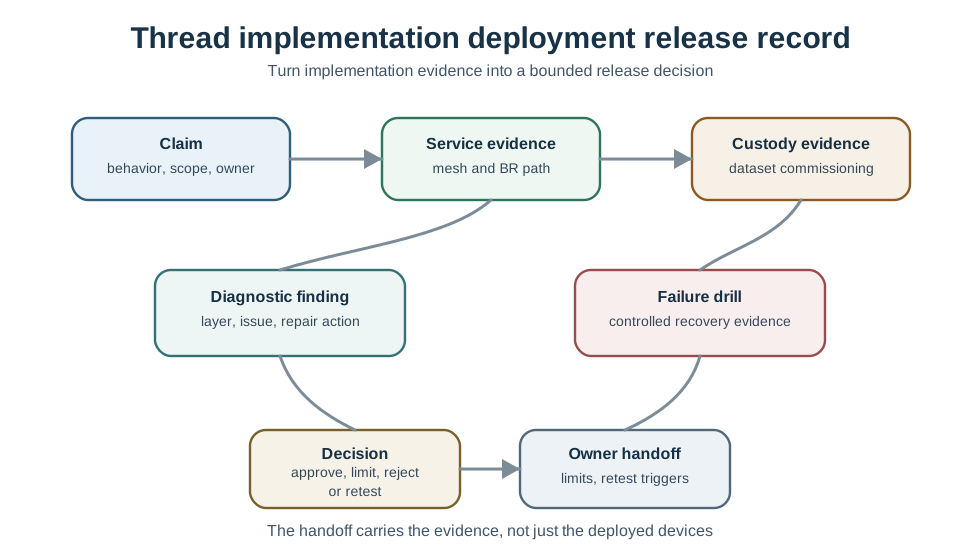
Staged Release Record
The second figure shows how implementation evidence becomes a release decision.
- A pilot, floor, lab, or device family can be approved while a different zone remains under retest.
Major section
Worked Implementation Deployment Records
Evidence gap: the team can add devices, but device removal and replacement custody are not recorded.
- Border Router service handoff Claim: local control and external telemetry are ready for the pilot zone.
- Commissioning custody repair Claim: a device family can be released to facilities support.
- Multi-zone diagnostic split Claim: two zones can share one application workflow.
Major section
Common Mistakes
Approving a join test as release evidence A join proves one commissioning path, not service availability, diagnostics, failure recovery, or support readiness.
- Mixing role responsibilities Leader, Border Router, commissioner, controller, bridge, and application endpoint evidence should stay separate.
- Using commands without decisions Diagnostics that do not change a release decision become tool noise rather than evidence.
- Leaving dataset custody informal If dataset, commissioning, and recovery material are not owned, the deployment is hard to repair.
Major section
Summary · Key Takeaway
Thread implementation deployment is approved by evidence, not by a successful setup screen.
- The record should show the release claim, mesh attachment, Border Router service, dataset custody, diagnostics, recovery behavior, staged decision, and operations handoff.
- Thread mesh evidence, Border Router service, controller behavior, cloud access, bridge behavior, and Matter fabric behavior can all matter, but none of them proves the others by itself.
- Thread Implementation Deployment Evidence should turn Thread planning into deployment evidence for commissioning, role changes, border routing, diagnostics, repair, and operational ownership.
Major section
Concept Relationships
Mesh evidence Connects role, parent, neighbor, and route observations to the behavior being released.
- Border Router service Connects Thread to external IP paths while staying separate from controller and application evidence.
- Dataset custody Connects channel, prefix, commissioning, removal, and recovery authority to operational ownership.
- Diagnostics evidence Connects observed failures to a layer, repair action, retest, and release decision.
Deck summary
Key takeaways
A bench unit joined once, but the installer must prove that every room can join the intended network, reach the building service, recover after loss, and leave evidence that support staff can read.
- The implementation deployment evidence stack separates the release claim from the proof that supports it: mesh evidence, Border Router service, dataset custody, diagnostics, failure drill, staged decision, and operations handoff.
- Optimization control Treat router count, placement, poll intervals, retries, and firmware tuning as change-controlled decisions with rollback and retest triggers.
- Some deployments require Thread devices to reach services that are not native to the mesh.
Retrieval practice
Recall check 1 of 4

Radio Remi says: answer from memory, then check your reasoning.
Q1A Thread deployment review should keep which evidence layers separate rather than merging them?
Show answer
Answer: A A Thread deployment separates mesh, border-router service, application, cloud, and Matter fabric evidence.
Retrieval practice
Recall check 2 of 4
Radio Remi says: answer from memory, then check your reasoning.
Q2What should a Thread deployment record prove about operational dataset custody?
Show answer
Answer: A The operational dataset defines network membership, and commissioning must transfer it only through the authenticated secure flow.
Retrieval practice
Recall check 3 of 4
Radio Remi says: answer from memory, then check your reasoning.
Q3A team shows that one Thread device can join and appear in a controller app. They want to approve implementation deployment for the pilot zone. How should reviewers decide on pilot-zone deployment?
Show answer
Answer: B A join and controller view are only part of the evidence.
Retrieval practice
Recall check 4 of 4
Radio Remi says: answer from memory, then check your reasoning.
Q4A deployed device stops reporting. The device still appears commissioned, but the application receives no telemetry. What should the reviewer ask for first?
Show answer
Answer: A The visible symptom could come from several layers.
Print reference
Answers
Answer key.
- A · A Thread deployment separates mesh, border-router service, application, cloud, and Matter fabric evidence.
- A · The operational dataset defines network membership, and commissioning must transfer it only through the authenticated secure flow.
- B · A join and controller view are only part of the evidence.
- A · The visible symptom could come from several layers.