Zigbee, Thread & Matter · Study deck
Advanced Thread Features
Picture a care home moving its low-power devices away from a noisy channel.
Radio Remi is your guide for this deck.

After studying this chapter
Learning objectives
You will be able to:
- Review advanced Thread claims without relying on stale version, product, or timing promises.
- Separate Operational Dataset changes from application configuration changes.
- Explain how partition, Leader, router, parent, and child evidence fit together.
- Evaluate Border Router redundancy claims without confusing Border Routers with Thread Leaders or Matter bridges.
Major section
Start With the IPv6 Mesh Claim
Wall units can hear the change at once, but sleepy room sensors wake only now and then.
- The site owner must prove that the whole mesh moves together and that no alarm source is left behind.
- A few healthy routers do not prove that every child is reachable.
- A cloud view can help review the fleet, but it must not be the only place that notices a failed move.
Major section
Start With the IPv6 Mesh Claim (continued)
This opening does not approve a product or change plan.
- Under the Hood examines shared settings, roles, partitions, group scope, border behavior, and the records used to explain recovery.
- Advanced Thread Features should help prove where IPv6 is native, where mesh behavior is managed, and where the border or application layer still sets limits.
- The simple review path is join, address, route, recover, and observe.
Major section
Thread Advanced Evidence Reference · In 60 Seconds
Advanced Thread claims should name the specific network behavior being approved, not only the protocol version.
- Advanced Thread review is not about memorizing a feature list.
- This chapter turns advanced Thread topics into evidence records.
- Operational Dataset changes need staged parameters, activation timing, rollback expectations, and evidence that sleepy children can receive the change.
Major section
What Counts as Advanced Evidence
Advanced evidence starts where basic connectivity ends.
- A device that joins once is not enough.
- A reviewed Thread deployment needs evidence for change, failure, scale, and operations.
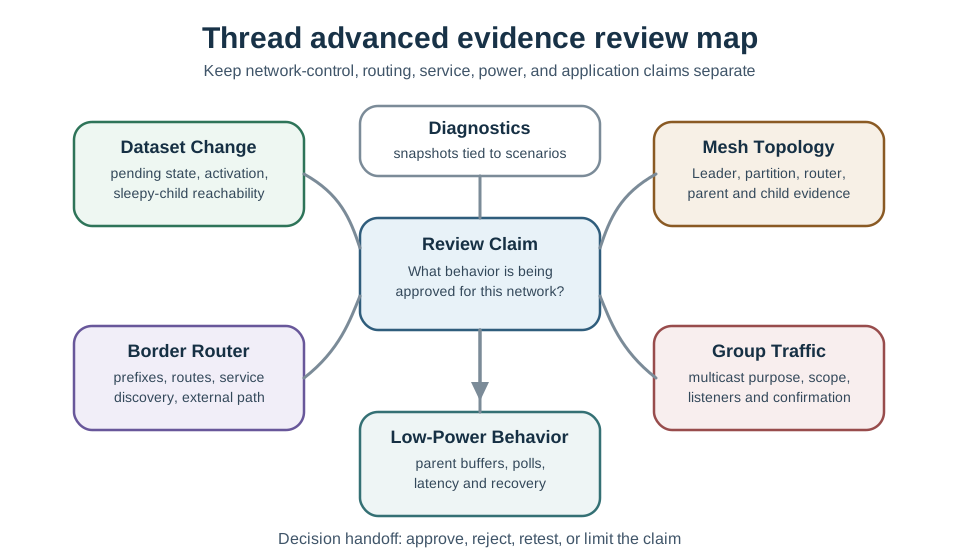
- Dataset change evidence Active and pending Operational Dataset records, activation policy, expected receivers, sleepy-child reachability, and rollback expectations.
Major section
What Counts as Advanced Evidence (continued)
Topology evidence Leader, partition, router, child, and parent-state records that explain how the mesh behaves when links or routers change.
- Border Router evidence External prefixes, routes, service discovery, NAT64 or DNS64 use when relevant, and behavior when one gateway path disappears.
- Group traffic evidence Multicast scope, listener population, message purpose, retry expectations, and proof that group traffic is not replacing required unicast confirmation.
- Operational evidence Diagnostic snapshots, incident records, configuration custody, update authority, and the exact boundary between Thread behavior and application behavior.
Major section
Advanced Review Map
The advanced evidence families should stay separate during review.
- When a review record mixes all advanced topics into one answer, it becomes hard to tell whether the network, the Border Router, the controller, or the application is responsible for a failure.
Major section
Address Scope and Address Lifetime
Advanced Thread evidence often turns on which IPv6 address is being used.
- The same device can hold several addresses at once, and each address has a different reach and lifetime.
- Link-local address Reaches only a direct neighbor and is useful for one-hop control exchanges.
- Mesh-local EID Stays stable within the Thread mesh and is the safer choice for long-lived on-mesh application connections.
Major section
Address Scope and Address Lifetime (continued)
RLOC Reflects the device's current routing position and can change after parent changes or router promotion.
- Global unicast address Comes from a Border Router advertised prefix when the device must be reachable beyond the mesh.
- The common failure is pinning long-lived on-mesh behavior to the RLOC.
- A review record should name the intended reach and lifetime, then check that the address scope matches that claim.
Major section
Partition, Leader, and Router Evidence
Thread can continue operating through normal control-plane changes, but the names are easy to misuse.
- Partition A partition is a connected Thread mesh segment with its own control-plane state.
- Router Routers forward mesh traffic and can provide parent service to end devices.
- Router count alone does not prove good coverage or stable parent choices.
Major section
Parent Selection and Sleepy Children
The right review question is not "How long will the battery last?" without context.
- The useful question is: "Does the parent, child, and application behavior match the required response time and maintenance model?".
- Sleepy-child evidence should be scenario specific.
- A SED keeps its radio off and polls its parent for buffered traffic.
Major section
Multicast and Service Discovery
Thread can support multicast and service-discovery behavior, but constrained mesh traffic still needs disciplined scope.
- A group command can be appropriate for discovery, membership, or local group behavior.
- It should not become a substitute for evidence that every required endpoint completed a critical action.
- This keeps multicast from becoming a hidden reliability claim.
Major section
Diagnostics Without Tool Drift
Advanced diagnostics should explain a network condition, not teach a command manual.
- The reviewer can ask for diagnostic snapshots, but the chapter should preserve the evidence categories rather than one vendor's current command output.
- Diagnostic records should include the observation window and the reason for collecting the evidence.
- A snapshot without a question often turns into data hoarding; a snapshot tied to a claim supports a defensible decision.
Major section
Common Mistakes · Advanced Review Checklist
Treating version labels as evidence A protocol version can identify capability scope, but approval still needs deployment-specific behavior and logs.
- Using the Operational Dataset for app settings Dataset mechanisms are for network operation.
- Application configuration needs its own distribution and rollback model.
- Ignoring sleepy-child timing Low-power children can miss immediate delivery windows.
Major section
Summary · Key Takeaway
Advanced Thread review is evidence review, not feature collecting.
- Dataset changes, Leader changes, partition merges, router promotion, sleepy-child behavior, Border Router services, multicast scope, and diagnostic snapshots all answer different questions.
- A strong record keeps those questions separate.
- Thread Advanced Evidence Reference should connect Thread IPv6 mesh roles, routing, commissioning, border routers, security, power behavior, and deployment evidence.
Deck summary
Key takeaways
Wall units can hear the change at once, but sleepy room sensors wake only now and then.
- This opening does not approve a product or change plan.
- Advanced Thread claims should name the specific network behavior being approved, not only the protocol version.
- Advanced evidence starts where basic connectivity ends.
- Topology evidence Leader, partition, router, child, and parent-state records that explain how the mesh behaves when links or routers change.
Retrieval practice
Recall check 1 of 5

Radio Remi says: answer from memory, then check your reasoning.
Q1Approving a Thread channel change during maintenance most needs which evidence?
Show answer
Answer: A A Thread channel change needs a staged Operational Dataset update, sleepy-child reachability, and a rollback expectation.
Retrieval practice
Recall check 2 of 5
Radio Remi says: answer from memory, then check your reasoning.
Q2For a long-lived connection between two devices on the same Thread mesh, why use the mesh-local EID rather than the RLOC?
Show answer
Answer: A The ML-EID stays stable across topology changes inside the Thread mesh, while the RLOC follows routing position.
Retrieval practice
Recall check 3 of 5
Radio Remi says: answer from memory, then check your reasoning.
Q3A team wants to change a Thread network channel during maintenance. Which review record best supports approval of the change?
Show answer
Answer: B Dataset changes are control-plane operations.
Retrieval practice
Recall check 4 of 5
Radio Remi says: answer from memory, then check your reasoning.
Q4A review note says, "The Thread Leader changed during a router outage, so the Matter application failed over correctly." What is the main problem with that claim?
Show answer
Answer: B The record is mixing layers.
Retrieval practice
Recall check 5 of 5
Radio Remi says: answer from memory, then check your reasoning.
Q5A team changes a lighting scene. Where should that setting be managed?
Show answer
Answer: C The operational dataset is for network state.
Print reference
Answers
Answer key.
- A · A Thread channel change needs a staged Operational Dataset update, sleepy-child reachability, and a rollback expectation.
- A · The ML-EID stays stable across topology changes inside the Thread mesh, while the RLOC follows routing position.
- B · Dataset changes are control-plane operations.
- B · The record is mixing layers.
- C · The operational dataset is for network state.