Testing & Validation · Study deck
Unit Testing for IoT Firmware
Picture a temperature rule that passes every normal value but fails after a device update.
Test Tessa is your guide for this deck.

After studying this chapter
Learning objectives
You will be able to:
- use seams and test doubles to isolate hardware-dependent code
- build a reviewable unit-test record
- explain why a green unit suite can still lie about system behavior
- Explain: A unit test checks one small piece of firmware logic on its own, with controlled inputs and a result you can read.
Major section
Overview: Checking One Small Behavior in Isolation
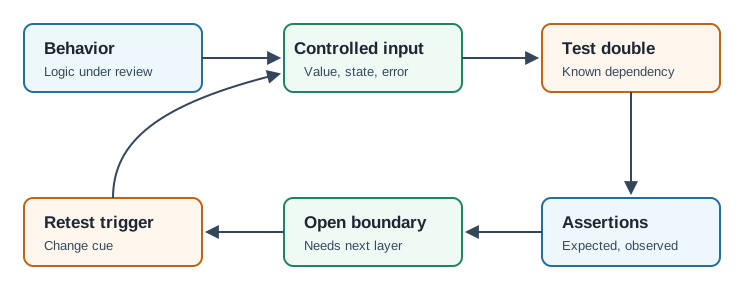
A unit test checks one small piece of firmware logic on its own, with controlled inputs and a result you can read.
- The word that does the work is isolation.
- You can confirm the gear has the right number of teeth and turns smoothly in your hand long before the clock exists.
Major section
Overview: Checking One Small Behavior in Isolation (continued)
If you only need the intuition, this layer is enough: a unit test isolates one firmware behavior, feeds it controlled inputs, and checks a reviewable result.
- That check is fast and certain, but it does not tell you the assembled clock keeps time — that needs the other gears, the spring, and the case.
- Unit tests are the per-gear checks of firmware.
- This boundary keeps a green unit result both valuable and honest.
Major section
Overview: Checking One Small Behavior in Isolation (continued)
A parser that turns a byte sequence into a reading can be fed a malformed sequence to confirm it rejects it instead of crashing.
- Fast and repeatableBecause it avoids real hardware and timing, it runs in milliseconds and gives the same result every run, so it can run on every commit.
- Proves logic, not the deviceA pass confirms the logic given the test's inputs; the real sensor, bus, and timing still need integration and hardware-aware evidence.
- If you can explain isolation and what a pass does and does not claim, you have the core idea.
Major section
Practitioner: Seams, Test Doubles, and a Reviewable Record
Firmware is hard to unit-test when logic is welded directly to hardware — reading a register inline, calling a vendor driver, or sleeping on a real timer.
- Most firmware unit tests need only stubs and fakes to supply inputs and a couple of spies or mocks to confirm an output call happened.
Major section
Practitioner: Seams, Test Doubles, and a Reviewable Record (continued)
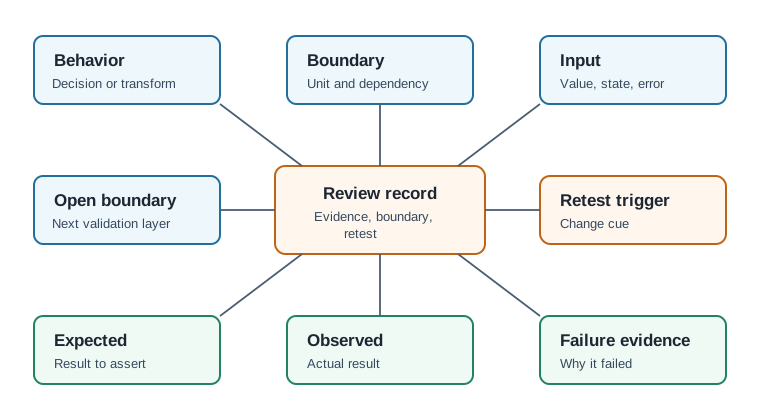
Worked Example: A Sensor Threshold DecisionConsider firmware that takes a sensor reading and decides whether to raise a warning.
- Those fields admit what mocks, stubs, and isolated code cannot prove and identify the change that invalidates the result.
- No warning is raised.
- Confirms the common path does not false-alarm.
Major section
Practitioner: Seams, Test Doubles, and a Reviewable Record (continued)
The record connects a fast green test to the wider testing pyramid without overstating it as system validation.
- The test then asserts the verdict and, where it matters, that a diagnostic was recorded.
- Stub returns a value one step above the limit.
- A warning is raised exactly at the boundary.
Major section
Practitioner: Seams, Test Doubles, and a Reviewable Record (continued)
If you can place a seam, pick the right double, and write a record that names what stays open, you can stop here.
- Boundary values are where off-by-one logic breaks.
- The reading is rejected, not treated as real.
- Bad sensor data must not become a false decision.
Major section
Under the Hood: Why a Green Unit Suite Can Still Lie
Coverage Counts Lines, Not CasesA coverage percentage tells you which lines executed, not whether the cases that matter were tried.
- Unit tests fail to protect firmware in three recurring ways: the test double does not match real behavior, the tests are over-coupled to implementation, and coverage is mistaken for quality.
- A fake flash never wears out or fails a write; real flash does.
- Sensor, driver, or data-shape change.
Major section
Under the Hood: Why a Green Unit Suite Can Still Lie (continued)
A Double Is Only as Good as Its FidelityThe deepest trap in firmware unit testing is the stand-in that lies.
- A stub returns a clean reading instantly; the real sensor returns a noisy value after a settling delay, or a status byte the firmware must check first.
- Determinism Is Engineered, Not Assumed "Repeatable" does not happen by accident.
- Behavior may be wrong while calls still match.
Major section
Under the Hood: Why a Green Unit Suite Can Still Lie (continued)
The usual sources of flakiness in firmware tests are real time and delays, randomness, uninitialized or shared global state, and order dependence between tests.
- Over-Mocking Makes Brittle, Low-Value TestsVerifying a result (state) is usually more robust than verifying the exact sequence of internal calls (interaction).
- When a test asserts every internal call, it breaks on a harmless refactor that did not change behavior, and it can pass even when the behavior is wrong as long as the calls match.
- Asserting implementation instead of behavior: Over-mocked tests break on refactors and miss real bugs.
Major section
Under the Hood: Why a Green Unit Suite Can Still Lie (continued)
Tolerating flakiness: An intermittent unit-test failure is a defect, not a rerun candidate.
- Prefer asserting the observable outcome — the returned value, the resulting state, or the one output call that matters — and reserve strict call-order mocks for the few cases where the sequence is the behavior.
- The fixes are concrete: inject a controllable clock instead of sleeping, seed or stub randomness, reset state in setup, and never let one test rely on another having run first.
- Reading coverage as quality: Lines executed is not cases tried; design the cases that break things.
Major section
Under the Hood: Why a Green Unit Suite Can Still Lie (continued)
A test that fails once in fifty runs is not noise to rerun; it is a defect in the test or the code.
- A suite can run most of a parser on well-formed input and report a high number while never feeding it the malformed packet that crashes a field unit.
- Overstating the result: A unit pass is logic evidence; name the hardware and interface questions it leaves open.
- A unit suite earns trust when it shows both what it proved and what it deliberately did not.
Deck summary
Key takeaways
A unit test checks one small piece of firmware logic on its own, with controlled inputs and a result you can read.
- If you only need the intuition, this layer is enough: a unit test isolates one firmware behavior, feeds it controlled inputs, and checks a reviewable result.
- A parser that turns a byte sequence into a reading can be fed a malformed sequence to confirm it rejects it instead of crashing.
- Firmware is hard to unit-test when logic is welded directly to hardware — reading a register inline, calling a vendor driver, or sleeping on a real timer.
Retrieval practice
Recall check 1 of 3

Test Tessa says: answer from memory, then check your reasoning.
Q1Why can a unit test for IoT firmware run in milliseconds and give the same result every time?
Show answer
Answer: A Isolation buys speed and determinism, but it also means a pass is a claim about logic under controlled inputs, not about the physical device.
Retrieval practice
Recall check 2 of 3
Test Tessa says: answer from memory, then check your reasoning.
Q2You need to unit-test firmware logic that decides whether to raise a warning from a sensor reading, but the logic currently calls the sensor driver directly. What makes the logic testable, and which test double fits the sensor?
Show answer
Answer: A A seam lets you substitute the dependency; a stub supplies the controlled readings the cases need so you can assert the decision deterministically.
Retrieval practice
Recall check 3 of 3
Test Tessa says: answer from memory, then check your reasoning.
Q3A firmware module has thousands of passing unit tests and high line coverage, but field devices crash when a real sensor returns a value after a settling delay with a status byte set. The stub in the tests returned a clean reading instantly. What does this reveal?
Show answer
Answer: A The green suite tested logic against a double that never reproduced real timing and status; that physical behavior belongs to the hardware-aware layer, and the unit record should have named it as open.
Print reference
Answers
Answer key.
- A · Isolation buys speed and determinism, but it also means a pass is a claim about logic under controlled inputs, not about the physical device.
- A · A seam lets you substitute the dependency; a stub supplies the controlled readings the cases need so you can assert the decision deterministically.
- A · The green suite tested logic against a double that never reproduced real timing and status; that physical behavior belongs to the hardware-aware layer, and the unit record should have named it as open.