Testing & Validation · Study deck
Security Testing for IoT Devices
Picture a building door that accepts commands from a phone and a service desk.
Test Tessa is your guide for this deck.

After studying this chapter
Learning objectives
You will be able to:
- Explain: The deeper skill is conducting security testing responsibly: with authorization and scope, with findings classified and bounded to the tested build, and with mitigations that are actually retested rather than assumed.
- Explain: Security testing is the discipline of probing those weaknesses on purpose — but defensively and under authorization, to find and fix them before an attacker does, not to produce exploit recipes.
- Explain: The core techniques are static analysis (SAST), dynamic analysis (DAST), fuzzing, penetration testing, and threat-driven test cases; each finds a different class of weakness and none replaces the others.
Major section
Start With the Story: Test the Route an Attacker Would Try
Practitioner selects defensive methods and records findings.
- An application programming interface is the defined route software uses to ask another system for data or action.
- A normal test may prove that the right user can open the door.
- A device can do its normal job perfectly and still be unsafe.
Major section
Start With the Story: Test the Route an Attacker Would Try (continued)
A security test also asks what a wrong user, old request, or exposed service route can do.
- A test must not leave a lock, pump, or alarm dependent on a distant service or unknown test account.
- This opening does not teach attack for its own sake or approve testing without permission.
- Under the Hood examines input bounds, authorization edges, test isolation, fix proof, and the events that force a retest.
Major section
Overview: Security Testing Is Adversarial, Defensive Validation
Functional testing asks whether the device does what it should.
- Security testing asks a different, adversarial question: what can someone make it do that it should not.
- A device can pass every functional test and still expose a default credential, an open debug port, an unauthenticated service, or an unsigned update path.
Major section
Overview: Security Testing Is Adversarial, Defensive Validation (continued)
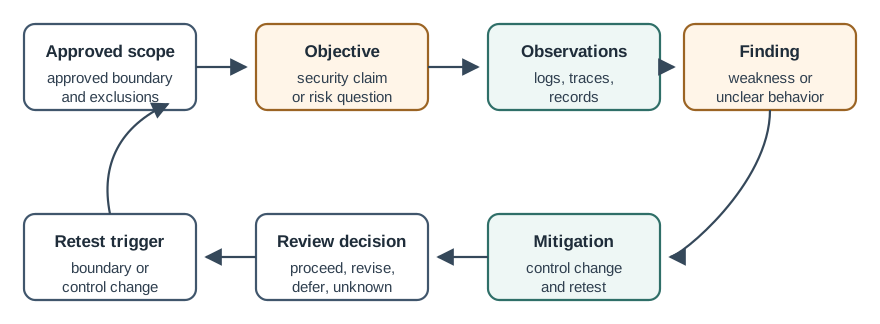
A confirmed finding then needs mitigation evidence and a retest before the review decision.
- Security testing is the discipline of probing those weaknesses on purpose — but defensively and under authorization, to find and fix them before an attacker does, not to produce exploit recipes.
- Weakly tested devices are recruited into botnets in large numbers, so the cost of skipping this work is real and downstream.
- The final trigger states when that decision expires.
Major section
Overview: Security Testing Is Adversarial, Defensive Validation (continued)
If you only need the intuition, this layer is enough: security testing is functional testing's adversarial twin — it checks what an attacker could do, defensively and with authorization.
- Derive your tests from assets, trust boundaries, and threats rather than running tools at random, and keep every conclusion bounded to the exact build you tested.
- Scope limits what may be exercised; the objective ties an asset and threat to expected behavior; and the observation preserves what actually occurred.
- This path connects adversarial investigation to defensive validation without allowing a scanner alert or exploit attempt to become an unreviewed verdict.
Major section
Overview: Security Testing Is Adversarial, Defensive Validation (continued)
The One-Minute ViewThink adversarially A functional pass is not a security pass; test what an attacker could make the device do.
- Cover the surfaceDevice, debug ports, firmware, update path, network services, cloud, and app are all in scope.
- Stay authorized and boundedTest under authorization, keep it defensive, and limit every finding to the build and configuration tested.
- Beginner ExamplesRead these examples as a progression from the simplest observation to the boundary that still needs evidence.
- Finish by separating “the feature works,” a functional claim, from “an unauthenticated request cannot trigger it,” a security claim.
Major section
Practitioner: Techniques and the IoT Attack Surface
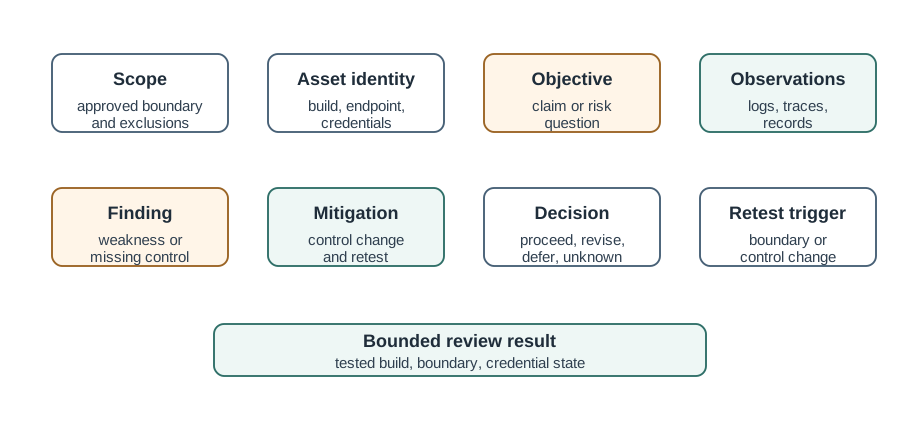
Security testing uses a small set of complementary techniques, each finding a different class of weakness.
- None replaces the others; a thorough program runs several and records what each covered.
- Early, on every change (shift-left).
- Reports possible issues it cannot confirm at runtime; false positives.
- Finds crashes, not always their exploitability or root cause.
Major section
Practitioner: Techniques and the IoT Attack Surface (continued)
Real, chained weaknesses a skilled tester can combine.
- Concrete tests derived from a threat model for specific assets and boundaries.
- Whenever the threat model or design changes.
- That sequence connects a security technique to a bounded, reproducible result and requires the claimed fix to be exercised again.
Major section
Under the Hood: Authorization, Bounding, and Proving the Fix
Until that exists, the issue's status has changed but its security claim has not.
- The deeper skill is conducting security testing responsibly: with authorization and scope, with findings classified and bounded to the tested build, and with mitigations that are actually retested rather than assumed.
- That classification drives ownership and severity, and the boundary keeps a result honest: a clean test of one endpoint, one firmware image, or one credential state does not clear unrelated paths or future builds.
- Common Review FindingsReview these failure modes in the order they can weaken or invalidate the result.
Major section
Under the Hood: Authorization, Bounding, and Proving the Fix (continued)
A Mitigation Is Not Done Until It Is RetestedThe most common weak record marks a finding resolved after a control change without proving the fix.
- And because the surface keeps moving, every result needs a retest trigger — a build, credential, service, firmware, network, update, or hardware change that reopens the review.
- Finish with No retest trigger: A control change after the test silently leaves the old result in place.
- This sequence connects each warning to the evidence a reviewer should demand before accepting the claim.
Major section
Summary
Security testing is the adversarial, defensive twin of functional testing: it checks what an attacker could make the device do, under authorization, to fix weaknesses before they are exploited.
- Drive tests from a threat model — assets, trust boundaries, and threats — rather than probing at random.
- The core techniques are static analysis (SAST), dynamic analysis (DAST), fuzzing, penetration testing, and threat-driven test cases; each finds a different class of weakness and none replaces the others.
- Authorize and scope active testing first; keep material defensive, recording behavior and evidence rather than reusable misuse steps.
Deck summary
Key takeaways
Practitioner selects defensive methods and records findings.
- A security test also asks what a wrong user, old request, or exposed service route can do.
- Functional testing asks whether the device does what it should.
- A confirmed finding then needs mitigation evidence and a retest before the review decision.
- If you only need the intuition, this layer is enough: security testing is functional testing's adversarial twin — it checks what an attacker could do, defensively and with authorization.
Retrieval practice
Recall check 1 of 3

Test Tessa says: answer from memory, then check your reasoning.
Q1Why is passing all functional tests not enough to call an IoT device secure?
Show answer
Answer: C Security is about misuse, not just use.
Retrieval practice
Recall check 2 of 3
Test Tessa says: answer from memory, then check your reasoning.
Q2You want to find inputs that crash an IoT device's network protocol parser, including malformed packets a normal client would never send. Which security testing technique fits best?
Show answer
Answer: A Fuzzing systematically sends malformed and unexpected inputs to expose parser crashes and memory bugs that functional tests usually miss.
Retrieval practice
Recall check 3 of 3
Test Tessa says: answer from memory, then check your reasoning.
Q3What evidence is needed before accepting this security finding as resolved?
Show answer
Answer: B A mitigation is only complete when the same objective passes again on the identified build, with the result and residual assumptions recorded.
Print reference
Answers
Answer key.
- C · Security is about misuse, not just use.
- A · Fuzzing systematically sends malformed and unexpected inputs to expose parser crashes and memory bugs that functional tests usually miss.
- B · A mitigation is only complete when the same objective passes again on the identified build, with the result and residual assumptions recorded.