Testing & Validation · Study deck
Field Trials and Validation
Picture a field sensor that works in two dry rooms but fails in the damp pump room.
Test Tessa is your guide for this deck.

After studying this chapter
Learning objectives
You will be able to:
- start a field trial from one real site and one specific question
- choose a trial shape and the evidence it should produce
- know what a field trial result really covers versus what it leaves untested
- Explain: A successful demo cannot stand in for the missing condition.
Major section
Start With One Real Site and One Question
A successful demo cannot stand in for the missing condition.
- Fix its version, device group, site envelope, observation window, and halt rule before the trial starts.
- This evidence supports only the tested build, sites, and window.
- A field trial is not trying to "see what happens" in a vague way.
Major section
Start With One Real Site and One Question (continued)
Results hold for the sites, build, and window observed, not for every future deployment.
- A field trial is where the system finally meets the thing no lab fully reproduces: real users, real sites, real networks, and real installation.
- That keeps the field trial bounded before the first installation.
- Bounded to what was trialed.
Major section
Start With One Real Site and One Question (continued)
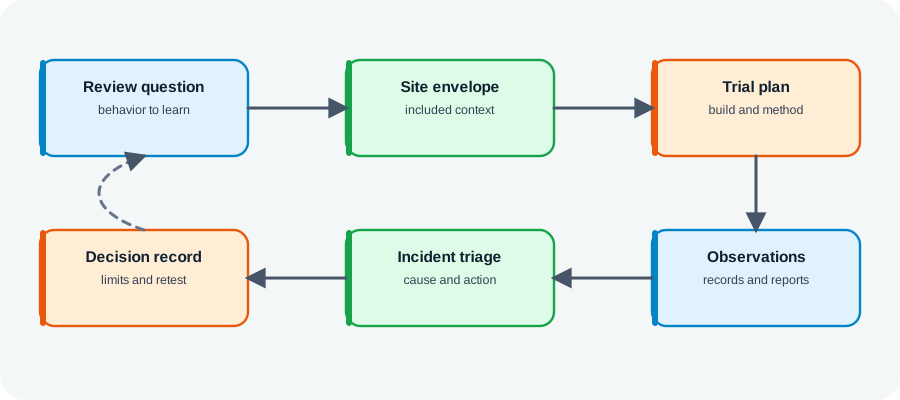
A trial has a defined question, selected sites, a known device build, an observation plan, an incident workflow, and a decision record.
- For example, a water-quality sensor pilot might include 12 devices across three pump rooms for six weeks, using one firmware build and one installation checklist.
- A release decision can cite missed samples, installer notes, battery drain, and gateway retries from those rooms.
- “A demo proves it can work once; a test proves it keeps working — bring the field, not the bench.”.
- A trial has a question, selected sites, a known build, an observation plan, and a decision record.
Major section
Start With One Real Site and One Question (continued)
If you only need the intuition, this layer is enough: a field trial validates the system in its real operating context, as a controlled activity with a question and a plan, not a casual early launch.
- The envelope records the environmental, network, operator, and usage context; the plan says how the chosen build will be exercised.
- That order prevents a memorable incident or a quiet trial from becoming an unbounded conclusion, and it connects real-site learning to the chapter's evidence-first deployment narrative.
- Lab, integration, environmental, and security testing each reduce risk in controlled conditions.
Major section
Choose the Trial Shape and the Evidence
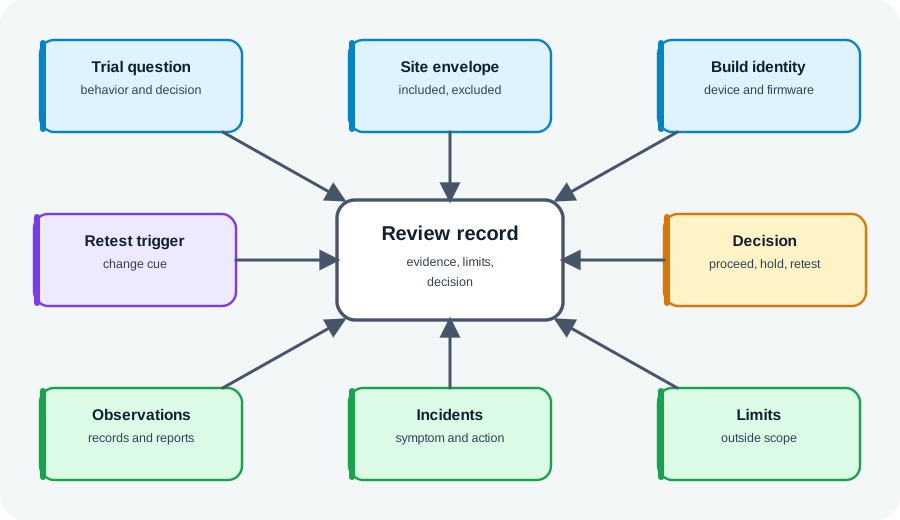
They share a need to be planned before any device ships, with the device and build identity, the site envelope, and the observation plan written down first.
- Installation, operation, and incident records from real use.
- User reports plus telemetry across more varied conditions.
- Beta users may not represent typical users.
Major section
Choose the Trial Shape and the Evidence (continued)
Bench says: the build identity — device, firmware, configuration, enabled features — is fixed and known.
- Bounds risk but does not by itself explain a regression.
- Three records belong in place before the trial starts.
- Field adds: the site envelope — connectivity, environment, power, placement, operator — plus what is excluded.
Major section
Choose the Trial Shape and the Evidence (continued)
The observation plan: what telemetry is recorded automatically, what requires a human note, the support path, and the criteria that turn a symptom into an incident record.
- The compact record closes the loop from contextual discovery to a bounded release action while preserving exactly what must be revisited after a change.
- If you can pick the method and plan build, site envelope, and observation up front, you can stop here.
- Finish with limits, retest trigger, and decision: these prevent one successful site or one failed installation from speaking for every deployment.
Major section
Know What the Trial Really Covers
The deeper skill is using field evidence honestly: correlating what users report with what devices recorded, triaging incidents into something reproducible, and refusing to let a trial close questions it cannot.
- Participant reports and device telemetry are two views of the same event, and the truth is usually in comparing them.
- Reconcile the two on time, device, and sequence before recording a conclusion; a report alone is a claim, and telemetry alone may miss the human-visible symptom.
Major section
Know What the Trial Really Covers (continued)
Bench says: extremes, security behavior, manufacturing variation, and long-term wear stay with controlled tests.
- Bench says: telemetry alone — which can miss the symptom a human actually sees.
- Field trials supplement controlled tests; they do not replace them.
- Field adds: evidence tied to one build — any firmware or configuration change makes it stale.
Major section
Know What the Trial Really Covers (continued)
A field incident is reviewable only when it records the symptom, its scope (one device or many on the same build), the suspected cause, the action, and the retest trigger.
- And because field evidence is tied to a build, a firmware or configuration change during or after the trial makes prior evidence stale — which is what a retest trigger guards against.
- Work through these observations as a diagnostic sequence: No clear question: The trial starts without one, so the result cannot support a decision.
- Reports without telemetry: Participant feedback is collected but device data is missing, so reports cannot be corroborated.
Major section
Summary
A field trial is the final, most realistic validation gate — real users, sites, and networks — and a controlled evidence activity, not a soft launch.
- Field evidence is specific: it holds for the build, sites, and window trialed, and must not be stretched to every future deployment.
- Trials validate installation friction, operational fit, diagnostic readiness, and change impact better than any lab.
- Correlate participant reports with device telemetry before concluding, and triage every incident by symptom, scope, suspected cause, action, and retest trigger.
Deck summary
Key takeaways
A successful demo cannot stand in for the missing condition.
- Results hold for the sites, build, and window observed, not for every future deployment.
- A trial has a defined question, selected sites, a known device build, an observation plan, an incident workflow, and a decision record.
- If you only need the intuition, this layer is enough: a field trial validates the system in its real operating context, as a controlled activity with a question and a plan, not a casual early launch.
- Bench says: the build identity — device, firmware, configuration, enabled features — is fixed and known.
Retrieval practice
Recall check 1 of 3

Test Tessa says: answer from memory, then check your reasoning.
Q1How should an IoT field trial be treated relative to a casual early launch?
Show answer
Answer: D A field trial is structured validation, not a loose preview.
Retrieval practice
Recall check 2 of 3
Test Tessa says: answer from memory, then check your reasoning.
Q2Before releasing a new power-saving firmware to an entire fleet, a team wants real-world evidence that it does not hurt connectivity. What is the soundest field approach?
Show answer
Answer: C A staged rollout with telemetry-driven metrics and halt criteria gathers real-world evidence while limiting how many devices a regression can reach.
Retrieval practice
Recall check 3 of 3
Test Tessa says: answer from memory, then check your reasoning.
Q3How should the team follow up the participant report and delayed telemetry?
Show answer
Answer: B Correlating the report with telemetry locates the behavior; the incident then needs scope, suspected cause, and a retest or handoff, without overstating beyond the trial.
Print reference
Answers
Answer key.
- D · A field trial is structured validation, not a loose preview.
- C · A staged rollout with telemetry-driven metrics and halt criteria gathers real-world evidence while limiting how many devices a regression can reach.
- B · Correlating the report with telemetry locates the behavior; the incident then needs scope, suspected cause, and a retest or handoff, without overstating beyond the trial.