Testing & Validation · Study deck
Environmental and Physical Testing
Picture a farm monitor that works on a desk but fails after a cold wet night.
Test Tessa is your guide for this deck.

After studying this chapter
Learning objectives
You will be able to:
- choose the physical stress (temperature, vibration, ingress) and the evidence it should produce
- know what an environmental test result does and does not cover
- connect a chosen stress condition to a specific field failure risk
- Explain: The test should copy the real stress, not merely prove that one loose board can run in a warm room.
Major section
Start With the Device in the Weather
The test should copy the real stress, not merely prove that one loose board can run in a warm room.
- A microcontroller is the small computer that runs the device.
- A gateway is the unit that links local devices to another network or service.
- One lab cycle cannot predict every field year.
Major section
Start With the Device in the Weather (continued)
A case can look fine while a reading drifts or a plug loosens.
- Under the Hood defines the exact result boundary, margin search, and retest rule.
- A lab bench is a benign place — stable power, room temperature, dry air, no vibration.
- Temperature, moisture, vibration, and electrical stress cause faults software tests cannot reproduce.
Major section
Start With the Device in the Weather (continued)
The question is not "does the code run?" It is "does this exact assembly still do the job after the physical world has had a chance to attack it?".
- The result of an environmental test is therefore bound tightly to what was tested — the exact assembly, configuration, and exposure profile.
- If the device survives but loses calibration during the cold-to-warm transition, the result is not a pass; it becomes a design or retest action tied to that exposure profile.
- That habit keeps the survival-is-not-function rule visible from the first page.
Major section
Start With the Device in the Weather (continued)
“A demo proves it can work once; a test proves it keeps working — bring the field, not the bench.”.
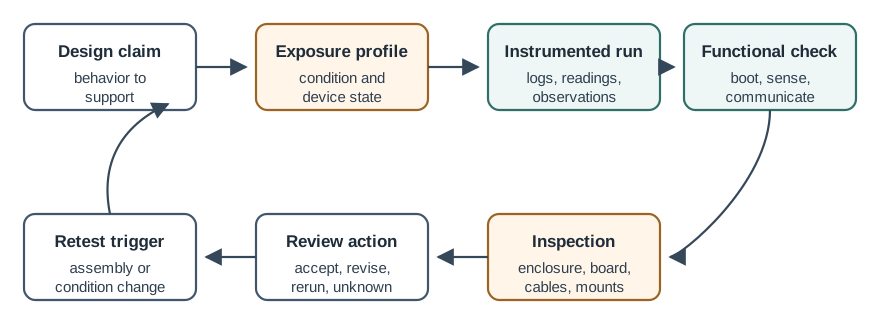
- The run reveals behavior during stress; the functional check tests the claimed service; and inspection finds damage or ingress that a live metric may miss.
- This sequence connects physical stress to an auditable decision instead of a bare survived/failed label.
- Work through these observations as a diagnostic sequence: A sensor node works on the bench but resets in winter; a thermal-cycling test reproduces the fault before shipping.
Major section
Choose the Stress and the Evidence
Environmental testing is a family of controlled stresses, each targeting a different physical failure mode.
- Powered and transmitting at the limits; cycling through states.
- Emissions stay within limits and the device tolerates interference and electrostatic discharge.
- Slow faults: memory leaks, drift, and early-life failures over long runs.
- A pass label with neither is weak.
Major section
Choose the Stress and the Evidence (continued)
Trend in memory, timing, and measurement over the run.
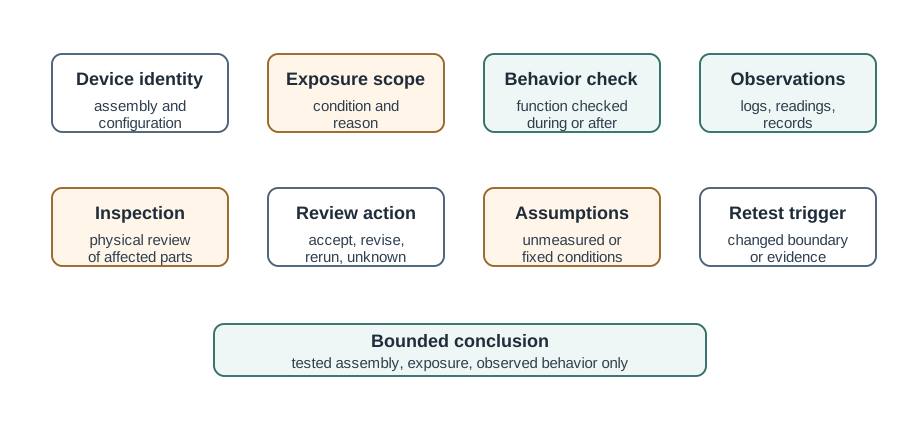
- A strong environmental test does two things: it monitors behavior during or immediately after exposure — logs, counters, sensor readings, connectivity, reset records — and it inspects the physical assembly afterward at the parts the stress would affect.
- The record should name the assembly and configuration tested, the exposure profile and why it was chosen, the function under review, and any condition assumed rather than measured.
- End at review action, assumptions, and retest trigger, which state what the result permits and when it expires.
Major section
Know What the Result Really Covers
In review shorthand, this is where survival is not function, qualification versus accelerated stress, and combined exposure stop being slogans and become evidence checks.
- The recurring trap is accepting "no visible damage" as a pass.
- Qualification needs the monitored behavior that proves the function under review held, not just that the case survived.
Major section
Know What the Result Really Covers (continued)
A device can emerge from a thermal or vibration run intact yet drift out of calibration, drop packets, or fail to rejoin the network.
- Bench says: no visible damage — a device can emerge from a thermal run intact yet still drift or drop packets.
- Two different goals use stress differently.
- And every environmental result is bound to the physical boundary that produced it: the enclosure, gasket, adhesive, connector, sensor opening, and mounting.
Major section
Know What the Result Really Covers (continued)
The unit was idle during exposure when the field state is transmitting: Unstated assembly.
- Some faults appear only when conditions combine — vibration while hot, moisture under enclosure strain — so combined exposure is worth running when a failure is suspected to be coupled, with the rationale recorded.
- When one of those changes — a new gasket material after a passed moisture test, for instance — the old result no longer covers the new boundary, and the test must be rerun or its limits restated.
- A bare-board result stands in for a sealed unit because the enclosure or connector state was not recorded: Wrong inspection.
Major section
Know What the Result Really Covers (continued)
Work through these observations as a diagnostic sequence: Survival mistaken for function. "No visible damage" is accepted as a pass with no monitored behavior: Wrong device state.
- The post-exposure check looked at the wrong parts for the stress applied: Stale after a change.
- A material or assembly change left the old result in place with no retest trigger.
- A trustworthy review names the assembly, the exposure, and the change that reopens the conclusion.
Deck summary
Key takeaways
The test should copy the real stress, not merely prove that one loose board can run in a warm room.
- A case can look fine while a reading drifts or a plug loosens.
- The question is not "does the code run?" It is "does this exact assembly still do the job after the physical world has had a chance to attack it?".
- “A demo proves it can work once; a test proves it keeps working — bring the field, not the bench.”.
- Environmental testing is a family of controlled stresses, each targeting a different physical failure mode.
Retrieval practice
Recall check 1 of 3
Test Tessa says: answer from memory, then check your reasoning.
Q1Why do IoT products need environmental and physical testing in addition to software and integration tests?
Show answer
Answer: D Cracked joints, breached seals, warped plastics, and ESD resets are physical failures only real-world stress on the real assembly will surface.
Retrieval practice
Recall check 2 of 3
Test Tessa says: answer from memory, then check your reasoning.
Q2What can the team conclude from this thermal run record?
Show answer
Answer: C Survival is not function.
Retrieval practice
Recall check 3 of 3
Test Tessa says: answer from memory, then check your reasoning.
Q3A sealed sensor assembly passed a moisture-ingress test. Later, a design change replaces the gasket material, and the original record has no retest trigger. What is the strongest action?
Show answer
Answer: D The gasket is integral to the moisture seal.
Print reference
Answers
Answer key.
- D · Cracked joints, breached seals, warped plastics, and ESD resets are physical failures only real-world stress on the real assembly will surface.
- C · Survival is not function.
- D · The gasket is integral to the moisture seal.